Free Break Time Calculator

UK Break Time Compliance Calculator

Instantly check whether your team's shifts meet UK Working Time Regulations. Enter the shift length and break provided — get a clear compliant or non-compliant result in seconds.

Free to use
No sign-up required
UK Working Time Regulations built in

Stop calculating manually — track breaks automatically

This calculator gives you the numbers. TimeTally tracks hours, breaks, and approvals automatically — so you never need to calculate it manually again. From £2/employee/month.

Employees submit time tracking from anywhere

Staff submit time tracking via the iOS app or web. Clock in/out is tracked automatically. Regular and overtime hours are separated — no paper forms, no chasing.
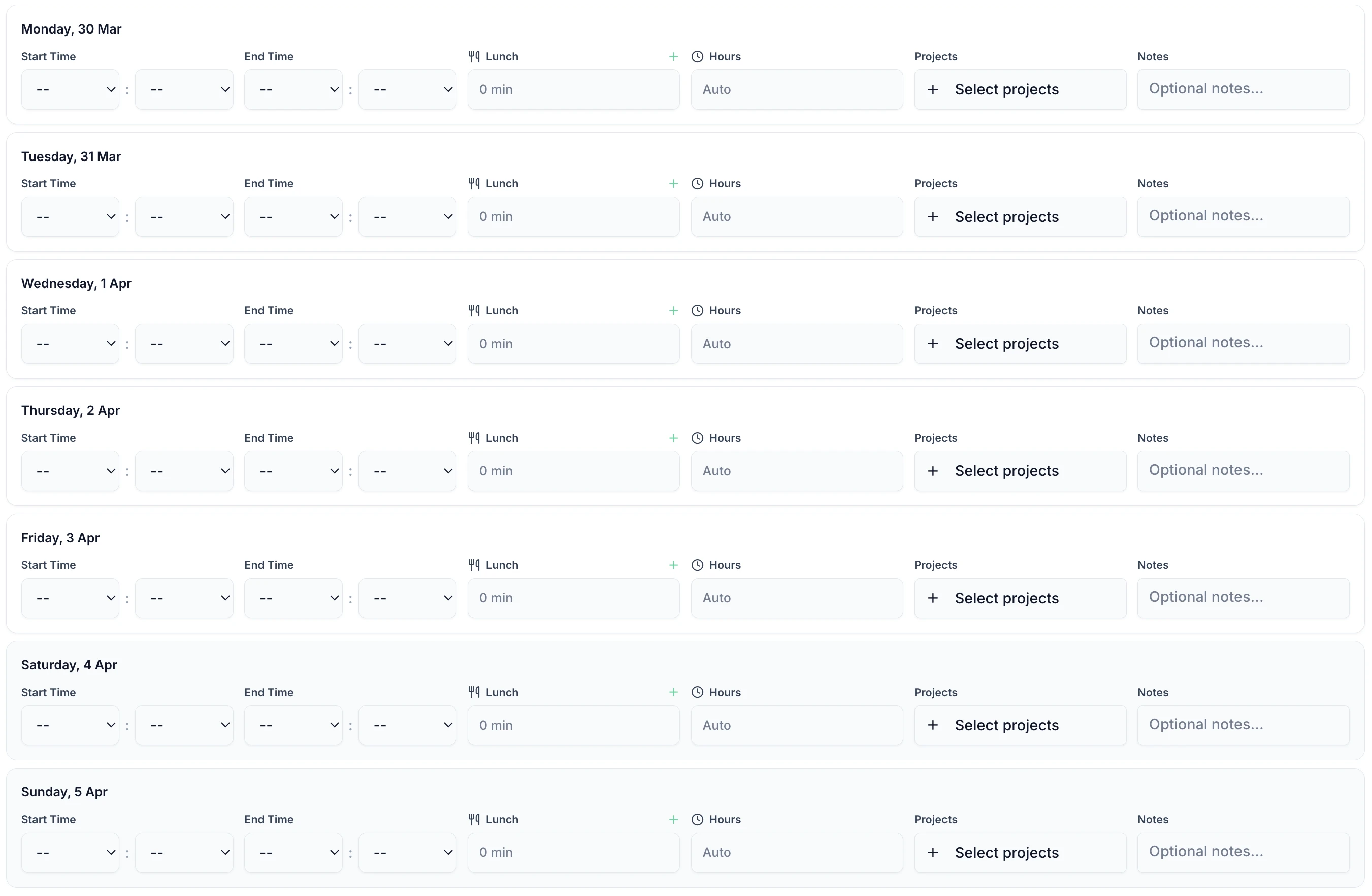
Clock in/out
iOS & web
Auto overtime
Instant notifications
TimeTally timesheet entry showing clock in/out and hours worked

Review and approve time tracking in one tap

All pending time tracking land in your dashboard. Approve or query with a single tap. Every decision is timestamped — full audit trail for every timesheet.
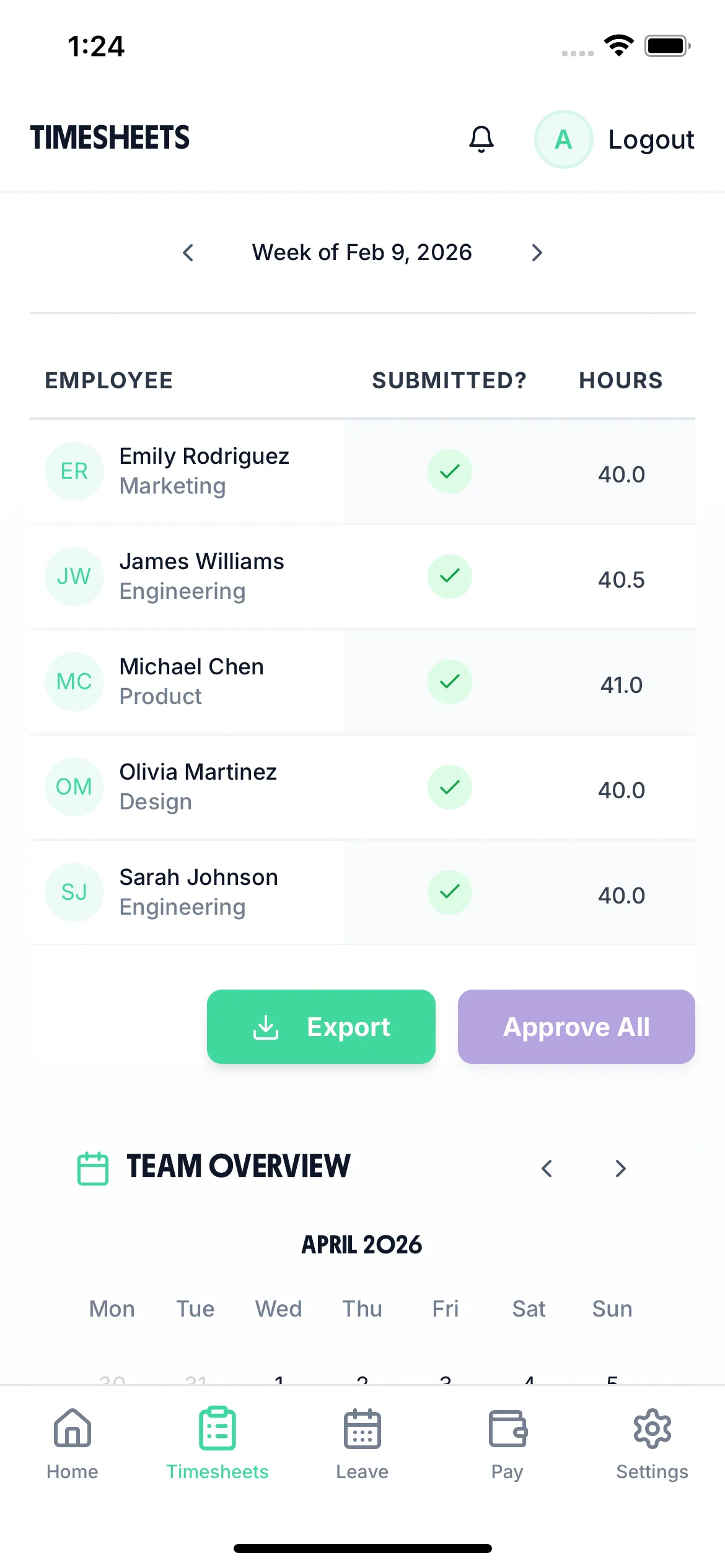
  • All pending time tracking in one place
  • Approve or query with one tap
  • Timestamped approval audit trail
  • Employee notified automatically
TimeTally iOS app showing employer timesheet approval

Pay calculated accurately from approved hours

Pay is calculated directly from approved time tracking. Overtime rates applied automatically. Regular and overtime hours separated — no manual adjustments, no errors.
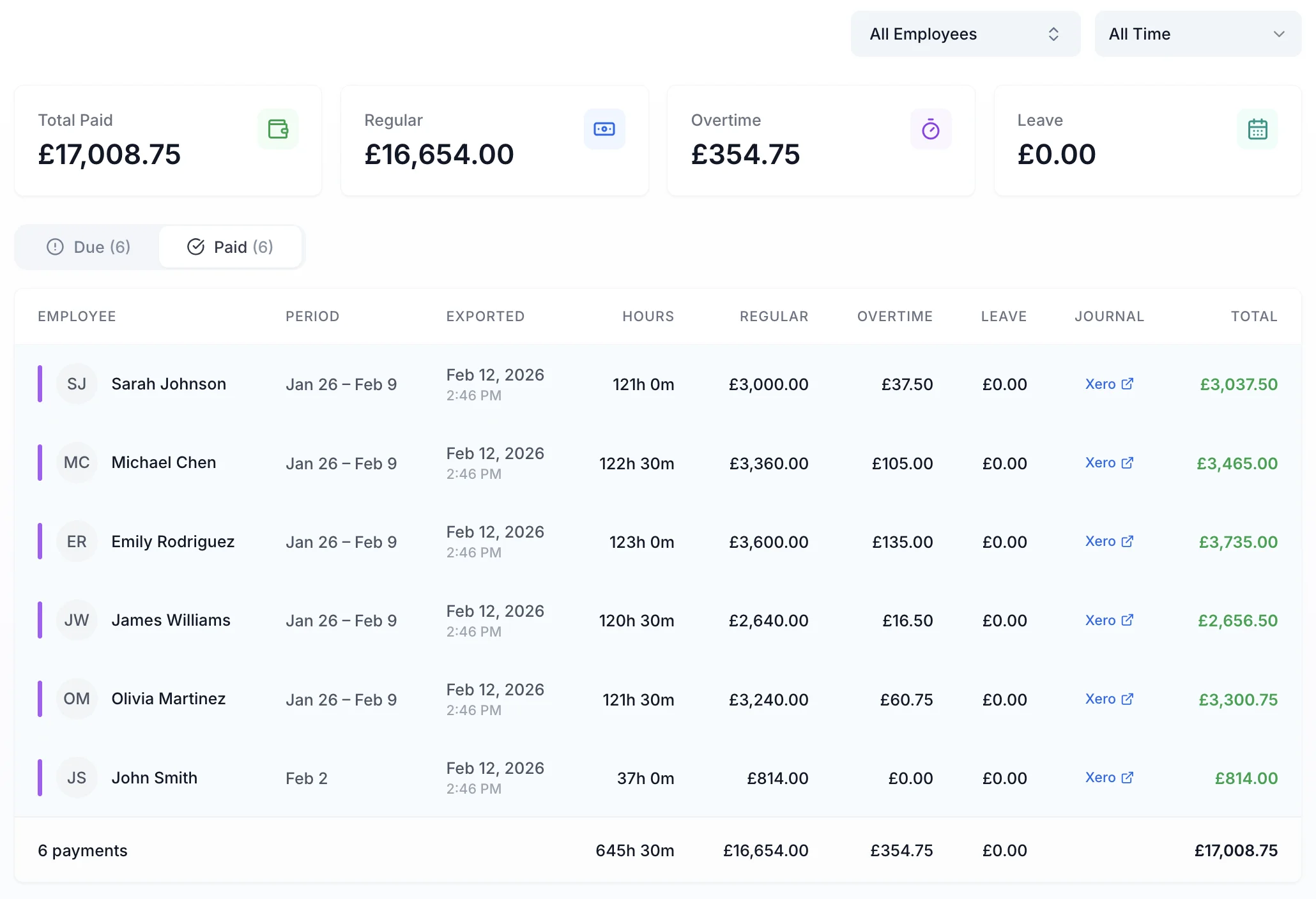
Auto overtime rates
Regular vs OT split
Clean audit trail
No manual entry
TimeTally pay calculations showing regular and overtime hours broken down

Hours data flows straight to payroll

Approved time tracking feed directly into your payroll export. Direct integration with Xero and QuickBooks — no manual data entry, no missed overtime.
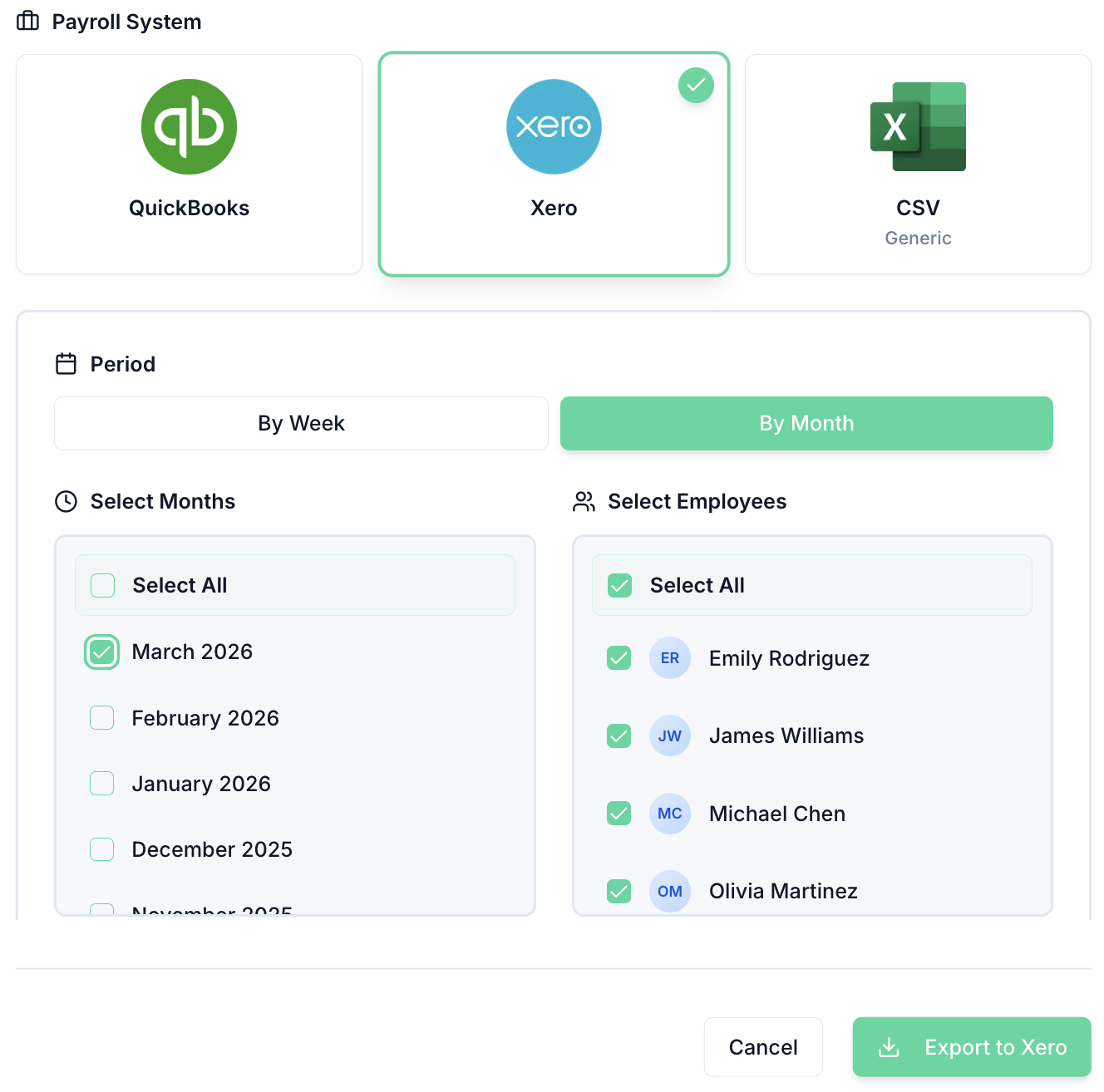
  • Direct Xero & QuickBooks integration
  • CSV export for any payroll software
  • Approved hours included automatically
  • Clean audit trail for every entry
TimeTally payroll export showing hours data sent to Xero and QuickBooks
Meet TimeTally

Stop doing this manually
for every employee

TimeTally automatically tracks, approves, and records break times for your entire team. Explore all features or see how it works.

Automatic calculations

Break durations recorded on every timesheet automatically. Regular hours and break time tracked separately — no spreadsheets needed.

One-tap approvals

Managers approve or reject time tracking from any device, with a full audit trail of every decision timestamped and stored automatically.

Payroll-ready exports

Approved hours feed directly into Xero, QuickBooks, or CSV exports — so your payroll run is always accurate and on time.

See what we offer

No credit card required · Set up in minutes · Cancel anytime

TimeTally has been excellent for our business. The app is simple to use, reliable, and makes managing staff records straightforward. The system has saved us a significant amount of administration time. Highly recommended for any business looking for an easy-to-use workforce management solution.

CLI Manchester

Jordan Ingoe, CLI Manchester

Break Time: Frequently Asked Questions

Everything you need to know about UK break time regulations. For related topics, try our working hours calculator or overtime pay calculator.

How many breaks are workers entitled to in the UK?
Under the Working Time Regulations 1998, adult workers who work more than 6 hours in a day are entitled to one uninterrupted rest break of at least 20 minutes. This is a minimum — employers can choose to give longer breaks. Workers on shifts under 6 hours have no statutory right to a rest break.
What is the 20-minute break rule?
If an adult worker works more than 6 hours in a single day, UK law requires a minimum 20-minute uninterrupted rest break. This break must be a single continuous period — it cannot be split into shorter pauses of, say, 10 minutes each. The employer decides when the break is taken, within the working day.
Do young workers (under 18) get longer breaks?
Yes. Young workers under 18 are entitled to a 30-minute rest break if they work more than 4.5 hours in a day — stricter than the 6-hour threshold for adults. Young workers also cannot work more than 8 hours per day or 40 hours per week, with no opt-out available. They must also have 12 hours rest between shifts (compared to 11 hours for adults).
Do rest breaks have to be paid?
Not automatically. UK law does not require rest breaks to be paid. Whether breaks are paid depends entirely on what is stated in the employment contract. Most employers do not pay for meal breaks but may pay for shorter rest breaks. Check your employment contract or staff handbook for your employer's policy.
What counts as an 'uninterrupted' break?
A break is uninterrupted if the worker is completely free from work duties for the entire duration. Workers cannot be required to answer phones, serve customers, monitor equipment, or be 'on call' during their statutory rest break. Brief interruptions — even if infrequent — may mean the break does not legally count as the statutory rest entitlement.
Can employers require workers to stay on site during breaks?
Yes. There is no legal requirement for employers to allow workers to leave the premises during breaks. However, the break must still be genuinely uninterrupted. Employers can require workers to remain on site for security or operational reasons, but workers must be free from all work duties during that time.
Are there different break rules for certain industries?
Yes. Some sectors have specific rules that may differ from or supplement the standard Working Time Regulations. Road transport drivers must follow EU-derived drivers' hours rules (a 45-minute break after 4.5 hours of driving). Aviation crew, seafarers, and railway workers each have sector-specific rest requirements. If you work in one of these sectors, check the rules specific to your industry.
What is the 11-hour rest rule between shifts?
Separate from in-shift breaks, adult workers must have at least 11 consecutive hours of rest between the end of one working day and the start of the next. For example, finishing at 11pm means the next shift should not start before 10am the following day. Young workers under 18 must have 12 consecutive hours rest between shifts.
Can a worker waive their right to a rest break?
Adult workers can agree in writing to modify certain working time rules, but the right to a rest break during shifts longer than 6 hours cannot be waived by an individual worker. However, collective or workforce agreements (between employers and recognised trade unions or elected workforce representatives) can modify when and how rest breaks are taken in certain circumstances.
What are the penalties for not providing rest breaks?
Failing to provide the statutory rest break is a criminal offence. The Health and Safety Executive can investigate and prosecute employers, and courts can impose unlimited fines for serious breaches. Workers can also bring a claim to an employment tribunal if they are denied their statutory rest breaks. Maintaining accurate records of break times — for example using timesheet software — is the best way to demonstrate compliance.

Still have a question? See all FAQs →

Related tools