

Timesheet Software for UK Construction

Construction workers move between job sites, work variable hours, and earn overtime that has to be right. TimeTally lets your team log hours from their phone, assign them to a job site, and submit for approval — with an optional GPS check that confirms they were on site. It is not construction management software: it is the hour record underneath your job costing, CIS returns and payroll. Approved timesheets export to Xero, QuickBooks, or CSV. From £3 per worker per month.

Construction timesheet showing hours, breaks and job site for the week
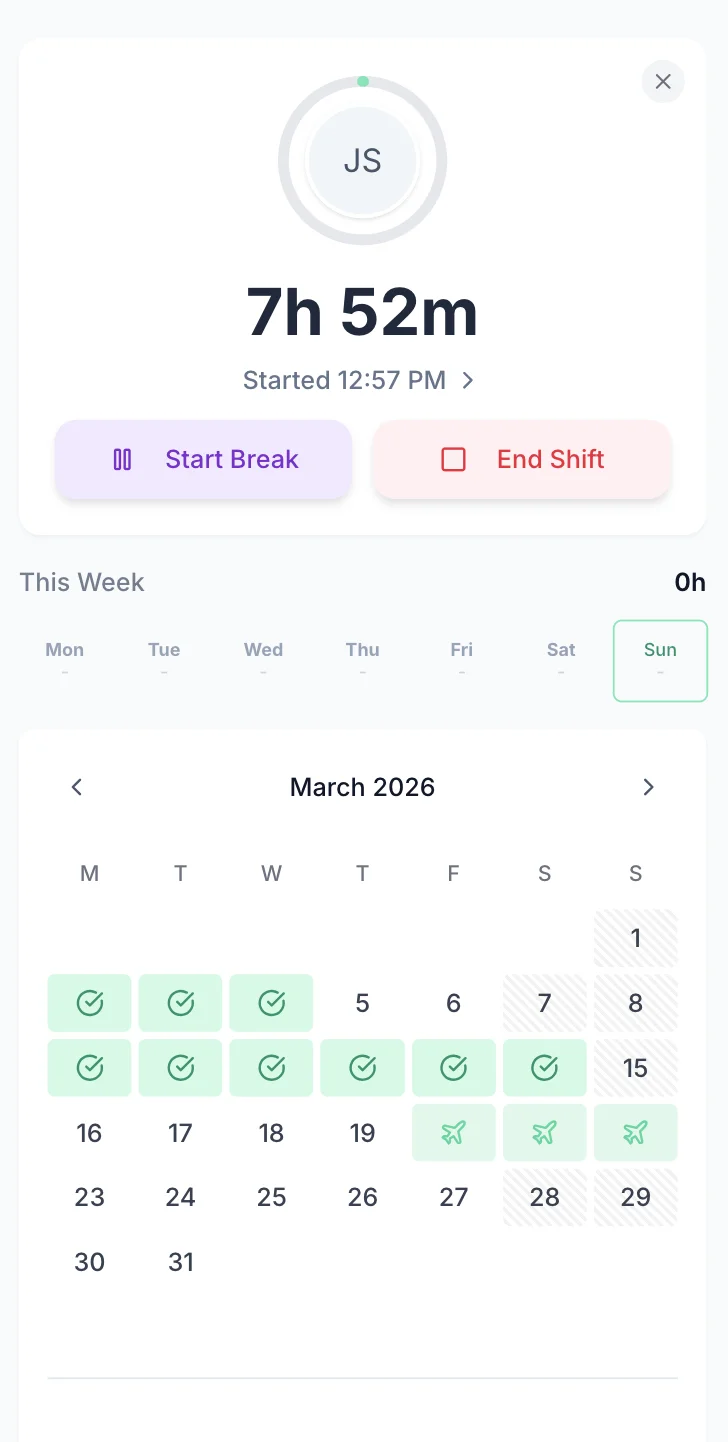
Construction worker clocked in on site from their phone

The app is simple to use, reliable, and makes managing staff records straightforward. The system has saved us a significant amount of administration time.

CLI ManchesterJordan Ingoe, CLI Manchester

Replace Paper Timesheets With Digital Entry

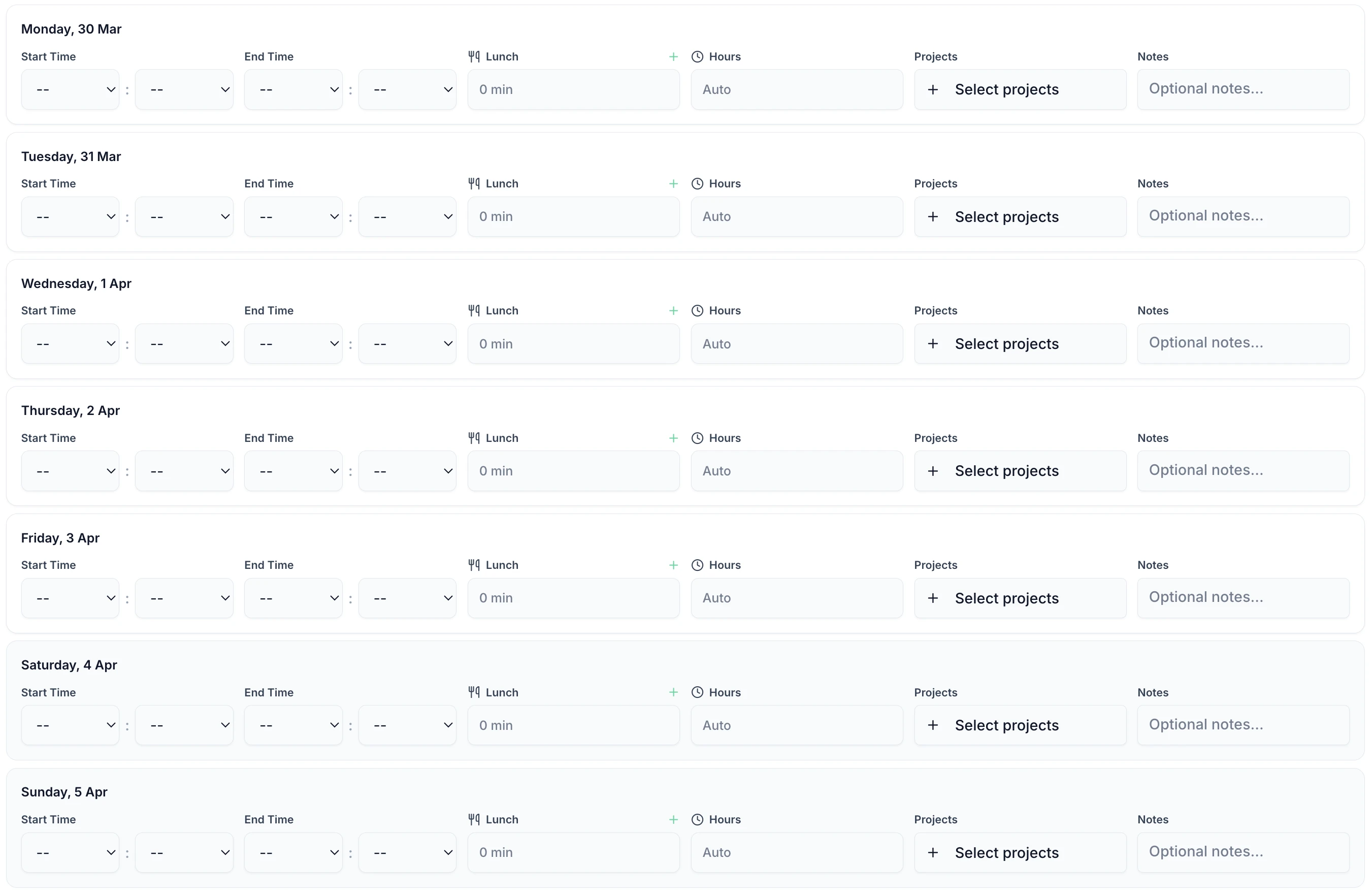
An on-site timesheet takes under 60 seconds to fill in. Enter start time, end time, and breaks — assign hours to a project — done. It works in any phone browser, so there is nothing to install and nothing to hand in at the end of the week. No more chasing paper forms from the back of vans. Replace your paper timesheet templates with an on-site timesheet the crew fill in where they are standing.

TimeTally timesheet entry screen showing hours, breaks, and project assignment
  • Weekly Calendar View

    See all working days at a glance

  • Flexible Time Entry

    Enter start/end times or total hours

  • Automatic Break Deduction

    Break times deducted from total hours

  • Job Site Tracking

    Assign hours to specific projects

  • Work Notes

    Add details about tasks completed

  • Instant Calculations

    Total hours updated in real time

Every construction time tracking scenario, handled

Tap any card for the detail.

Start your free trial

14-day free trial · No credit card needed

What it does on site

What TimeTally Does for Construction Teams

TimeTally is a timesheet and holiday management tool. Here is what it actually does and how it helps construction companies.

Hour Tracking by Job SiteHourly Rates and OvertimeMobile Access — No App RequiredPayroll ExportBreak TrackingTimesheet Approval
  1. Workers enter their start and end times and assign hours to a project. Create a project for each job site, client, or contract. If a worker splits their day across two sites, they can log hours against each one separately. Reports show total hours and labour costs per project — useful for job costing and quoting future work.

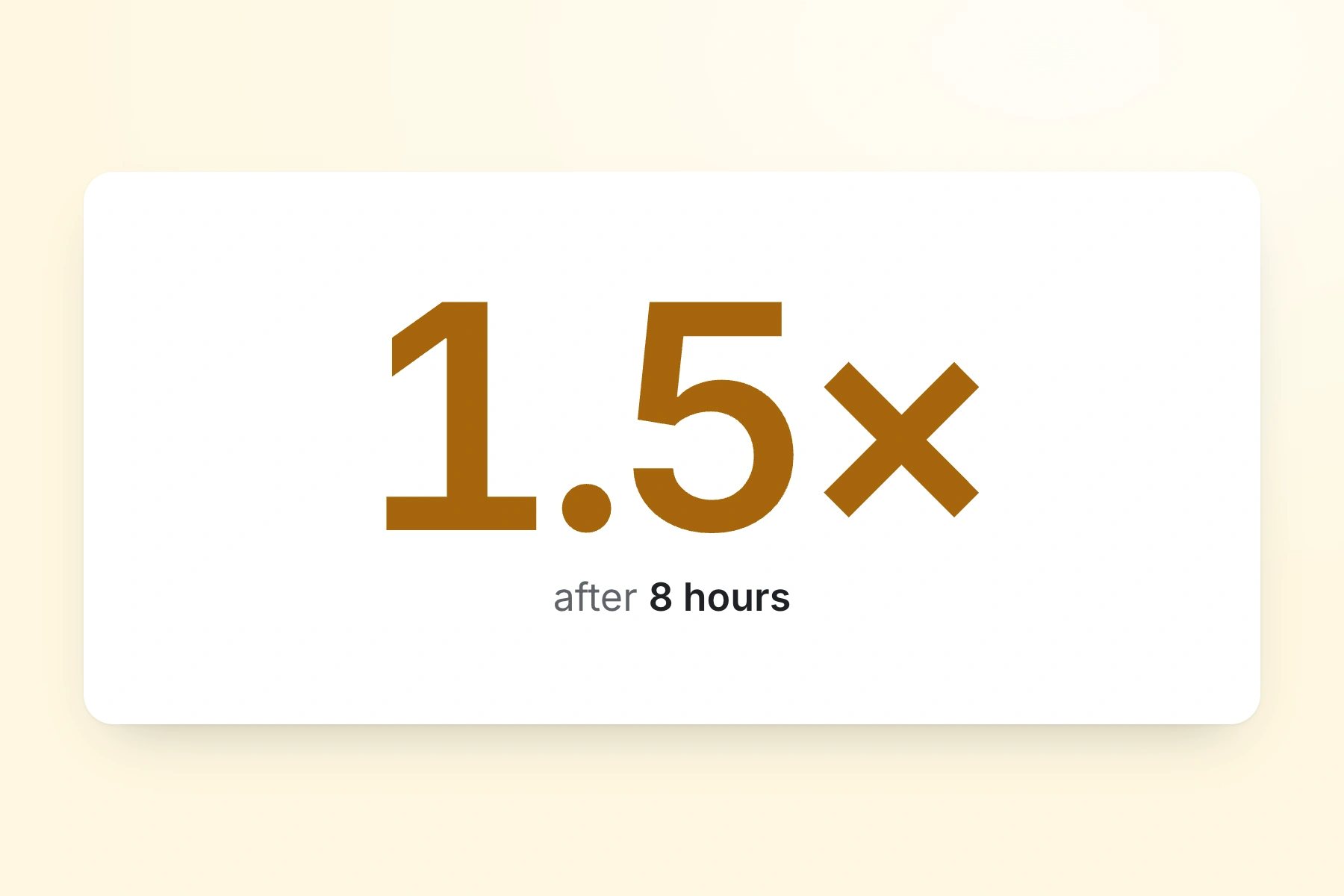
  2. Set an hourly rate and overtime rate for each worker. TimeTally calculates standard pay and overtime pay automatically when timesheets are submitted. You can set daily or weekly overtime thresholds to match your contracts — for example, time-and-a-half after 8 hours per day or after 40 hours per week.

  3. TimeTally works in any mobile browser. Workers do not need to download an app or create an account on their personal phone — they can bookmark the page and log hours in under a minute. There are also native iOS and Android apps for those who prefer them. Works on site with a basic phone signal.

  4. Export approved timesheets to Xero, QuickBooks, or CSV with one click. The export includes employee names, standard hours, overtime hours, pay amounts, and break deductions. Your payroll provider or accountant can use these figures directly — no manual re-entry needed.

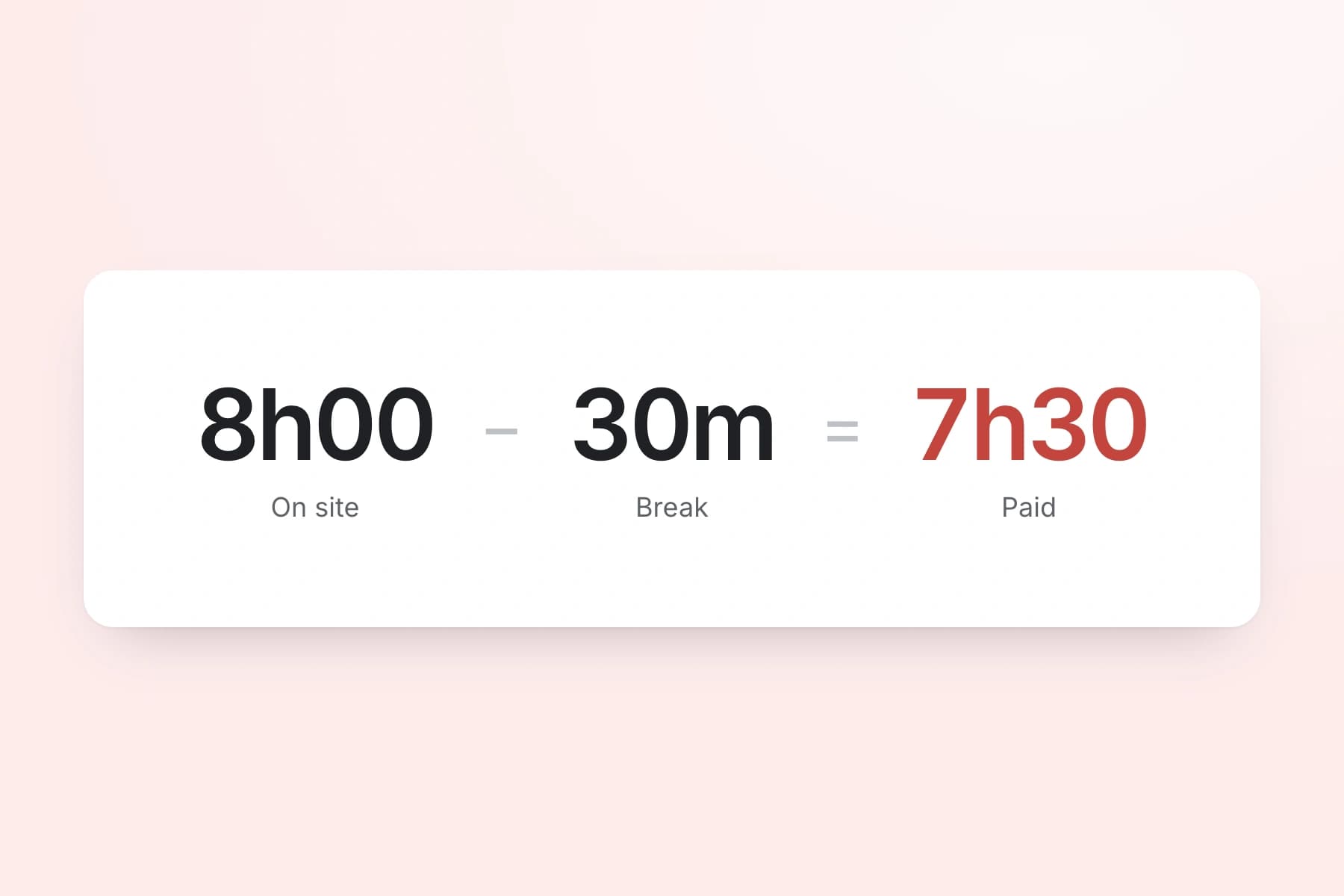
  5. Track lunch breaks and rest breaks separately. Under UK law, workers on shifts over 6 hours are entitled to a 20-minute uninterrupted break — use our break time compliance calculator to check. TimeTally records breaks and deducts them from total hours so pay calculations are accurate. You can also set automatic break deductions if your site has standard break times.

  6. Workers submit their timesheets for the week. Site managers or office staff review and approve or reject each submission. Approved timesheets feed into payroll exports. This gives you a clear compliance audit trail of who approved what and when — useful if queries arise later.

Explore time trackingEmployee time tracking software

Approve a Crew's Week From the Site Office

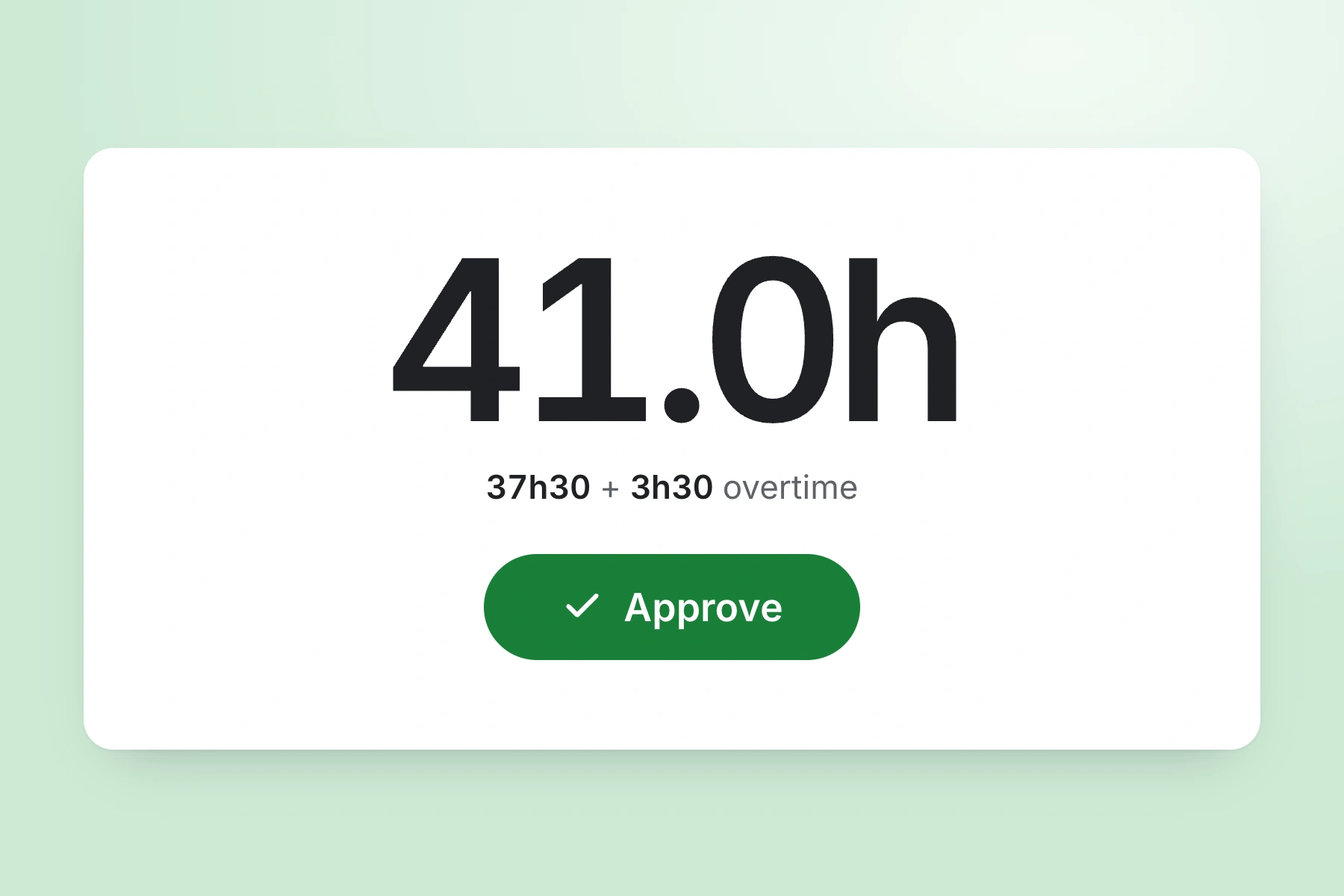
Site managers approve or reject timesheets from a phone, a tablet or a desktop. Each week arrives already totalled, with regular hours separated from overtime and the hours split across the job sites the worker moved between. Approved and paid are tracked as separate states, so a week signed off on site cannot be paid twice when the office runs payroll, or missed when a job finishes mid-week and the crew move on.

  • Overtime is calculated against that worker's own threshold before anyone opens the sheet. If you give the time back instead of paying it, the TOIL value is shown alongside.
  • Each day is one line. Open it to see the unpaid break, the second shift, the job site the hours went to, and any note the worker added.
  • Pay rates are permission-based. On a site running its own labour beside two subcontract gangs on different day rates, a site manager can approve everyone's hours without seeing what any of them are paid.
  • Group workers by site so you can filter the list and export one job at a time. A firm running four jobs can pull each crew's week on its own.
TOIL is optionalPay is permission-based
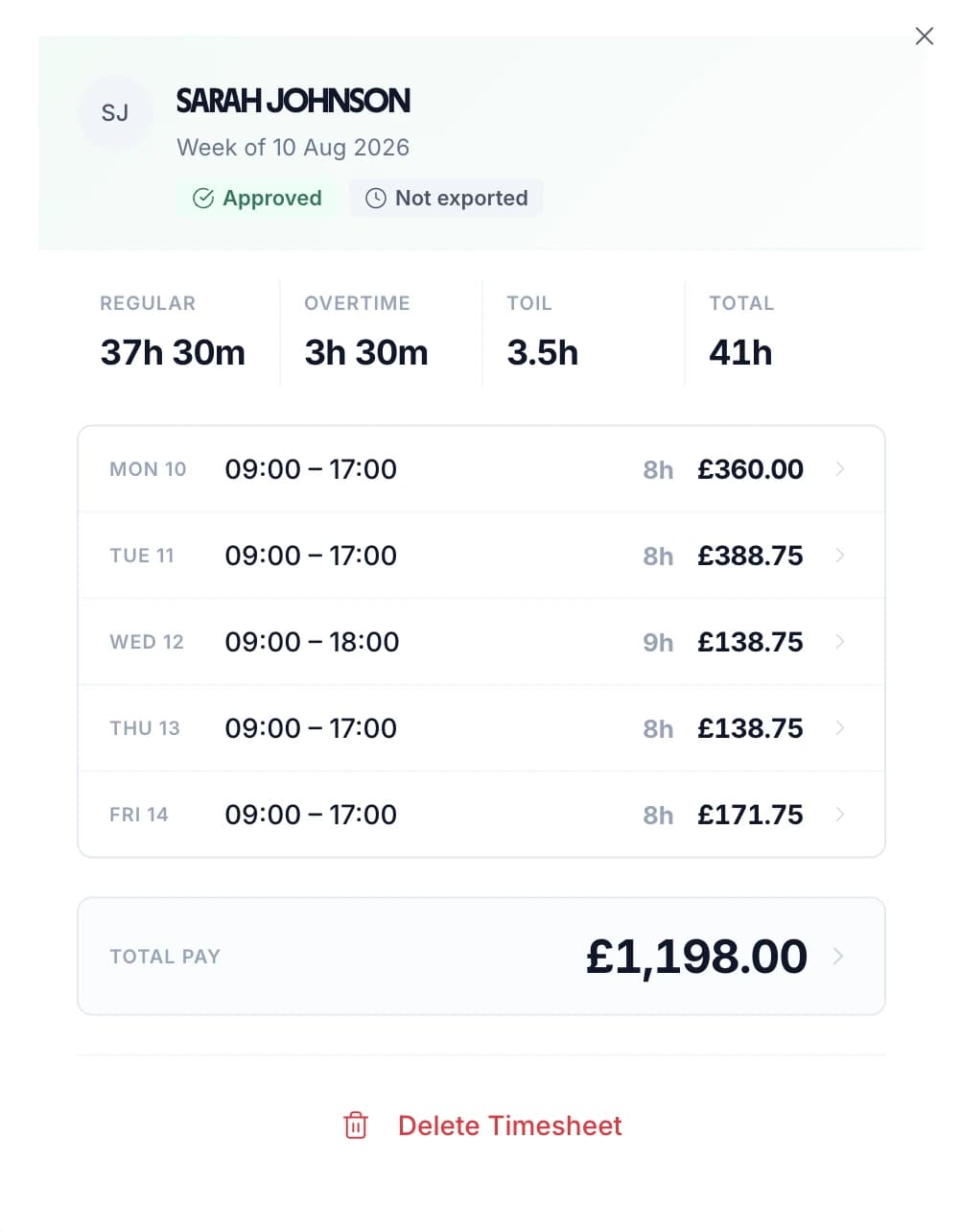
Approved weekly construction timesheet showing regular hours, overtime, TOIL and pay per day

Every Worker's Submitted Hours in One List

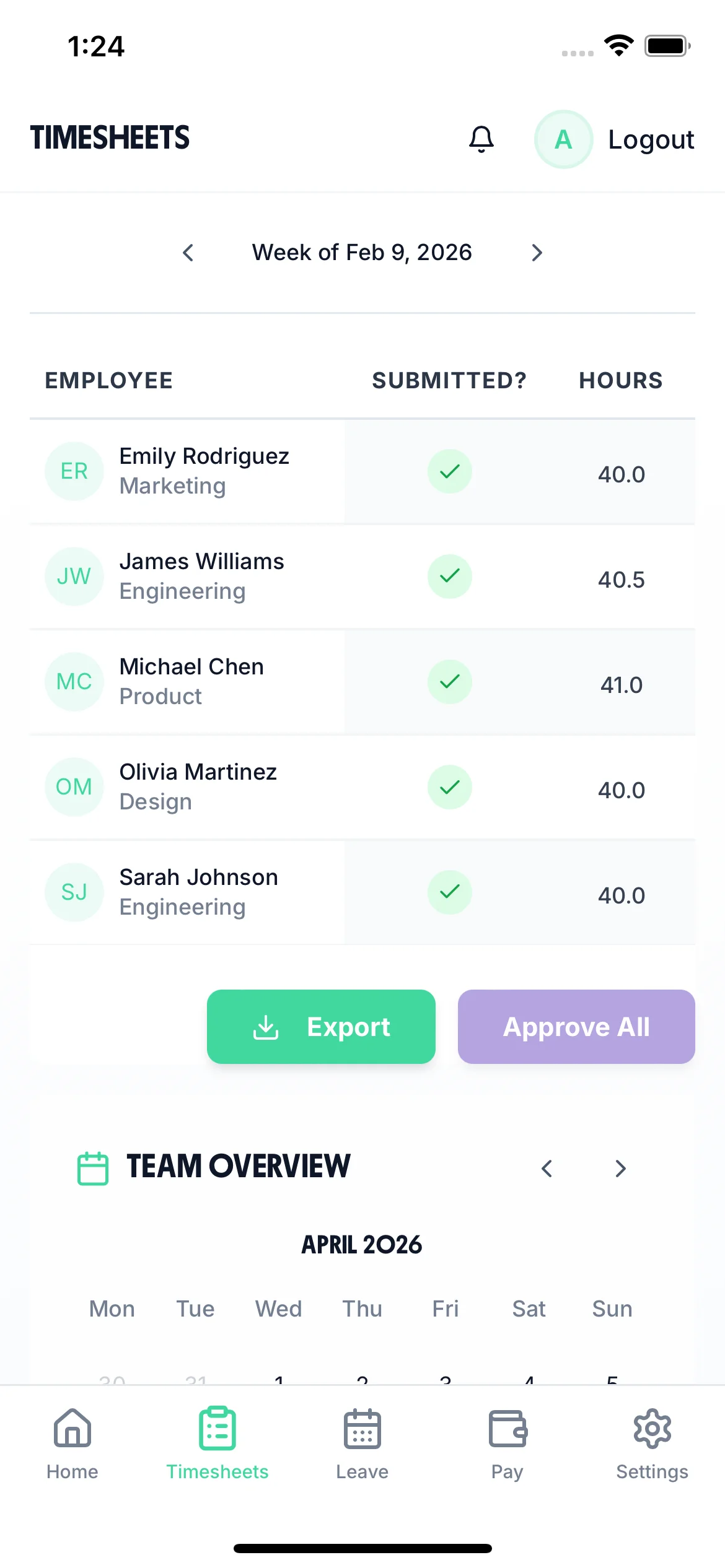
The timesheet screen lists every worker for the current period with their total hours and their status: not submitted, submitted, approved or rejected. A site manager can see who still owes a sheet without ringing round the gangs, and can work down the list from a phone in the cabin.

  • View the whole crew for the period, or filter to one worker. Each row opens to the day-by-day hours behind the total.
  • Approve a worker's outstanding days for the period in one action, or open a single day and approve or reject it on its own.
  • Rejections carry a written reason, so a worker who booked hours to the wrong job site knows what to correct and resubmit.
  • Send a reminder to a specific worker in one tap. It arrives as a notification in their app — nothing is chased automatically, you choose who gets it.
Phone, tablet or desktopReminders are sent by hand
Site manager view on a phone listing each construction worker's submitted hours and approval status

Watch a Timesheet Go From Site to Approved

A short loop of the timesheet screen. Hours are entered day by day, breaks are deducted from the total, and the completed period is submitted for a site manager to approve.

All Departments
Jun 2026
M
T
W
T
F
S
S
M
T
W
T
F
S
S
M
T
W
T
F
S
S
M
T
W
T
F
S
S
M
T
AR1

Amelia Roberts

Kitchen

JK2

James Kelly

Front of house

PS3

Priya Shah

Kitchen

MP4

Maya Patel

Front of house

TW5

Tom Wilson

Bar

Timesheet Requests

3
AR

Amelia Roberts

37h 30m · Week of Jun 15

JK

James Kelly

38h 30m · Week of Jun 8

Time-off Requests

2
PS

Priya Shah

3d · Annual Leave

MP

Maya Patel

2d · Sick Leave

AR

Amelia Roberts

Monday 15 June · 09:00

AR

0h 00m

09:00 – 17:00

Break
End Done

Timesheet submitted

Week of Jun 15

AR

Amelia Roberts

Kitchen

Week of Jun 15, 2026

Mon15
09:00–17:00·30m

7h 30m

Tue16
09:00–17:00·30m

7h 30m

Wed17
09:00–17:00·30m

7h 30m

Thu18
09:00–17:00·30m

7h 30m

Fri19
09:00–17:00·30m

7h 30m

Submit Timesheet Submitted

Payroll Export

Week of Jun 15, 2026 · 5 employees

Employee
Reg. pay
Overtime
Total
AR

Amelia Roberts

37.5h

£281.25

£281.25

JK

James Kelly

40h

£300.00

£22.50

2h

£322.50

PS

Priya Shah

32h

£240.00

£240.00

MP

Maya Patel

38h

£285.00

£285.00

TW

Tom Wilson

40h

£300.00

£45.00

4h

£345.00

Total · 5 employees

£1,406.25

£67.50

£1,473.75

Confirm Export Exported!

Optional Controls for Contracts That Need Tighter Records

Four settings an admin can turn on. Most firms use one or two, on the jobs where the hours are billed to a client or checked by someone else. The rest of your sites carry on as they are.

Require workers to be on site to clock in.

Set a boundary around each job site as a point and a radius. The radius is set per site and can be anywhere from 25 metres to 5 kilometres, so a fenced compound and an estate-wide groundworks package do not have to share a setting. Add sites as jobs start and deactivate them at handover.

Each site also has an enforcement setting. Strict refuses a clock-in from outside the boundary. Lenient allows it and records how far outside the worker was, which suits a site with poor GPS reception. Individual workers can be exempted.

Two things to know before you enable it. The check only applies where clocking in is the only way to log hours — if workers can also submit a form, they can type in the hours the geofence refused. And GPS clocking is a paid add-on, included free for the length of the trial.

How the GPS check works in full

Take start and end times from clock-ins only.

Strict clocking is off by default. With it off, workers type their own start and end times.

Turn it on for contracts where the hours are billed to a client or defended in a final account. Start and end times then come only from recorded clock-in and clock-out events. A worker cannot change a 07:40 start to 07:30 on the Friday the sheet is due, and a missed clock-out has to be resolved rather than filled in from memory a week later.

Site managers can still correct a genuine mistake, so the record stays accurate.

More on tamper-proof timesheets

Set the timesheet period to one, two or four weeks.

Choose a period of one, two or four weeks, then set the date the first period runs from. Every period after that follows the same cycle.

This matters in construction because the two halves of the payroll rarely run to the same clock. Direct crews are usually paid weekly while subcontract valuations run monthly. Match the period to the run it feeds and no one adds four weekly sheets together by hand or argues about which week fell in which valuation.

Tag hours by project, location and activity.

Projects are switched on already. Locations and activities are separate settings you turn on when a contract needs the work broken down further. Workers pick from your list as they submit.

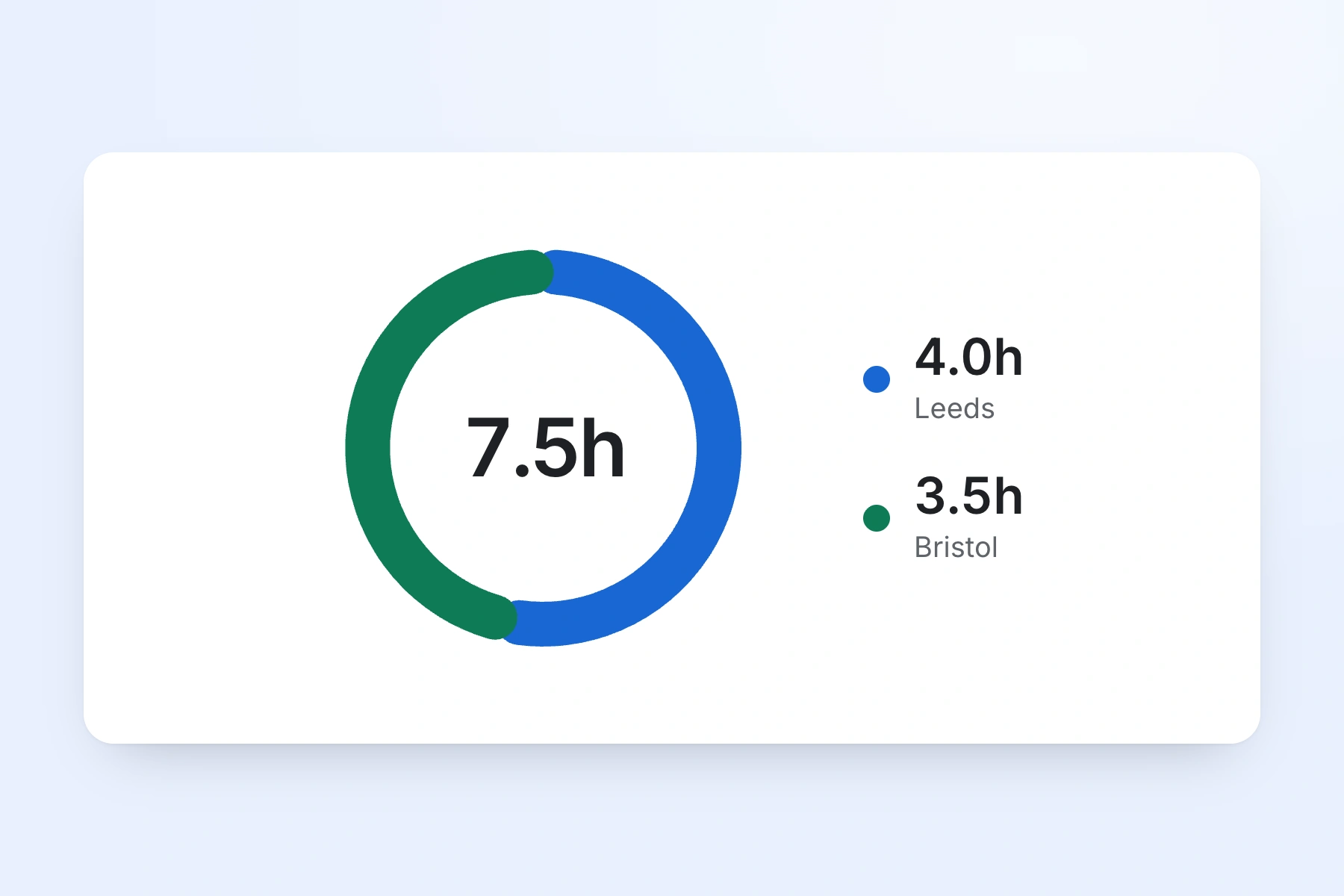
Whatever you use appears everywhere the hours appear: on timesheet lines, on shifts, and in every export and report. That is the difference between knowing a week cost forty hours and knowing the Leeds fit-out took twenty-six of them.

Payroll Integration

Export Construction Hours to Payroll

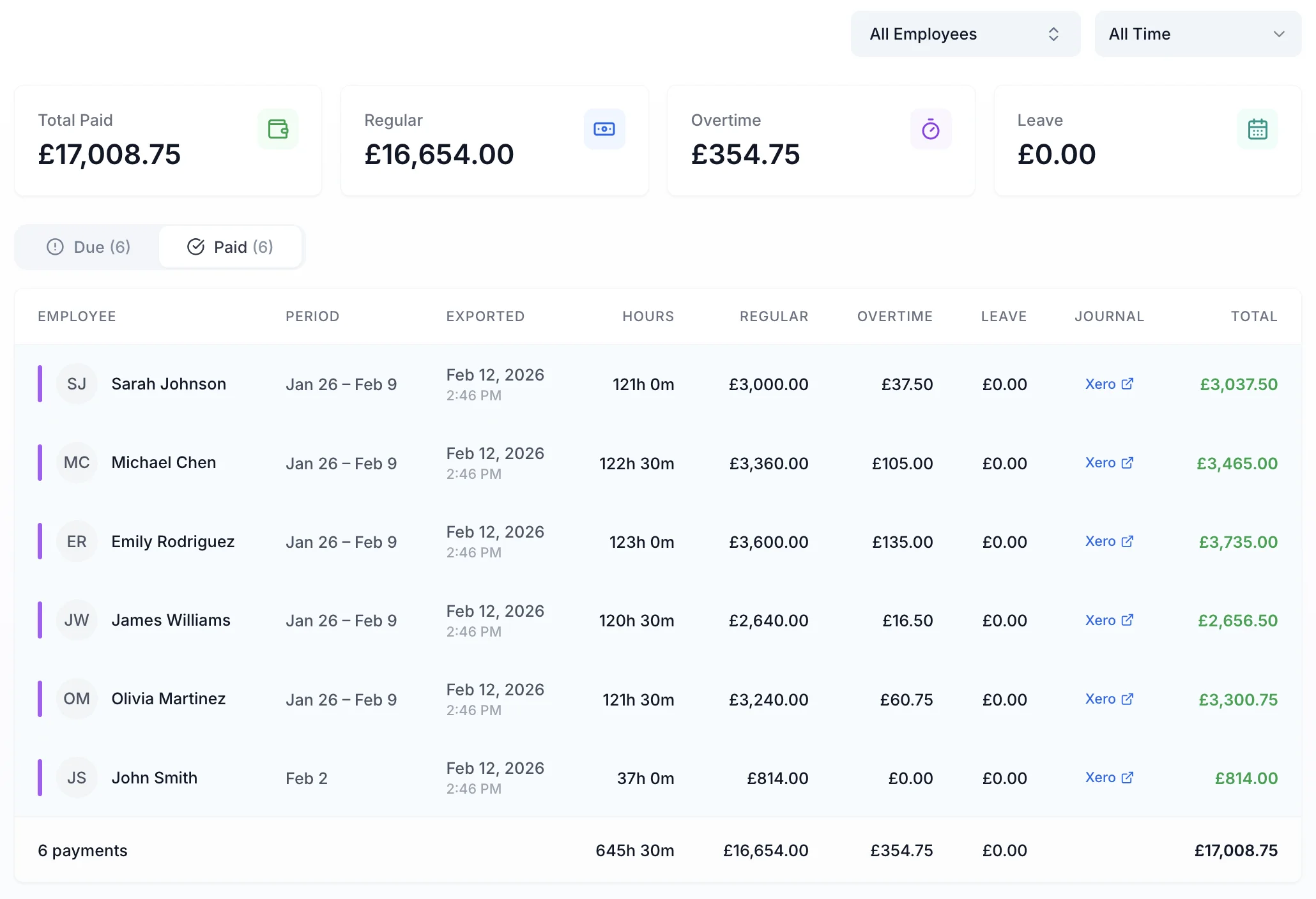
Stop manually re-entering worker hours into payroll software. TimeTally exports approved timesheet data to Xero, QuickBooks, or CSV. The export includes hours worked, overtime, pay amounts, and project breakdowns — everything your accountant needs to run payroll and prepare CIS submissions.

TimeTally payroll export showing hours and pay by employee and project
  • Track by Job Site

    See which projects consumed the most labour hours. Use this data for job costing, future quotes, and identifying which contracts are profitable.

  • Automatic Overtime

    Standard hours and overtime are separated automatically based on the thresholds you set per worker. No manual calculation needed for time-and-a-half or double-time rates.

  • Hours Data for CIS Reporting

    TimeTally records hours worked per subcontractor — data your accountant needs when preparing CIS returns. The tool does not generate CIS returns itself, but it provides the underlying hour records.

Why it matters

Why Construction Companies Need Accurate Timesheets

Construction timesheets carry more weight than most: UK construction has a unique combination of regulatory, financial, and practical reasons to record hours properly. Workers move between sites, overtime is common, and several pieces of legislation touch on how hours are kept.

The Construction Industry Scheme (CIS) requires contractors to deduct tax from payments to subcontractors and report those deductions to HMRC monthly. While TimeTally does not generate CIS returns or verify subcontractor status, having accurate, auditable records of hours worked per subcontractor is the foundation of any CIS reporting process. Without reliable timesheet data, your accountant or payroll provider cannot produce accurate CIS submissions.

The Working Time Regulations 1998 limit average weekly working hours to 48 (calculated over a 17-week reference period) and require at least 11 consecutive hours of rest between shifts. Construction workers can opt out of the 48-hour limit, but employers must still keep records of hours worked. These records can be requested by HMRC or the HSE at any time.

The CDM Regulations 2015 place duties on contractors to manage health and safety risks on construction sites. While CDM does not specifically mandate timesheet software, keeping clear records of who was on site and when supports your duty to manage worker welfare — particularly around fatigue and working hours.

Beyond compliance, accurate timesheets are simply good business. If you are quoting for jobs and do not know how many hours your last three projects actually consumed, you are guessing at margins. Project tracking lets you see labour costs per site, identify which jobs are profitable, and quote more accurately in future — use our ROI calculator to see the potential savings. For payroll, getting hours and overtime calculations right means fewer disputes with workers and fewer corrections at month end.

UK Compliance

How TimeTally Helps with Construction Compliance

TimeTally is a timesheet tool, not a compliance system. But construction time tracking is the starting point for meeting several regulatory obligations, because every one of them rests on an accurate hour record. Here is what the data supports — and what it does not do.

CIS — Hour Records for Subcontractors

The Construction Industry Scheme requires contractors to report subcontractor payments to HMRC. TimeTally records hours worked per subcontractor and calculates pay, giving your accountant the data they need to prepare CIS returns. TimeTally does not generate CIS returns, verify subcontractor tax status, or submit anything to HMRC — that remains with your accountant or payroll software.

Working Time Regulations

TimeTally records all hours worked, including overtime. This gives you the data to check the 48-hour weekly average (over a 17-week reference period) and 11-hour daily rest requirements. You can export these records if HMRC or the HSE request them. TimeTally does not actively monitor or alert you to breaches — you need to review the data yourself.

CDM 2015 — Site Records

CDM Regulations require principal contractors to manage health and safety risks. While CDM does not mandate timesheet software specifically, having a digital record of who worked on which site and for how long supports your welfare management obligations. It is more reliable than paper sign-in sheets.

HMRC Record-Keeping

HMRC requires employers to keep records of hours worked for at least two years. TimeTally stores all timesheet data digitally with timestamps and approval records — a complete audit trail that you can export whenever needed.

National Minimum Wage

Accurate hours tracking ensures your effective hourly rate does not fall below the National Minimum Wage. This is relevant where incorrect break deductions or unrecorded overtime could push the effective rate below the legal minimum.

Holiday Entitlement

All UK workers — including construction workers — get 5.6 weeks statutory holiday (28 days for full-time). TimeTally calculates entitlement automatically, including pro-rata for part-time workers and mid-year starters, and tracks remaining allowance in real time.

Simple, Transparent Pricing

One price. Every feature. No surprises.

£3/employee/month

Billed monthly, incl. VAT. Cancel anytime.

Hour tracking by job site or project
Hourly rates and overtime calculation
Mobile access — no app required
Payroll export to Xero, QuickBooks, or CSV
Break tracking and timesheet approval
Get Started

In short

What is construction timesheet software?

Construction timesheet software records the hours each worker spends on each job site, so those hours can be costed to the project and paid correctly. TimeTally does this for UK construction firms from £3 per worker a month. Workers log start time, end time and breaks from any phone browser or the iOS app, assign the hours to a job site, and submit the period for approval. Site managers approve from any device. Overtime is calculated against the thresholds you set for each worker. Approved hours export to Xero, QuickBooks or CSV, which is the record your accountant works from for payroll and for CIS returns.

Price
£3 per worker a month
Logging
Any phone browser, or the iOS app
Costs to
A project per job site or contract
Exports to
Xero, QuickBooks, CSV
Supports
CIS, WTR and HMRC hour records

Frequently Asked Questions

Is TimeTally CIS compliant?

TimeTally records CIS time — hours worked per subcontractor — and calculates pay, which is the data your accountant needs when preparing CIS returns for HMRC. However, TimeTally does not generate CIS returns, verify subcontractor tax status, or submit anything to HMRC. Those tasks sit with your accountant or dedicated CIS software. What TimeTally does is give them accurate, auditable hour records to work from.

Can workers log hours from a construction site?

Yes. TimeTally works in any mobile browser — workers just need a basic phone signal. They can bookmark the page on their phone and log hours in under 60 seconds. No app download is required, though there is also a native iOS app on the App Store. It works on any smartphone.

How do I track contractor hours across active job sites?

Create a project in TimeTally for each active site or contract. When a worker submits their hours they pick the project they were on, and if they moved between two sites that day they log hours against each one separately. The project report then shows total hours and labour cost per site, updated as timesheets are approved, so you can see which jobs are consuming the hours you quoted for while the work is still running rather than after it has finished.

Can I track hours by job site or project?

Yes. You create projects in TimeTally (one per job site, client, or contract). Workers select which project they worked on when submitting their timesheet. If they split their day across two sites, they can log hours against each one separately. Reports show total hours and labour costs per project.

How does overtime work?

You set an hourly rate and overtime rate for each worker, along with a daily or weekly overtime threshold. TimeTally automatically calculates standard pay and overtime pay based on these settings. For example, you could set overtime at time-and-a-half after 8 hours per day, or after 40 hours per week.

Does TimeTally help with Working Time Regulations?

TimeTally records all hours worked, which gives you the data to check the 48-hour weekly average and rest period requirements under the Working Time Regulations 1998. You can export records at any time for inspections. However, TimeTally does not actively monitor or alert for WTR breaches — it provides the data, and compliance decisions remain with you.

Can I use TimeTally for subcontractors as well as employees?

Yes. You can add both employees and subcontractors to TimeTally, and as contractor timesheet software it treats them the same way as an employee — same weekly submission, same approval, same export. Each person gets their own hourly rate and overtime settings. The hours data can then be used for both payroll (for employees) and CIS reporting (for subcontractors).

Does TimeTally produce CITB levy reports?

No. TimeTally does not produce CITB-specific reports. However, it does record total hours and labour costs by project, which is useful data when your accountant calculates your CITB levy return. You can export all timesheet data to CSV for further analysis.

Do construction workers need a phone signal to log hours?

They need signal at the moment they submit. TimeTally runs in the mobile browser, so a worker on a site with no coverage can log their hours when they get back into signal — at the end of the day, or from the van on the way home. The iOS app retains entries made offline and syncs them when the phone reconnects. Nothing is lost either way, but a worker on a dead site is recording the day retrospectively rather than in real time.

How do holiday requests work for construction workers?

Workers tap 'Book Time Off', select their dates, and submit. Their manager gets a notification and can see the team calendar to check for clashes before approving. Remaining holiday allowance is shown in real time. Statutory entitlement (5.6 weeks for full-time) is calculated automatically, including pro-rata for part-time workers.

What payroll systems does TimeTally export to?

TimeTally exports to Xero, QuickBooks, and CSV/Excel. The export includes employee names, standard hours, overtime hours, pay amounts, and break deductions. Your accountant or payroll provider can import the CSV if a direct integration is not available.

Can site managers approve timesheets on their phone?

Yes. Managers can review and approve or reject timesheets from their phone. They see each worker's submitted hours, project assignments, and any notes. Approval is per individual timesheet — managers review each one and approve or reject.

How much does construction timesheet software cost in the UK?

TimeTally is £3 per worker per month including VAT, billed monthly, with every feature included and no tiered plans. A ten-person crew is £30 a month. There is a 14-day free trial and no card is needed to start. Seasonal firms can remove workers when a contract ends and the bill follows the headcount.

Still have a question? See all FAQs

Try TimeTally Free for 14 Days

No credit card required. Set up your construction team in 10 minutes. Start tracking hours by job site and exporting approved hours to payroll.

FREE 14-day trial · No credit card required · Cancel anytime

Support that answers

A real person replies within 24 hours. No ticket queues, no bots.

UK GDPR compliant

A UK company, ICO regulated. Your data encrypted and never sold.