Handle sensitive absences with care and accuracy. Create a custom compassionate leave type in TimeTally, record bereavement and family emergency absences properly, and maintain the records your business needs — all within your absence management system.
Tap a card to read the detail.
14-day free trial · No credit card needed
Bereavement and family emergencies require a compassionate response. Having a clear process and accurate records means managers can focus on supporting the employee, not scrambling with administration.
There is no legal obligation to offer paid compassionate leave in the UK, but most employers provide between 3 and 5 days as a matter of good practice and staff welfare.
Employees do have a statutory right to take a reasonable amount of unpaid time off to deal with an emergency involving a dependant. Recording this properly protects both parties.
A clear compassionate leave policy, backed by a system to record it, ensures consistency across the organisation and removes uncertainty during difficult moments.
Best practice: Include your compassionate leave policy in your employee handbook alongside your sick leave policy. Having clear written policies helps managers respond consistently and sensitively. Read our guide to staff leave management for more advice.
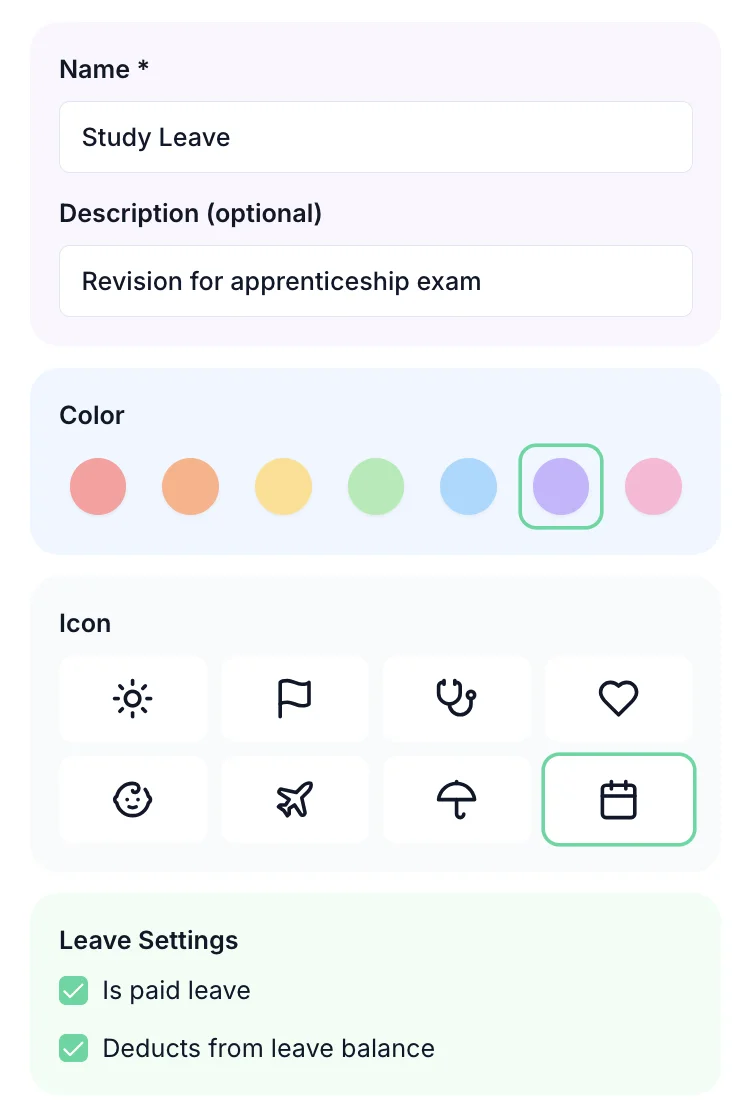
Create a “Compassionate Leave” custom leave type in TimeTally with its own colour and optional allowance. This keeps compassionate absences separate from sick leave and annual leave, giving you accurate records without inflating other absence categories.
Distinct colour coding
Compassionate leave appears in its own colour on the team calendar, separate from other absence types
Flexible allowances
Set a standard allowance (e.g. 5 days per year) or leave it flexible for manager discretion
Quick to record
Managers can record compassionate leave on behalf of an employee in seconds — minimising admin during a difficult time
Accurate records of compassionate leave are important for policy reviews, fair treatment, and payroll accuracy.
Tracking compassionate leave ensures all employees are treated consistently, which protects against grievances and tribunal claims
Understand how much compassionate leave your organisation uses to inform and improve your policy over time
Export compassionate leave data via CSV or sync with payroll integrations to ensure correct pay calculations
The team calendar shows when a colleague is on compassionate leave so teams can offer support and manage workload
Without a proper system, compassionate leave creates unnecessary stress for everyone involved.
Without a clear policy and records, different managers offer different amounts of compassionate leave. This creates resentment and potential grievance claims.
Compassionate absences get lumped in with sick leave because there is no separate category. This inflates sickness records and triggers unnecessary absence reviews.
Compassionate leave is granted verbally and never recorded. When payroll runs, nobody knows whether the days should be paid or unpaid.
Without a clear policy, managers are unsure what to offer. Employees have to ask and negotiate during an already difficult time.
Track statutory and contractual holiday entitlement, carry-over, and pro-rata calculations.
Record self-certified and doctor-certified sick leave. Track Bradford Factor scores automatically.
Accrue, request, and track time off in lieu from overtime and on-call callouts.
Create custom leave types for compassionate, bereavement, and other special circumstances.
Track maternity, paternity, and shared parental leave alongside regular annual leave.
Any custom leave type you need — configured with its own rules, entitlement, and approval flow.
One price. Every feature. No surprises.
UK bereavement and compassionate leave law is more nuanced than most employers realise. Here's what the rules actually say.
The only statutory bereavement leave in the UK is Parental Bereavement Leave, which applies to the death of a child under 18. All other bereavement leave is discretionary — there is no statutory right to paid or unpaid time off.
The statutory right to unpaid time off for dependants covers genuine emergencies — including a bereavement — but is typically just 1 to 2 days. This is distinct from compassionate leave, which is a separate contractual provision.
Parents who lose a child under 18, or who suffer a stillbirth after 24 weeks of pregnancy, are entitled to 2 weeks of Parental Bereavement Leave and Statutory Parental Bereavement Pay at the SPP rate (£184.03/week in 2024/25).
Compassionate leave typically covers the bereavement of close family members — partner, parent, child, or sibling. Some employers extend this to grandparents or close friends. The scope should be clearly defined in the policy.
There is no statutory requirement to pay during compassionate leave. Most employers offer full pay for a defined period — commonly 3 to 5 days for a close family bereavement. The policy should specify the pay arrangement clearly.
Grief affects performance and wellbeing long after the leave period ends. Consider flexible working, reduced targets, or a phased return. Maintain contact during leave with the employee's consent — do not leave them feeling forgotten.
A clear policy should define who qualifies, how many days are granted, whether it is paid, and how employees should request leave. Without a written policy, inconsistent treatment can expose the employer to discrimination claims.
If an employee becomes too unwell to work following bereavement, sick leave provisions should apply from that point. Employers should not pressure grieving employees back to work before they are ready — this risks both legal and reputational harm.
Swipe to see more →
There is no statutory right to paid compassionate leave in the UK. However, all employees have the right to take a 'reasonable' amount of unpaid time off to deal with an emergency involving a dependant (under the Employment Rights Act 1996). Many employers choose to offer paid compassionate leave as part of their benefits package, typically between 3 and 5 days.
TimeTally lets you create a custom 'Compassionate Leave' type with its own colour, icon, and allowance. When an employee needs time off for bereavement or a family emergency, the absence is recorded against this type. It appears on the team calendar and is tracked in the employee's leave history for accurate record-keeping.
Yes. When you create your compassionate leave type in TimeTally, you can set an allowance (e.g. 5 paid days per year) or leave it flexible for manager discretion. You can also set different allowances for different employees if your policy allows it.
Yes, it is best practice to track compassionate leave as a separate type. This avoids inflating sick leave records, gives you accurate data for policy reviews, and treats the absence with the sensitivity it deserves. TimeTally's unlimited custom leave types make this straightforward.
Having a clear policy and a formal system actually helps with sensitivity — managers know what to offer, and employees don't have to negotiate during a difficult time. TimeTally provides a straightforward way to record the absence quickly so the focus can remain on supporting the employee rather than on administration.
Still have a question? See all FAQs
A real person replies within 24 hours. No ticket queues, no bots.
A UK company, ICO regulated. Your data encrypted and never sold.