Calculate your statutory redundancy entitlement instantly. Enter age, years of service, and weekly pay — updated for the 2024 weekly pay cap of £643.
Tap a card to read the detail.
14-day free trial · No credit card needed
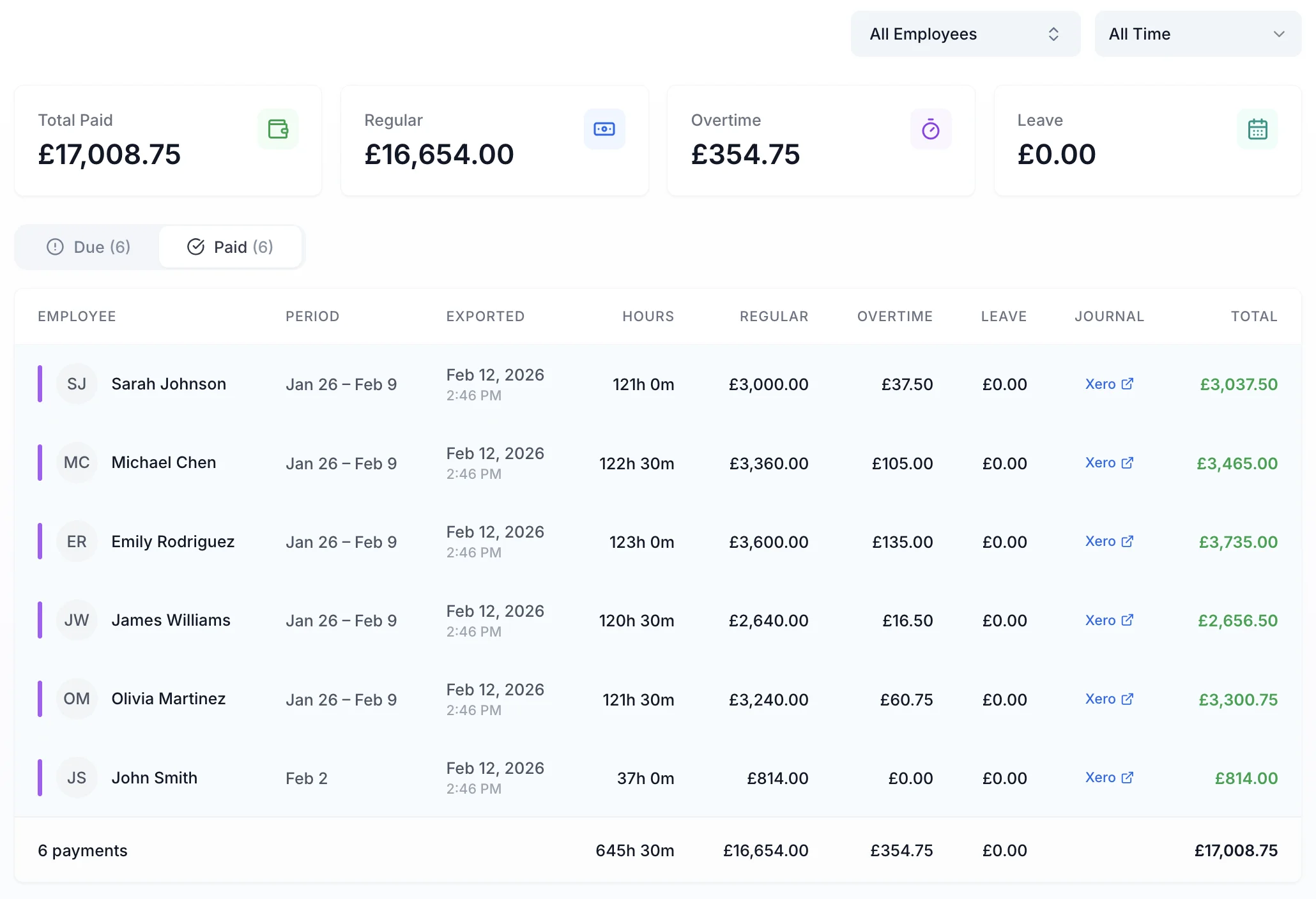
This calculator gives you the numbers. TimeTally tracks hours, approvals, and pay automatically — so you have accurate records for every employee, every pay period. From £3/employee/month.
Staff submit timesheets via the iOS app or web. Clock in/out is tracked automatically. Accurate hours records mean you always have the data you need — no paper forms, no chasing.

All pending timesheets land in your dashboard. Approve or query with a single tap. Every decision is timestamped — a full audit trail for every pay period.

Statutory redundancy pay has specific rules around eligibility, calculation, and tax. Here's everything you need to know.
Statutory Redundancy Pay (SRP) is calculated using three inputs: age, length of continuous service (up to 20 years), and weekly pay (capped at £643/week in 2024/25). The formula awards: 0.5 week's pay per year of service under age 22; 1 week's pay per year of service aged 22–40; and 1.5 weeks' pay per year of service aged 41 or over. The maximum SRP is 30 weeks' capped pay — currently £19,290. Continuous service is calculated to the day the employment ends, not the date notice was given.
Employees must have at least 2 years' continuous service to qualify for statutory redundancy pay. Service is calculated from the 'relevant date' — usually the date employment commenced. Breaks in service generally reset the clock, but some breaks are treated as preserving continuity (such as temporary cessation of work, or absence by arrangement). Employees who are dismissed without the correct notice are entitled to statutory notice pay, which is added to their service for redundancy calculation purposes.
The weekly pay cap (£643 in 2024/25, reviewed annually) limits the amount that counts for SRP calculation purposes. For employees who earn above this threshold, only the capped figure is used — not their actual weekly earnings. 'A week's pay' for employees with normal working hours is their contractual weekly pay. For those without normal working hours (e.g. zero-hours or variable-hours workers), it is the average of the last 12 weeks in which pay was received, excluding weeks with no pay.
Voluntary redundancy occurs when an employer invites employees to apply for redundancy — often with enhanced pay — before compulsory selection begins. Volunteering does not remove the right to statutory redundancy pay, but enhanced packages offered voluntarily are at the employer's discretion. Compulsory redundancy requires a fair selection process using objective criteria (e.g. skills, performance, attendance). Using age, gender, disability, or other protected characteristics as selection criteria — even implicitly — is unlawful discrimination.
Where an employer proposes to make 20 or more employees redundant within 90 days at one establishment, collective consultation obligations under the Trade Union and Labour Relations (Consolidation) Act 1992 apply. Consultation must begin at least 30 days before the first dismissal takes effect (45 days for 100 or more redundancies). Failure to comply can result in a 'protective award' of up to 90 days' gross pay per affected employee, payable to each individual — a potentially significant liability for large-scale restructures.
Many employers offer enhanced redundancy pay above the statutory minimum. Enhanced pay is contractual if it is included in the employment contract or an established policy — in which case refusing to pay it is a breach of contract. The first £30,000 of any redundancy payment (statutory or enhanced) is free of income tax and NIC. Any amount above £30,000 is subject to income tax (but not employee NIC). Post-employment notice pay (PENP) must be calculated correctly where enhanced terms are offered alongside notice pay.
Employees who are pregnant or on maternity leave at risk of redundancy have enhanced protection. They must be offered any suitable alternative vacancy in priority over other at-risk employees, even if they are less qualified than other candidates. This priority right extends for 18 months from the child's birth date. Failure to offer a suitable alternative is automatically unfair dismissal and sex discrimination. The enhanced protection applies regardless of service length — even an employee in their first month of employment has this right if pregnant.
A Settlement Agreement (formerly a Compromise Agreement) can be used to compromise a redundancy claim in exchange for a payment, often in addition to or instead of the statutory entitlement. The agreement must be in writing, the employee must receive independent legal advice (usually covered by an employer contribution to legal fees), and it must meet specific statutory requirements to be valid. Settlement agreements are commonly used where enhanced pay is offered in return for waiver of all employment claims — including any disputes about the fairness of the redundancy process.
Swipe to see more →
“TimeTally has been excellent for our business. The app is simple to use, reliable, and makes managing holidays, absences, and staff records straightforward. The system has saved us a significant amount of administration time and gives both managers and employees clear visibility of leave balances and requests. Highly recommended for any business looking for an easy-to-use workforce management solution.”
 Jordan Ingoe, CLI Manchester
Everything you need to know about redundancy pay under UK law. For related topics, try our overtime pay calculator or minimum wage calculator.
Calculate time and a half and double time pay for UK employees
Check National Minimum Wage and National Living Wage rates
Track and calculate weekly working hours for your team
Calculate time off in lieu entitlement for overtime worked
Service dates, hours worked and outstanding holiday are already in TimeTally when you need them.