Manage zero-hours workers alongside permanent staff. Track variable hours, calculate holiday entitlement accurately, and give every worker visibility of their own records — in one system.
UK law gives zero-hours workers the same holiday rights as permanent staff. TimeTally makes it easy to calculate entitlement on hours worked, alongside shift scheduling and timesheet tracking.
Under UK employment law, zero-hours workers accrue holiday at 12.07% of hours worked. TimeTally calculates this leave accrual automatically — no spreadsheet gymnastics. Workers who build up extra hours can also track TOIL in the same system.
Set leave entitlement to accrue as a percentage of hours — 12.07% is the standard. TimeTally calculates and updates the balance as hours are logged.
Zero-hours workers log actual hours each week. Overtime, irregular shifts, and variable patterns — all recorded accurately in the timesheet.
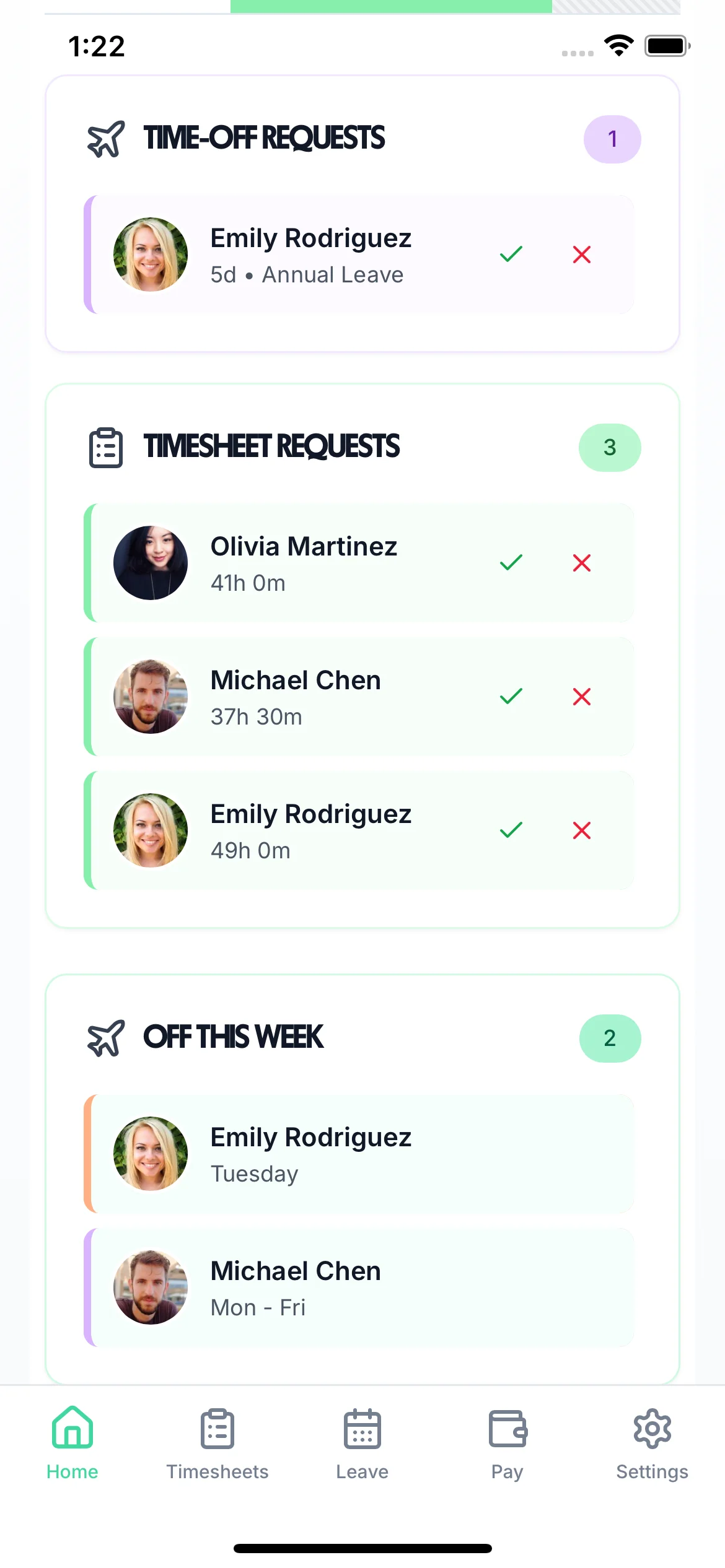
Workers see their shift schedule, leave balance, and timesheet in the TimeTally app — the same experience as your permanent employees.
Add zero-hours workers to the rota alongside permanent staff. They receive shift notifications and can confirm availability from their phone.
Export 52-week average pay data for holiday pay calculations under UK law. TimeTally gives payroll the accurate hours data they need.
Permanent staff, part-time staff, and zero-hours workers — all managed under one account without needing separate systems.
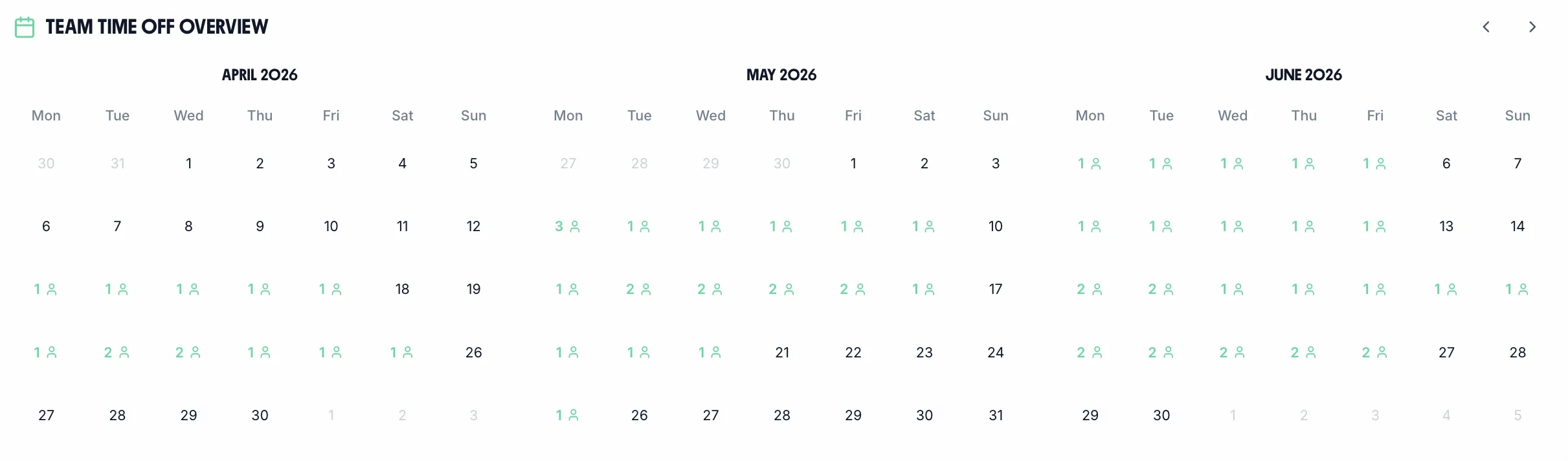
See zero-hours workers' leave bookings alongside permanent staff's annual leave and sick leave. One calendar for the whole team — no separate systems needed. Add zero-hours workers directly to the rota alongside your permanent staff.
Permanent and zero-hours staff visible together — complete staffing picture
Each worker's balance based on their actual hours — not a fixed entitlement
Hours and holiday data exported for payroll — including holiday pay calculations
Track statutory and contractual holiday entitlement, carry-over, and pro-rata calculations.
Record self-certified and doctor-certified sick leave. Track Bradford Factor scores automatically.
Accrue, request, and track time off in lieu from overtime and on-call callouts.
Create custom leave types for compassionate, bereavement, and other special circumstances.
Track maternity, paternity, and shared parental leave alongside regular annual leave.
Any custom leave type you need — configured with its own rules, entitlement, and approval flow.
One price for all employee types. No surprises.
Zero-hours workers have more employment rights than many employers realise — and the rules have tightened in 2025.
Most zero-hours contract holders fall into the 'worker' category under UK employment law — a status between employee and self-employed. Workers are entitled to the National Minimum Wage, paid annual leave, rest breaks, and whistleblower protection, but they do not have the full suite of employment rights. Critically, workers do not have the right to claim unfair dismissal unless they have two years' qualifying service as an employee. Correctly classifying zero-hours staff matters for both compliance and contractual drafting.
Since May 2015, exclusivity clauses in zero-hours contracts have been unenforceable under the Small Business, Enterprise and Employment Act 2015. An employer cannot contractually prevent a zero-hours worker from working for another employer during periods when they are not offered work. Workers dismissed or subjected to a detriment for working elsewhere are protected with day-one rights, with no qualifying period required. Zero-hours arrangements must be structured around genuine mutual flexibility.
Zero-hours workers who meet the 'worker' definition are entitled to the National Minimum Wage for all hours worked, 5.6 weeks' paid annual leave, 20-minute rest breaks when working more than 6 hours, and whistleblower protection. They are not, however, entitled to statutory sick pay (unless they also qualify as employees under certain tests), the right to request flexible working, or parental leave rights — those require employee status. Employers should not assume worker status strips all statutory obligations.
Continuity of employment is crucial for zero-hours workers who later gain employee status or seek statutory rights linked to length of service. Significant gaps between engagements — typically more than one week unless covered by a specific statutory exception — can break continuity. Broken continuity resets the clock for unfair dismissal protection and statutory redundancy pay qualification. Employers should document the pattern and nature of engagements to have a clear record if continuity is ever disputed.
Zero-hours workers who are classified as workers (rather than employees) have no statutory minimum notice entitlement when an engagement ends. However, if the zero-hours contract creates an employment relationship, statutory minimum notice under the Employment Rights Act 1996 applies after one month's service. Best practice is to include a defined notice clause in all zero-hours contracts to reduce ambiguity and prevent tribunal arguments about implied contractual terms.
Zero-hours workers must be paid at least the National Minimum Wage for every hour worked. Travel time counts as working time where the employer requires the worker to travel between assignments as part of the job — for example, a care worker travelling between client visits. Waiting time between assignments on-call at the employer's direction may also count, depending on the degree of control exercised. HMRC NMW enforcement focuses heavily on the care and hospitality sectors where zero-hours workers are common.
The Supreme Court's ruling in Harpur Trust v Brazel [2022] confirmed that employers cannot cap the statutory holiday entitlement of part-year workers — including those on zero-hours contracts with irregular or seasonal patterns — at 12.07% of hours worked. Such workers are entitled to the full 5.6 weeks, with pay calculated using the 52-week average reference period. The ruling means some workers with highly irregular or low-hour patterns may receive proportionally more holiday than hours worked would suggest.
Under the Employment Relations (Flexible Working) Act 2023 and associated regulations, workers who have worked a regular and consistent pattern for 26 or more weeks can request a more predictable contract that reflects those hours. Employers must respond to such a request within one month and can only refuse on specified grounds. This regularisation right represents a significant shift in the legal landscape for zero-hours arrangements and requires employers to monitor working patterns carefully.
Swipe to see more →
Zero-hours workers are entitled to 5.6 weeks' holiday per year under UK employment law, calculated on hours actually worked. In TimeTally, you can accrue holiday as a percentage of hours worked (12.07% is commonly used) so entitlement builds up accurately in proportion to hours actually put in.
Yes. Zero-hours workers have their own TimeTally profile and can submit leave requests, check their balance, and view their timesheet — using the same iOS app and web interface as permanent employees. Everything is managed in one system.
Holiday pay for zero-hours workers is based on average pay over the previous 52 weeks (under the Employment Rights (Amendment) Act 2023). TimeTally's timesheet data gives you the hours worked per week, which your payroll provider uses to calculate the average. Export the timesheet data directly to Xero or QuickBooks.
Yes. Zero-hours workers can be assigned to shifts in the rota software just like permanent staff. This gives them advance notice of their schedule and allows managers to see their availability alongside permanent team members.
Yes. Zero-hours workers have full self-service access through the TimeTally app. They can see their hours logged, leave balance, pending requests, and approved bookings — all in real time.
Zero-hours workers are charged at the same rate as permanent staff — £3 per employee per month. You only pay for employees who are active in the system, so you can add and remove zero-hours workers as your roster changes.
Still have a question? See all FAQs
A real person replies within 24 hours. No ticket queues, no bots.
A UK company, ICO regulated. Your data encrypted and never sold.