Free Rota Cost Calculator

Calculate your rota wage bill

Enter your staff count, hours per week, and hourly rates to instantly calculate your weekly, monthly, and annual wage bill — with per-employee breakdown in advanced mode.

5.0 · Used by 1,000+ UK businesses
Free to use
No sign-up required
2026 NMW rates built in

Stop estimating costs — track actual hours automatically

This calculator gives you an estimate. TimeTally tracks actual hours worked from your rota and exports directly to payroll — so your wage bill is always accurate, automatically. Works with rota management and timesheet tracking. From £2/employee/month.

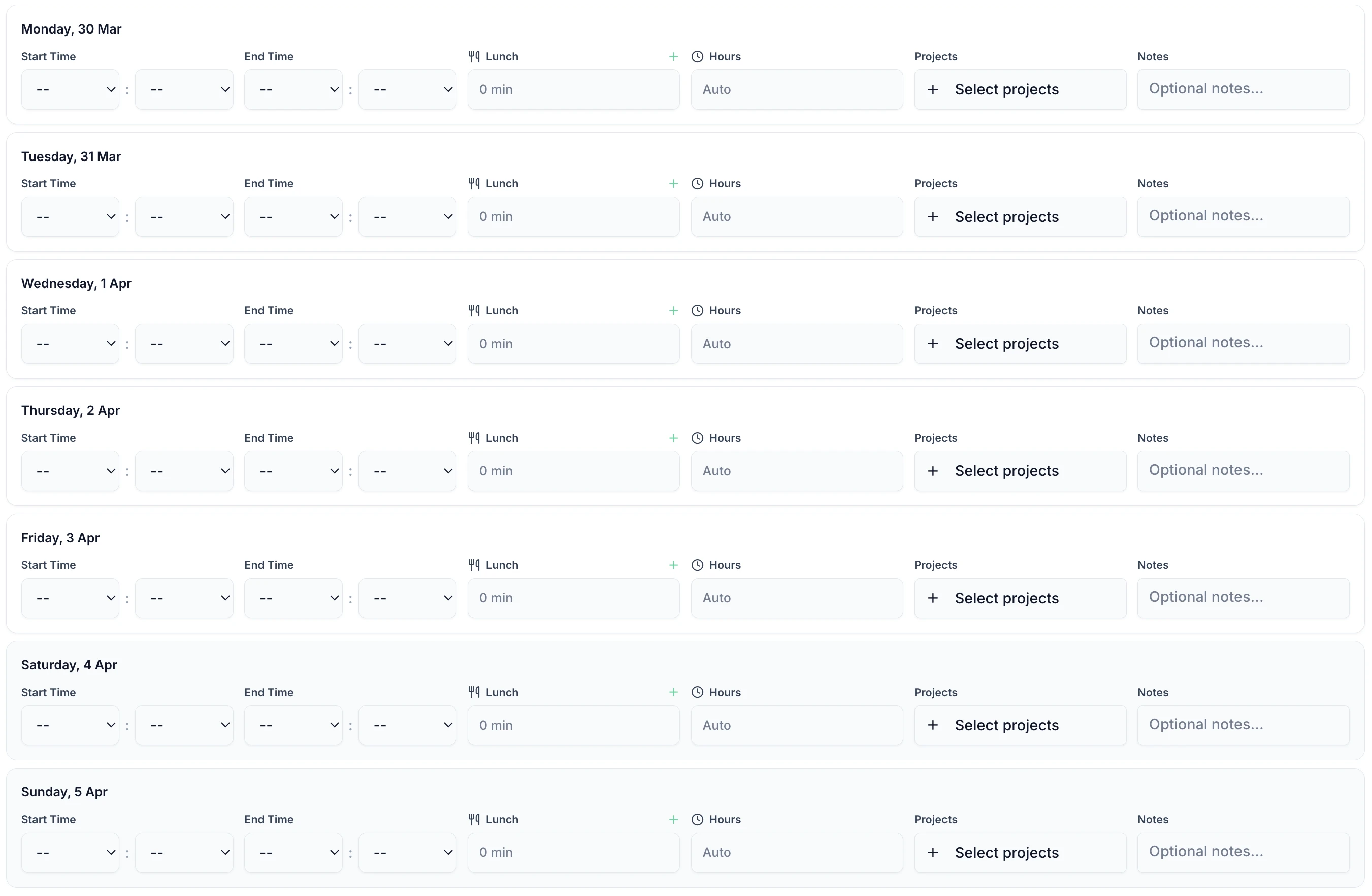
Build your rota and track actual hours worked

Staff clock in and out via the iOS app or web — automatically matched against your rota. Actual hours are recorded per shift, so your wage bill reflects what was really worked, not just what was planned.
Clock in/out
iOS & web
Auto overtime
Instant notifications
TimeTally timesheet entry showing clock in/out and hours worked against rota

Approve time in one tap

All pending timesheets land in your dashboard, matched against the rota. Approve or query with a single tap. Every decision is timestamped — a full audit trail for every shift and every pay period.
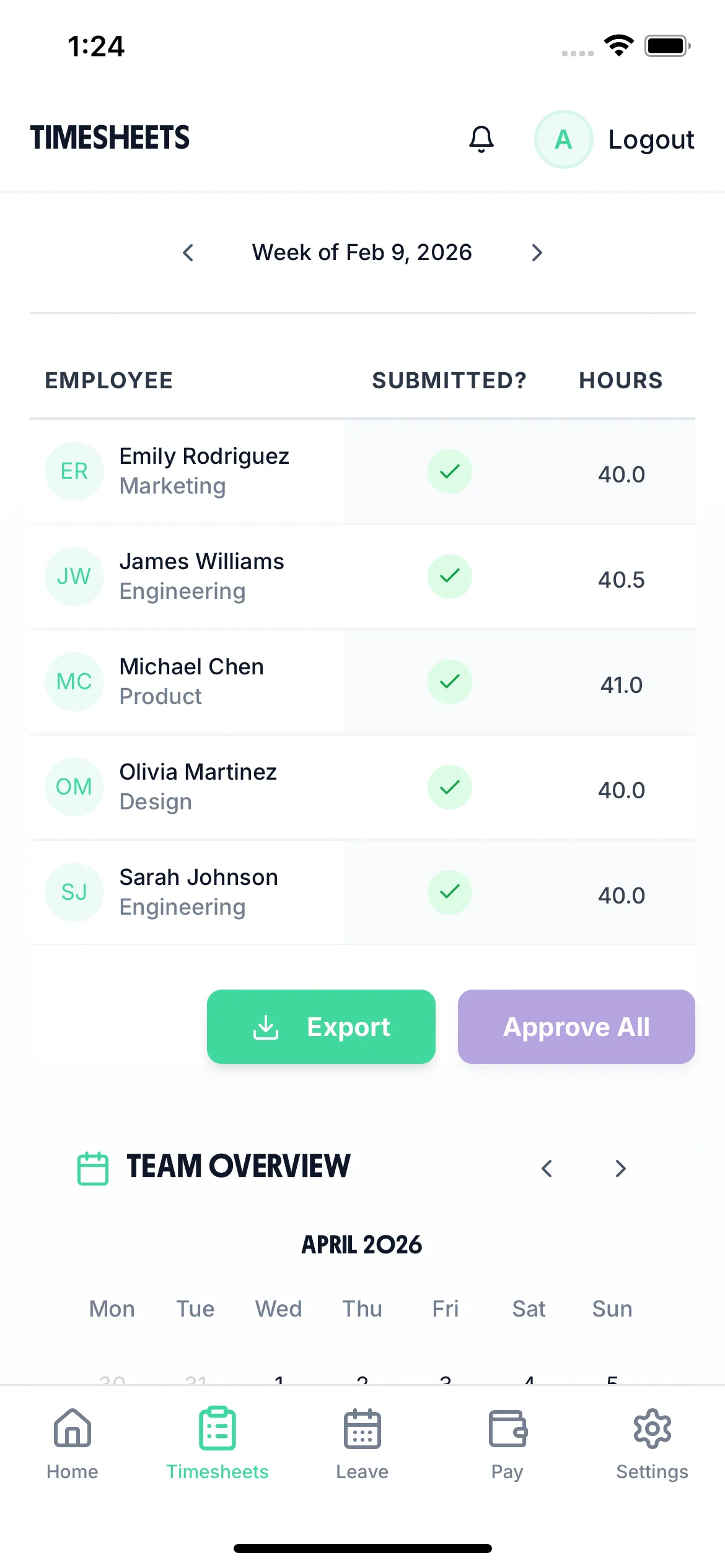
  • All pending timesheets in one place
  • Approve or query with one tap
  • Timestamped approval audit trail
  • Employee notified automatically
TimeTally iOS app showing employer timesheet approval for rota workers

Actual pay calculated from approved hours

Pay is calculated directly from approved time tracking. Hourly rates applied per employee, overtime calculated automatically. No manual adjustments, no errors — just accurate numbers for every pay run.
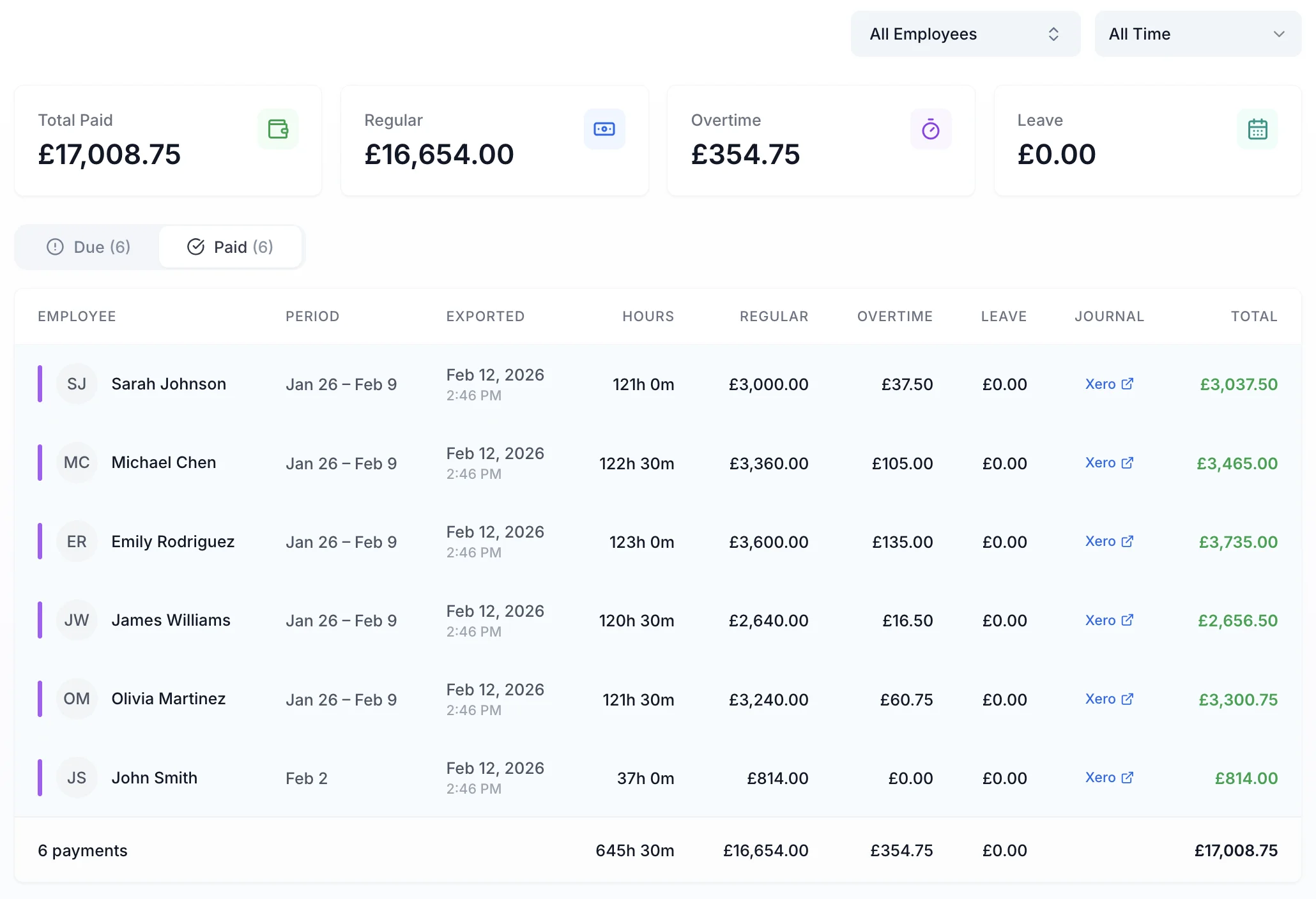
Per-employee rates
Auto overtime
Clean audit trail
No manual entry
TimeTally pay calculations showing actual hours and costs per employee

Hours flow straight to payroll

Approved hours feed directly into your payroll export. Direct integration with Xero and QuickBooks — no manual data entry, no missed shifts, no payroll errors.
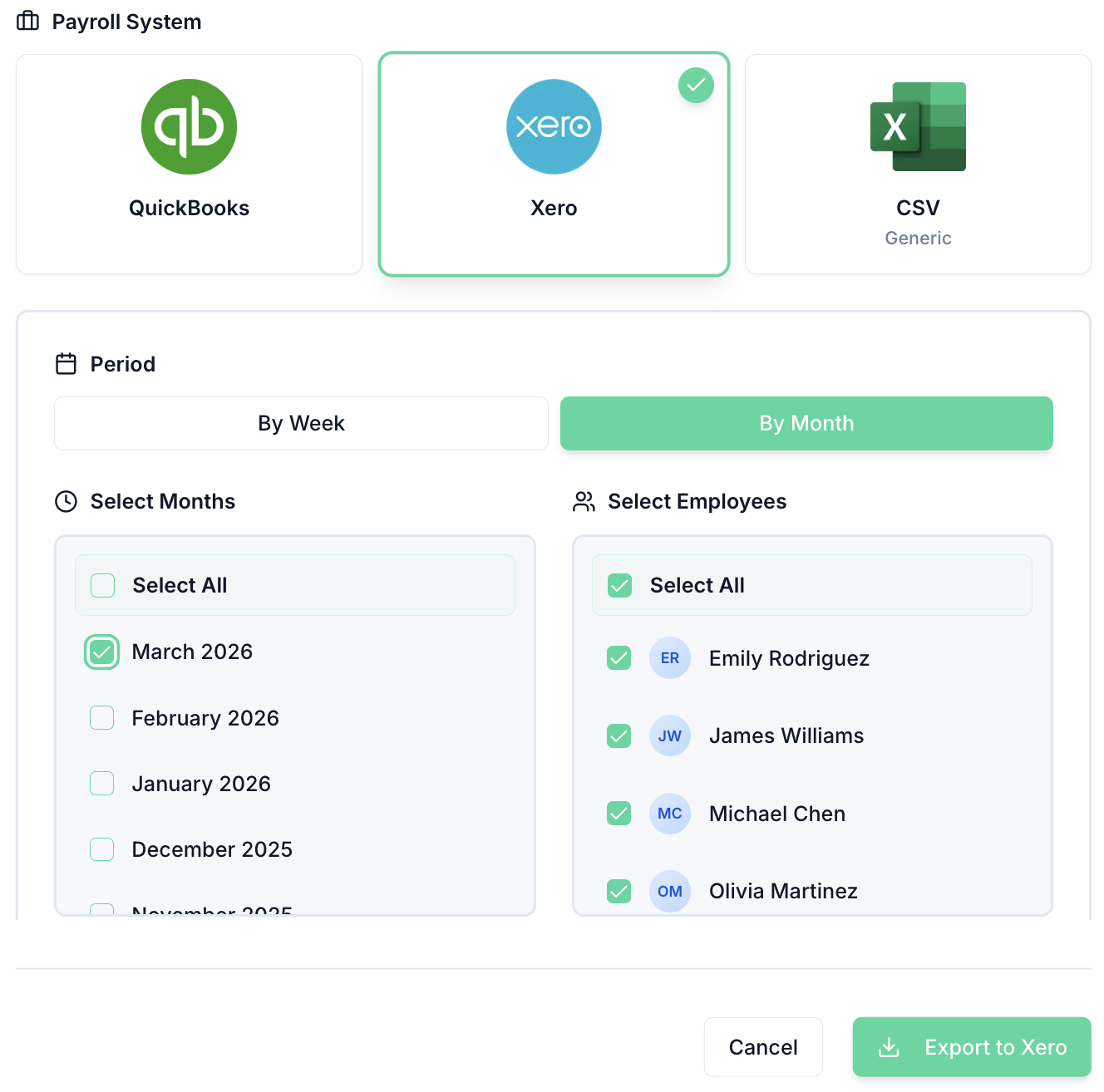
  • Direct Xero & QuickBooks integration
  • CSV export for any payroll software
  • Approved hours included automatically
  • Clean audit trail for every entry
TimeTally payroll export showing rota hours sent to Xero and QuickBooks
Meet TimeTally

Stop estimating costs manually
for every rota

TimeTally automatically tracks, approves, and calculates actual pay for your entire team — straight from your rota. Explore all features or see how it works.

Automatic wage calculations

Actual pay calculated from approved time tracking. Hourly rates applied per employee, overtime calculated automatically — no spreadsheets, no manual sums.

One-tap approvals

Managers approve or reject timesheets from any device, with a full audit trail of every decision timestamped and stored automatically.

Payroll-ready exports

Approved hours feed directly into Xero, QuickBooks, or CSV exports — so your payroll run reflects actual hours worked from the rota.

See what we offer

No credit card required · Set up in minutes · Cancel anytime

Loved by UK small businesses

Real reviews from TimeTally customers

Setup was dead simple and the team just got on with it. Got everyone up and running in an afternoon with no help needed. Does everything we need for timesheets and holidays without the faff.
SM

S.M.

Has completely changed how I handle timesheets. Used to dread it every week — now it takes me minutes. Really easy to get around and my staff picked it up straight away.
JT

J.T.

Started using it just for rotas but quickly realised it does loads more. The timesheets and leave management are great, and it even handles TOIL and overtime which I wasn't expecting. Use it for everything now.
RK

R.K.

Download on the App Store

Rota Cost Calculations: Frequently Asked Questions

Everything you need to know about calculating rota costs in the UK. For related topics, try our overtime pay calculator or hourly rate calculator.

How do I calculate my weekly wage bill?
Multiply each employee's contracted hours per week by their hourly rate to get their individual weekly cost. Sum all employees to get the total weekly wage bill. For example, five staff each working 37.5 hours at £13/hr gives a weekly wage bill of 5 × 37.5 × £13 = £2,437.50. Remember this is gross pay — you will also need to account for employer National Insurance contributions (13.8% on earnings above the Secondary Threshold) and pension contributions separately.
How do I calculate rota costs for shift workers?
For shift workers, calculate the cost per shift first: multiply the shift length in hours by the hourly rate for each employee covering that shift. Then sum across all shifts in the period. If employees work different patterns each week (for example, compressed hours or rotating shifts), use the actual hours scheduled per week rather than a fixed contracted hours figure. Tools like TimeTally can track actual hours against the planned rota automatically.
What is included in the wage bill?
The wage bill typically refers to gross pay — the total wages paid to employees before deductions. It does not include employer costs such as employer National Insurance contributions (currently 13.8% on earnings above the Secondary Threshold of £5,000/year), employer pension contributions (minimum 3% under auto-enrolment), or other on-costs such as training, uniforms, or recruitment. Total employment cost is typically 20–25% higher than the gross wage bill alone.
How do I account for overtime in rota costs?
If employees work hours beyond their contracted threshold and are entitled to overtime pay, you must include the overtime premium in your rota cost calculation. For example, if an employee works 5 hours of time-and-a-half overtime at a base rate of £13/hr, the overtime cost is 5 × £13 × 1.5 = £97.50, not 5 × £13 = £65. UK law does not require employers to pay a premium for overtime, but if the employment contract specifies an overtime rate, it must be honoured. The average hourly rate across all hours worked must also never fall below the National Minimum Wage.
What is the National Minimum Wage in the UK in 2026?
The National Minimum Wage (NMW) for workers aged 21 and over is £12.21 per hour from April 2025, which remains in effect in 2026. Separate rates apply to younger workers and apprentices: £10.00/hr for workers aged 18–20, £7.55/hr for workers aged 16–17, and £7.55/hr for apprentices in their first year or aged under 19. Employers must ensure that total pay divided by total hours worked — including any unpaid overtime — never falls below the applicable NMW rate. HMRC can impose back pay and financial penalties for non-compliance.
How do I calculate holiday pay costs for rota workers?
Under the Working Time Regulations 1998, all workers are entitled to a minimum of 5.6 weeks' paid holiday per year (equivalent to 28 days for someone working 5 days per week). For rota workers with variable hours, holiday pay is calculated as an average of earnings over the previous 52 weeks worked. This means your effective annual wage cost is higher than 52 weeks of contracted pay: multiply weekly wage cost by 52, then add the cost of holiday pay on top — approximately an additional 12.07% of pay for workers receiving the statutory minimum.
What is the difference between gross pay and total employment cost?
Gross pay is what an employee receives before income tax and National Insurance deductions. Total employment cost (sometimes called the 'on-cost') is what the employer actually pays and is significantly higher. It includes: gross pay, employer National Insurance contributions (13.8% on earnings above the Secondary Threshold of £5,000/year), employer auto-enrolment pension contributions (minimum 3% on qualifying earnings), and any other contractual costs such as enhanced sick pay or allowances. A quick estimate is to add approximately 20–25% to the gross wage bill to arrive at total employment cost.
How do I calculate the cost of a 4-on-4-off rota?
A 4-on-4-off rota involves employees working four consecutive shifts followed by four days off, repeating continuously. Over a 52-week year, an employee on 4-on-4-off works approximately 182.5 days (365 ÷ 2). If each shift is 12 hours, the annual hours worked are approximately 182.5 × 12 = 2,190 hours. Weekly cost is harder to express as a simple number because hours vary week to week, so calculate annual cost directly: 2,190 hours × hourly rate. Divide by 12 for a monthly figure or by 52 for a weekly average.
How much does it cost to staff a shift?
The cost of staffing a shift depends on: the number of employees required to cover the shift, the length of the shift in hours, and each employee's hourly rate. Multiply hours × rate for each employee covering the shift, then sum across all of them. For example, a 10-hour shift covered by three employees at £13/hr costs 3 × 10 × £13 = £390 in gross wages. Remember to factor in employer NI and pension contributions for the true cost to the business.
How do zero-hours contract workers affect rota costs?
Zero-hours contract workers are only paid for hours actually worked, so their cost varies week to week based on the hours allocated on the rota. This makes zero-hours workers more flexible in cost terms — you only incur wage costs for shifts that are rostered and worked. However, they are still entitled to National Minimum Wage for all hours worked, holiday pay accrued at 12.07% of pay (or the 52-week average pay method), and employer National Insurance and pension contributions apply in the same way as for contracted staff. Tracking actual hours for zero-hours workers is essential to ensure accurate pay calculations.

Related tools