Free TOIL Calculator UK

Free Calculator

Calculate your TOIL instantly

Hours banked
0
Hours used
7.5h
Balance
0d

0 hours × 1 rate = 0 hours TOIL ÷ 7.5h day = 0 days

OR
TimeTallyTimeTally Software

Track TOIL for your whole team automatically

Employees log overtime via the app. TOIL accrues automatically. You approve requests in one tap — no spreadsheets needed.

5.0 on the App Store
  • TOIL accrues automatically from approved overtime
  • Employees request TOIL via the iOS app
  • Manager approval with full audit trail
  • Maximum balance cap enforced automatically
TimeTally iOS app

Stop calculating manually — track TOIL automatically

This calculator gives you the numbers. TimeTally tracks overtime hours, TOIL balances, and approvals automatically — so you never need to calculate it manually again. From £2/employee/month.

Employees submit time tracking from anywhere

Staff submit time tracking via the iOS app or web. Clock in/out is tracked automatically. Overtime hours are identified and flagged — no paper forms, no chasing.

Clock in/out
iOS & web
Auto overtime
Instant notifications
TimeTally timesheet entry showing clock in/out and overtime hours

Review and approve time tracking in one tap

All pending time tracking land in your dashboard. Approve or query with a single tap. Every decision is timestamped — full audit trail for every timesheet.
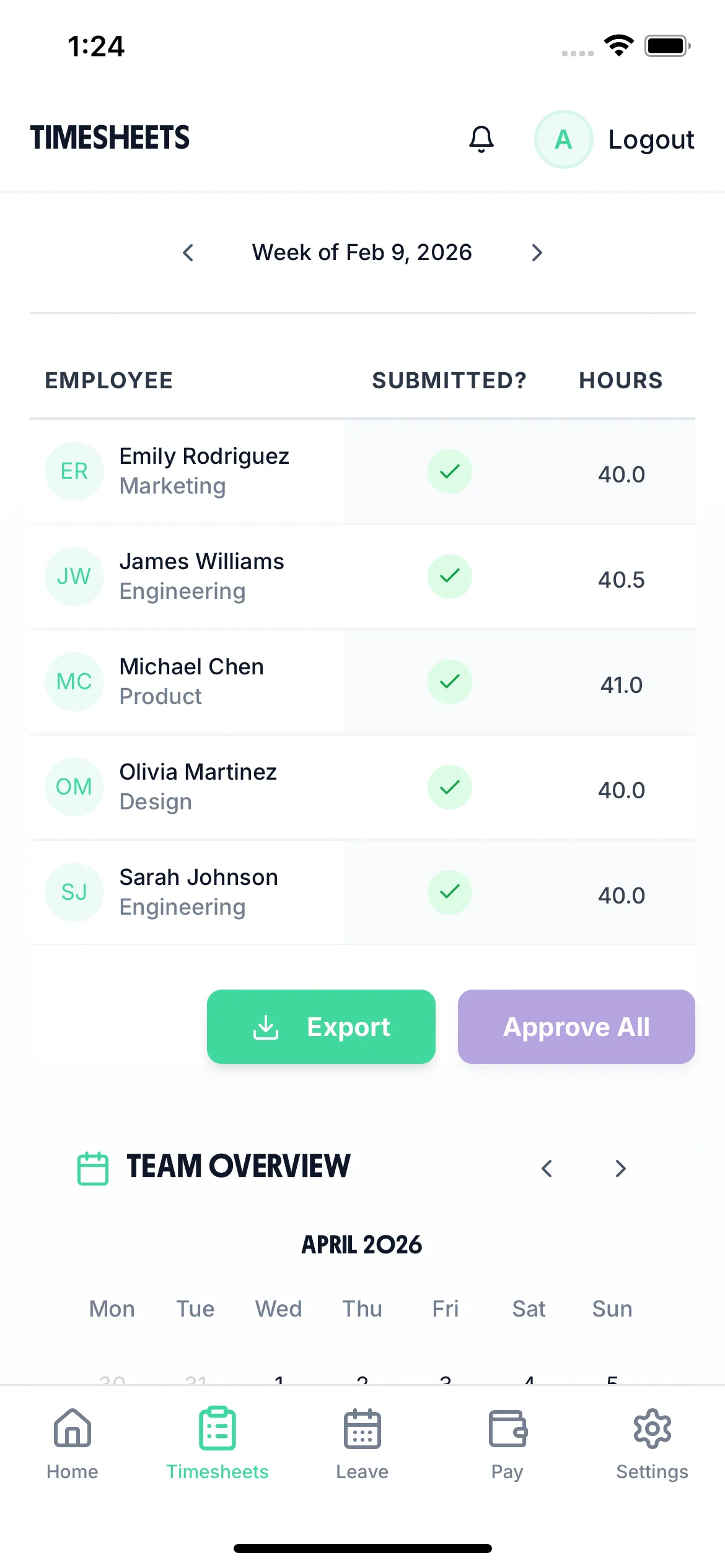
  • All pending time tracking in one place
  • Approve or query with one tap
  • Timestamped approval audit trail
  • Employee notified automatically
TimeTally iOS app showing employer timesheet approval

TOIL balances tracked automatically

TOIL accrues from approved overtime time tracking at your configured rate. Employees see their live balance. Expiry caps enforced automatically — no spreadsheets needed.
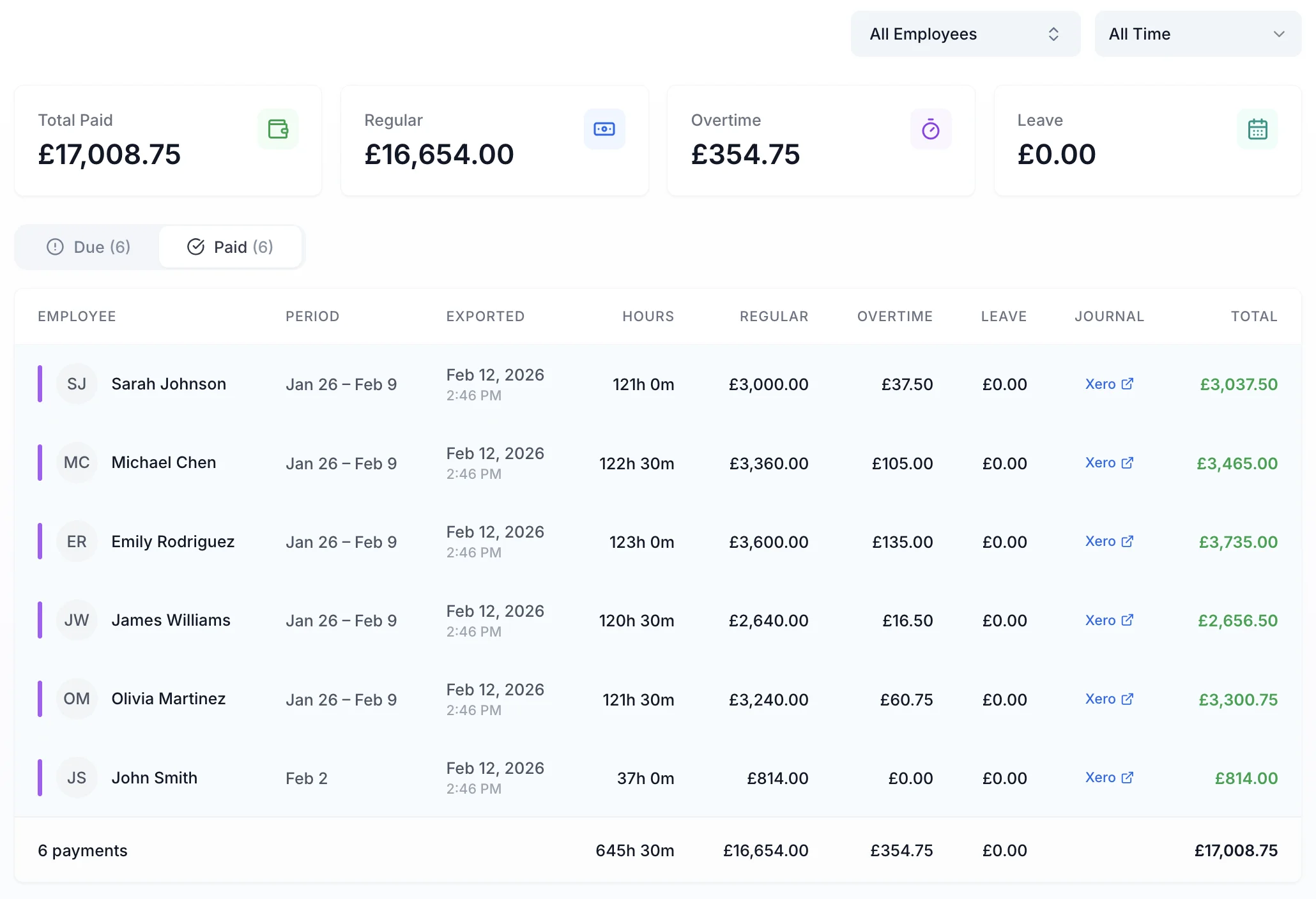
Auto TOIL accrual
1:1 or 1.5:1 rate
Balance expiry cap
Live balance view
TimeTally dashboard showing TOIL balances tracked from approved time tracking

Hours data flows straight to payroll

Approved time tracking feed directly into your payroll export. Direct integration with Xero and QuickBooks — no manual data entry, no missed overtime.
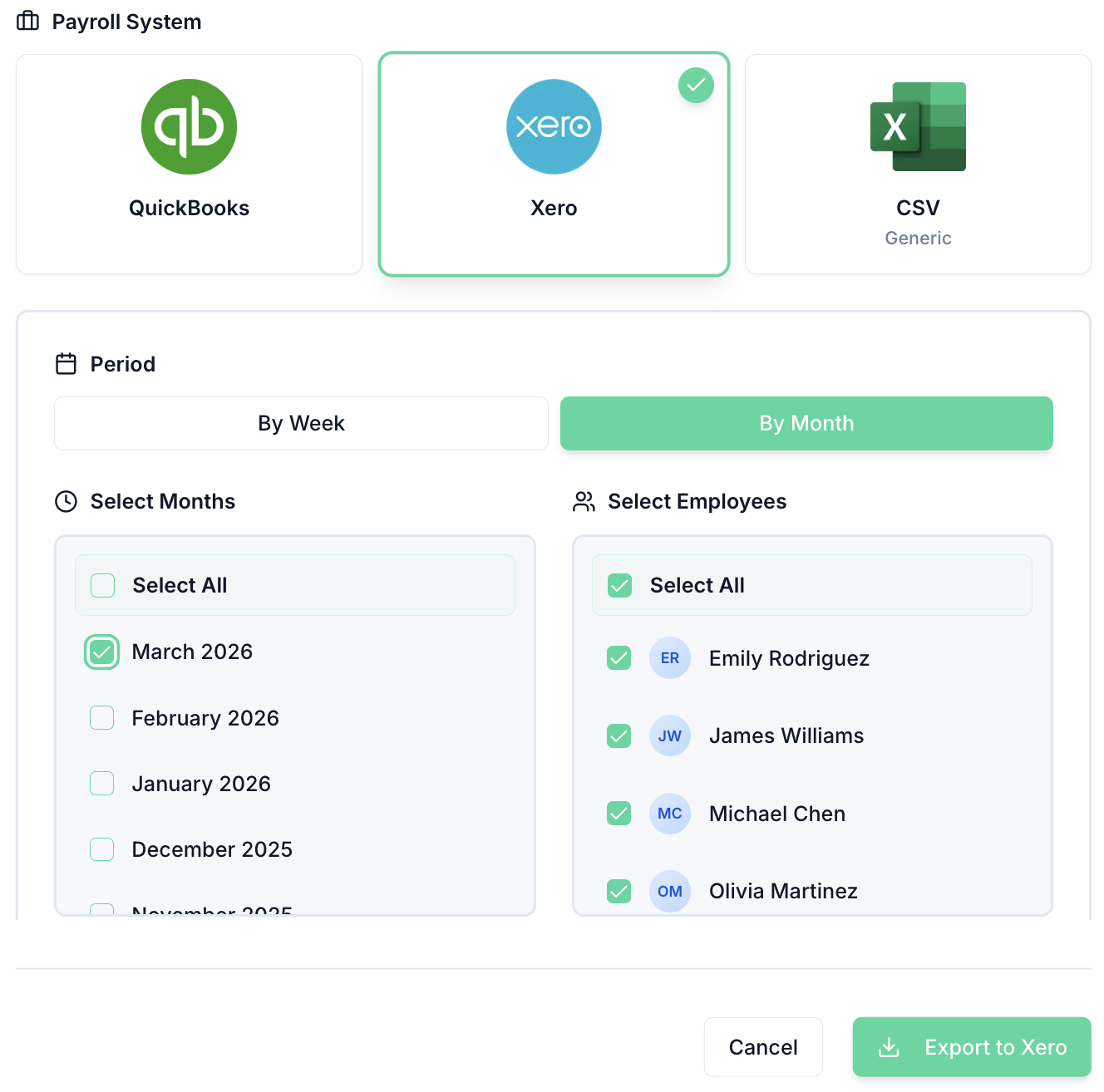
  • Direct Xero & QuickBooks integration
  • CSV export for any payroll software
  • Approved hours included automatically
  • Clean audit trail for every entry
TimeTally payroll export showing hours data sent to Xero and QuickBooks
Meet TimeTally

Stop doing this manually
for every employee

TimeTally automatically tracks overtime, accrues TOIL, and manages approvals for your entire team. Explore all features or see how it works.

Automatic calculations

Overtime rates and TOIL calculated automatically from approved time tracking. Regular hours and overtime tracked separately — configured at 1:1, 1.5:1, or 2:1 to match your policy.

One-tap approvals

Managers approve or reject time tracking from any device, with a full audit trail of every decision timestamped and stored automatically.

Payroll-ready exports

Approved hours feed directly into Xero, QuickBooks, or CSV exports — so your payroll run is always accurate and on time.

See what we offer

No credit card required · Set up in minutes · Cancel anytime

Loved by UK small businesses

Real reviews from TimeTally customers

Setup was dead simple and the team just got on with it. Got everyone up and running in an afternoon with no help needed. Does everything we need for timesheets and holidays without the faff.
SM

S.M.

Has completely changed how I handle timesheets. Used to dread it every week — now it takes me minutes. Really easy to get around and my staff picked it up straight away.
JT

J.T.

Started using it just for rotas but quickly realised it does loads more. The timesheets and leave management are great, and it even handles TOIL and overtime which I wasn't expecting. Use it for everything now.
RK

R.K.

Download on the App Store

TOIL: Frequently Asked Questions

Everything you need to know about Time Off In Lieu in the UK. For related topics, try our overtime pay calculator or working hours calculator.

What is Time Off In Lieu (TOIL)?
Time Off In Lieu (TOIL) is compensatory time off given to employees in exchange for overtime they have worked. Instead of receiving extra pay for overtime hours, the employee accrues equivalent paid time to take as leave at a later date. The term 'in lieu' means 'instead of' — so TOIL is time off instead of overtime pay.
Is TOIL a legal right in the UK?
No. There is no UK legislation that gives employees a statutory right to TOIL. It is a contractual arrangement between employer and employee. It must be agreed in writing — either in the employment contract or a separate TOIL policy. However, even with TOIL arrangements in place, the Working Time Regulations 1998 still apply and average weekly hours must not exceed 48 (unless the employee has opted out in writing).
What is a 1:1 vs 1.5:1 TOIL rate?
The accrual rate determines how much TOIL an employee earns for each overtime hour worked. At 1:1 (hour for hour), 2 overtime hours earns 2 hours of TOIL. At 1.5:1 (time and a half), 2 overtime hours earns 3 hours. At 2:1 (double time), 2 overtime hours earns 4 hours. Enhanced rates are often used for weekends, bank holidays, or unsociable hours to recognise the inconvenience.
Can TOIL expire?
TOIL expiry depends entirely on the terms agreed between employer and employee. Many employers set a deadline — typically 3 to 6 months from when the TOIL was accrued — after which unused TOIL is forfeited. There is no legal requirement for TOIL to carry over (unlike statutory annual leave). Any expiry terms must be clearly set out in the TOIL policy or contract.
Does TOIL have to comply with the National Minimum Wage?
Yes. Even when an employee takes TOIL instead of overtime pay, the overall pay package must still meet NMW requirements. If giving TOIL rather than pay means the employee's effective hourly rate drops below the applicable NMW rate for the hours actually worked, the employer is in breach. Accurate timesheet records are essential to demonstrate compliance.
What is the difference between TOIL and overtime pay?
Overtime pay gives the employee extra money for overtime hours — typically at a premium rate such as 1.5x or 2x their normal hourly rate. TOIL gives the employee extra time off instead. Both are alternatives for compensating overtime. The choice between them depends on what is agreed in the employment contract. Neither is a statutory right — both must be contractually agreed.
Can zero-hours workers accrue TOIL?
Yes, in principle. Zero-hours workers can accrue TOIL if their contract allows for it and if an overtime threshold is defined. However, defining 'overtime' for zero-hours workers can be tricky since there are no guaranteed hours. Any TOIL arrangement for zero-hours staff should be carefully worded in the contract to avoid ambiguity about when TOIL is triggered.
Must TOIL be written into the contract?
Best practice is to include TOIL arrangements in the employment contract or a separate written TOIL policy. This should cover: whether TOIL is available, the accrual rate, any cap on how much can be banked, the expiry window, and how TOIL requests are made and approved. Without written terms, disputes about TOIL entitlement are difficult to resolve.
How do employees take TOIL?
Employees request TOIL time off the same way they would request annual leave — usually by submitting a request to their manager in advance. The employer can set reasonable notice requirements and refuse requests during busy periods, provided this is stated in the TOIL policy. TOIL should be deducted from the employee's balance at the point of taking it, not at the point of requesting it.
What records do employers need to keep for TOIL?
Employers should keep records of: overtime hours worked (with dates and duration), TOIL accrued per employee, TOIL taken and remaining balances, and any requests and approvals. These records should be kept for at least 2 years (the statutory minimum for pay records). Timesheet software like TimeTally creates this audit trail automatically as part of the normal approval workflow.

Related tools