
Rota Planning
Rota PlannerSchedule shifts and manage your teamTime & Attendance
Time TrackingTimesheets, clocking in, and moreView all features One plan · £3 per employee per month
Free NI Calculator
Calculate employee and employer National Insurance contributions instantly. Updated for 2026/27: employees pay 8% between £12,570 and £50,270 and 2% above; employers pay 15% above £5,000.
Employee NI
Taken from their pay
£1,394.40 a year
£116.20 a month · £26.82 a week
Their pay after NI£28,605.60
Employer NI
Paid by you, on top
£3,750.00 a year
£312.50 a month · £72.12 a week
What they cost you£33,750.00
Total NI £5,144.40 a year. Effective employee rate: 4.6% of gross annual salary.
Employer NI starts at £5,000 a year (cut from £9,100 in April 2025, unchanged for 2026/27). Worked out on the annual figure; payroll works it out each pay period.
Your answer, band by band
Of £30,000 a year, the employee pays 0% on £12,570 and 8% on £17,430: £1,394.40 of employee NI. You pay 0% on £5,000 and 15% on £25,000: £3,750.00 of employer NI, on top of the salary.
Employee pays£1,394.40
You pay£3,750.00
Each pay period, payroll uses the same thresholds split by period: employee NI from £242 a week or £1,048 a month, 2% above £967 a week or £4,189 a month; employer NI from £96 a week or £417 a month. Category A unless you pick under 21.
Employees pay 8% on earnings between £12,570 and £50,270 a year and 2% on anything above £50,270. Employers pay 15% on everything above £5,000 a year, on top of the salary. The rates and thresholds are the same as 2025/26. Payroll works NI out each pay period, so the yearly figures here assume the salary is paid evenly.
Worked example: £30,000 a year, paid evenly, category A
Employee NI £1,394.40 a year (about £116.20 a month); employer NI £3,750.00 a year before any Employment Allowance.
Who works out what on a payslip
This calculator gives you the figures. TimeTally tracks hours, approvals, and pay automatically — so you have HMRC-compliant records for every employee, every pay period. From £3/employee/month.
Employer NI, paid by you, not on the payslip(£518.75 − £96) × 15%£63.41
NI on a weekly payslip is worked out on the weekly thresholds: £242 for employee NI and £96 for employer NI.
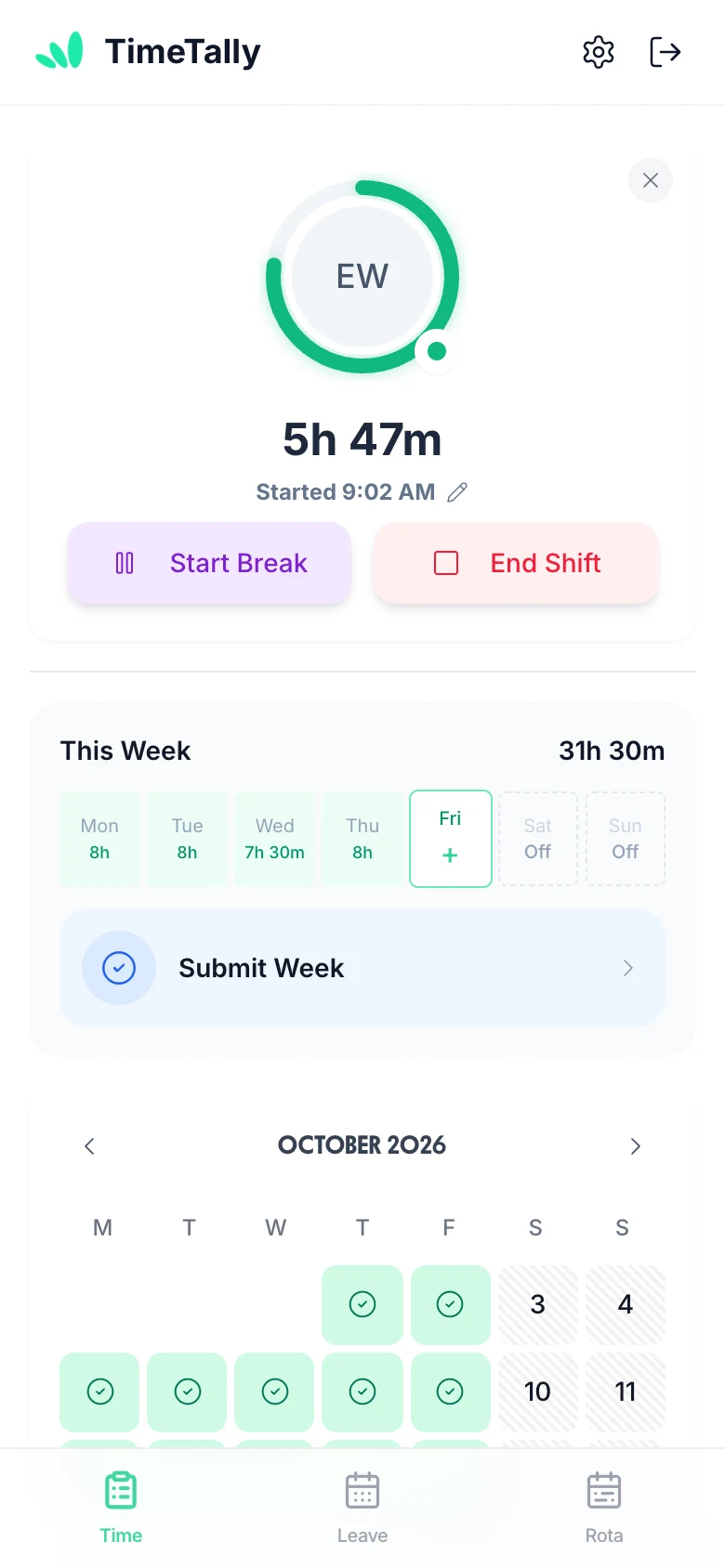
Staff submit timesheets via the iPhone or Android app. Hours are tracked automatically and approved by managers. When payroll day comes, your records are already accurate and HMRC-compliant.
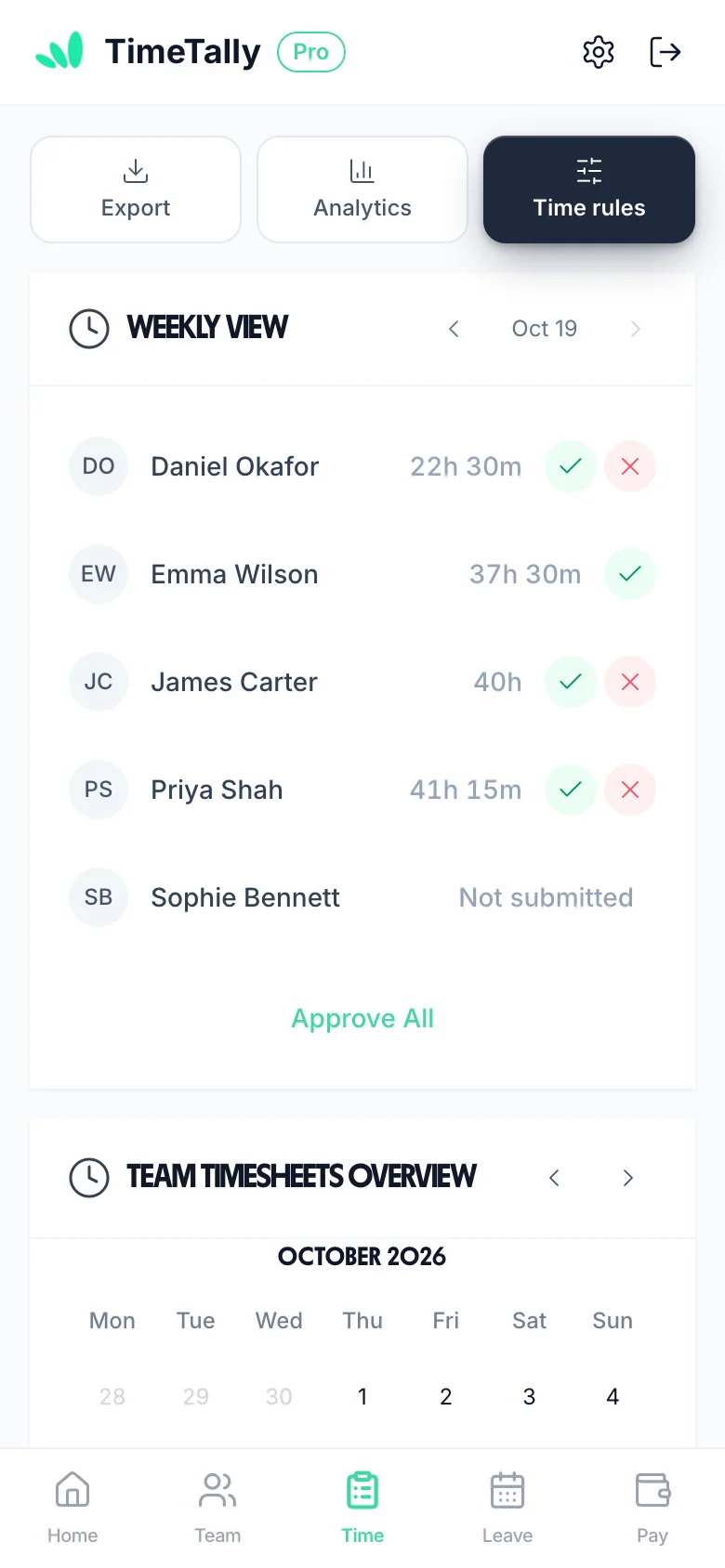
All pending timesheets land in one dashboard. Approve or reject with a single tap. Every decision is timestamped — a full audit trail for every pay period.
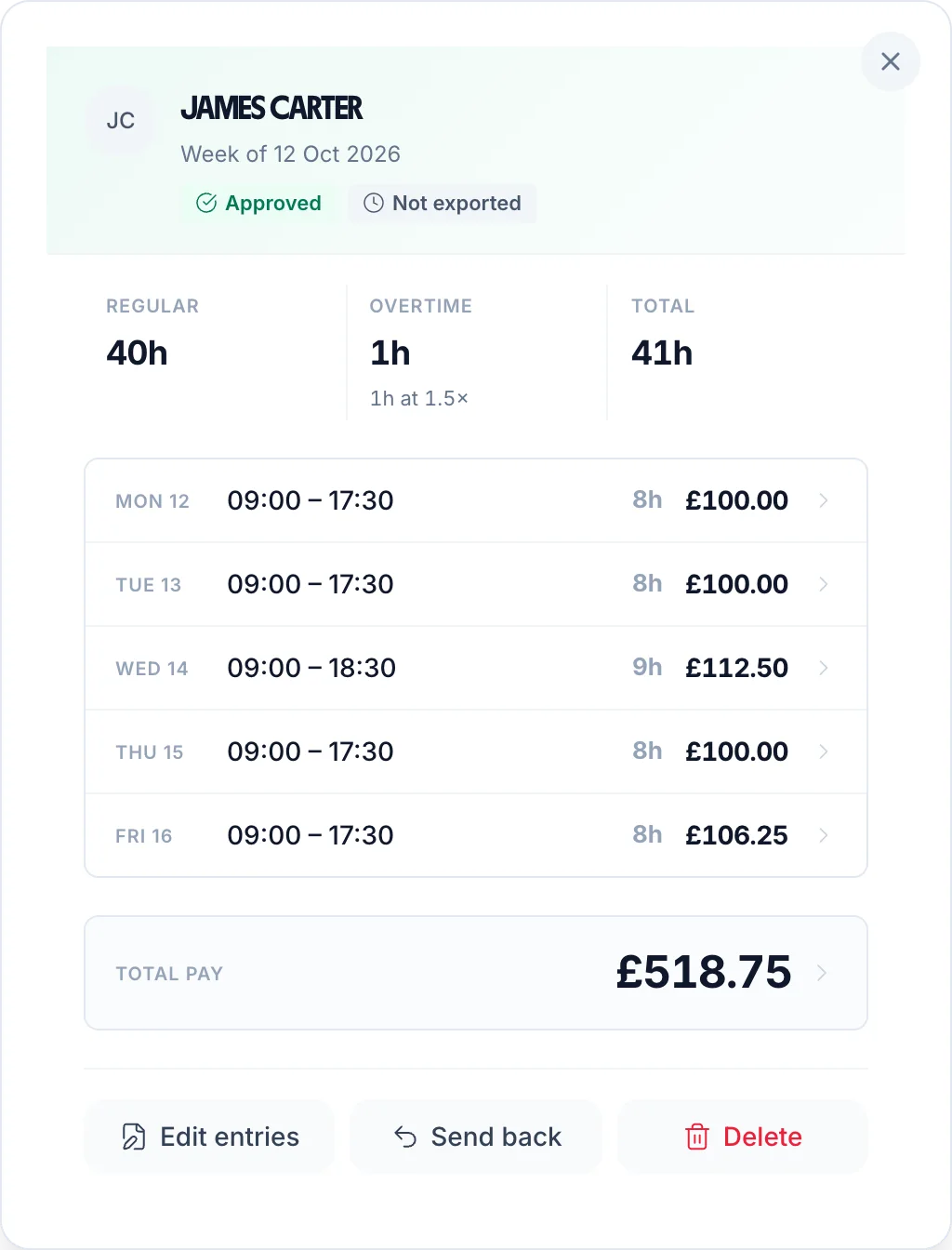
Pay is calculated directly from approved timesheets. See the full pay breakdown for every employee before you export, with regular and overtime hours split. No manual adjustments.
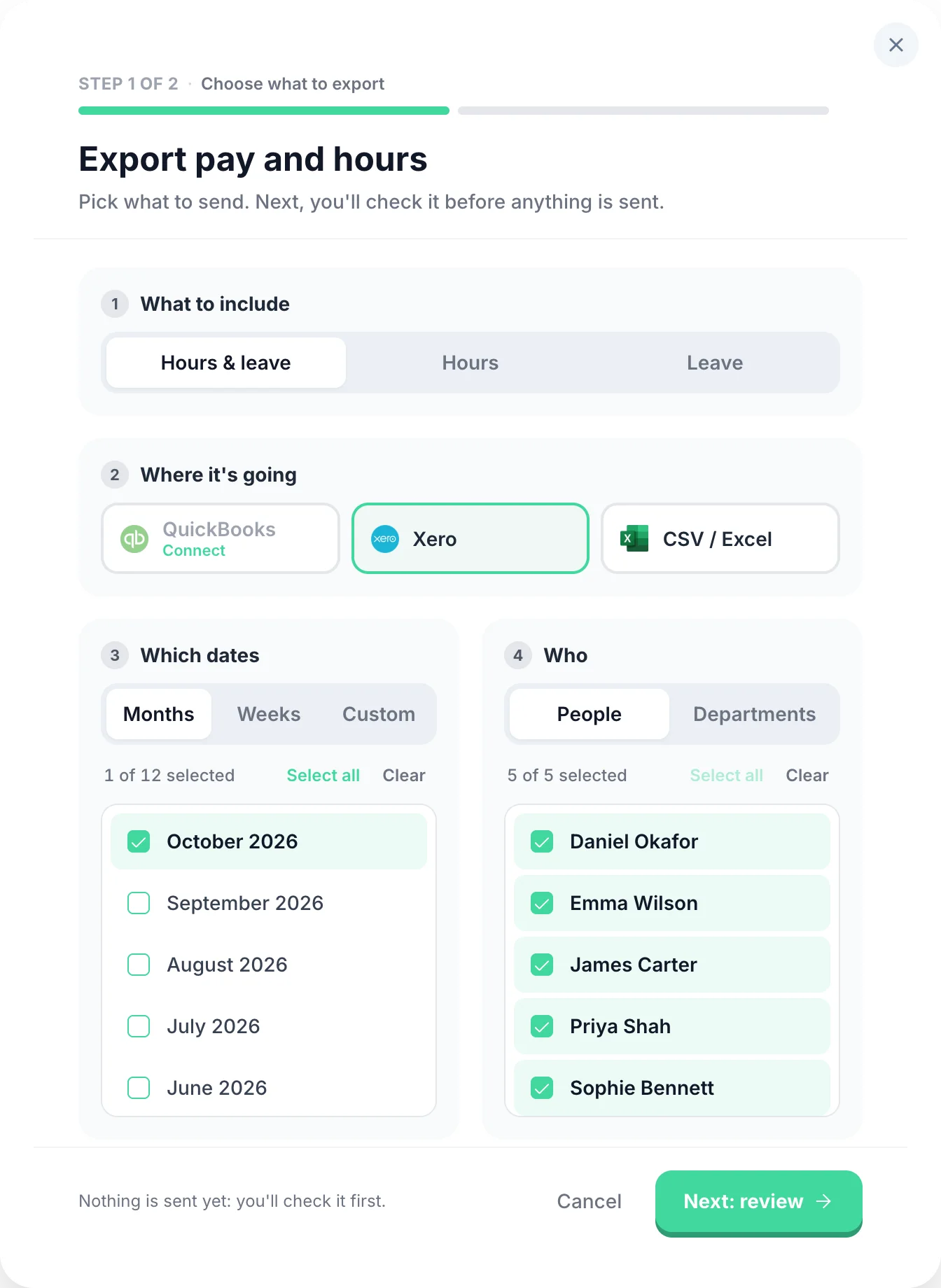
TimeTally doesn't run payroll or calculate National Insurance. It sends each person's approved hours and gross pay to your payroll as a CSV, or to Xero or QuickBooks as a wage journal, and you check it before anything is sent. Your payroll software applies the thresholds above every pay period.
TimeTally exports each pay period to Xero, QuickBooks or CSV, so gross pay is right before NI is ever calculated.
Select any feature for the detail.
Overtime that works itself out.
Two triggers: threshold overtime kicks in once an employee exceeds a set number of hours per day or week. Time-of-day overtime pays a premium for hours worked in a specific window (e.g. after 6pm or before 6am), regardless of total hours. Two pay methods: a rate multiplier (e.g. 1.5×) or a fixed hourly rate for overtime hours. Stack multiple rules, build tiers, and configure each employee independently.
Know exactly where the hours went.
Entirely optional — only enable it if you need it. When on, employees split their hours across projects when submitting (e.g. 3h on Client A, 4h on internal work). You can set project pay for the worker: an hourly rate on top of or instead of their usual rate, or a flat fee per entry (useful for callouts or site visits). Managers get a clear breakdown of where time is actually going.
Offer time off instead of overtime pay.
An optional alternative to paying overtime — enable it only if you want to offer time off in lieu instead of (or alongside) extra pay. Set a TOIL conversion rate (e.g. 1h overtime = 1.5h leave) and overtime hours automatically accrue as a TOIL balance — no manual tracking. TOIL is kept separate from annual leave so it never eats into holiday entitlement. Employees book it the same way they book any other leave.
Approve a whole week from your phone.
Managers approve or reject timesheets from any device — phone, tablet, or desktop. Rejections include a written reason so employees know exactly what needs fixing and can resubmit. Managers can see who has not submitted for the period, and are emailed as each timesheet comes in. Pay totals are calculated automatically from approved hours — no manual maths at payroll time.
Clock in, or fill in a form.
Two submission modes — employees use whichever fits their workflow. Clock-in mode starts a live timer the moment they begin their shift. The timer runs in the background even if the app is closed, so no hours are lost. Form mode lets them enter start time, end time, and breaks at the end of the day or week. Both work on mobile and desktop.
Every hour costed at the right rate.
Set each employee's own hourly rate and pay totals are calculated automatically from their approved hours. Scope managers to their department so they only ever see their own team's data. Want to keep salaries private? Hide pay rates and totals from managers entirely — they see hours, but never figures. Full control over who sees what.
Straight into Xero or QuickBooks.
Send approved timesheets to payroll in a few taps. Export to CSV, Xero, or QuickBooks — filter by date range, employee, or department, and choose exactly which columns to include. You can combine timesheet and leave data in a single export so your payroll software gets everything it needs in one file.
“TimeTally has been excellent for our business. The app is simple to use, reliable, and makes managing staff records straightforward. The system has saved us a significant amount of administration time. Highly recommended for any business looking for an easy-to-use workforce management solution.”
 Jordan Ingoe, CLI Manchester
Everything employers and employees need to know about NI for 2026/27. For related topics, try our minimum wage calculator or overtime pay calculator.
National Insurance (NI) is a tax on earnings paid by employees and employers in the UK. Employee NI funds the NHS, state pension, and certain benefits. Employer NI is a separate charge on top of gross wages — it is not deducted from the employee's pay but is an additional cost for the employer. Both are collected via PAYE alongside Income Tax.
Employees pay 0% on earnings below £12,570/year (the Primary Threshold), 8% on earnings between £12,570 and £50,270 (the Upper Earnings Limit), and 2% on everything above £50,270. These are the Class 1 rates for 2026/27, unchanged from 2025/26. NI is calculated on each pay period's earnings, not on the annual total, though the thresholds are scaled proportionally.
Employers pay 15% on each employee's earnings above £5,000/year (the Secondary Threshold). From 6 April 2025 the threshold fell from £9,100 to £5,000 and the rate rose from 13.8% to 15% (announced in the October 2024 Budget); both stay the same for 2026/27. For an employee on £25,000 a year, employer NI went from £2,194.20 ((£25,000 − £9,100) × 13.8%) to £3,000.00 ((£25,000 − £5,000) × 15%), £805.80 more. Employers pay 0% up to £50,270 for employees under 21 and apprentices under 25.
Eligible employers can take up to £10,500 a year off their employer NI bill in 2026/27 (it rose from £5,000 in April 2025). Since April 2025 there is no longer a £100,000 limit on the previous year's employer NI bill. A company whose only employee paid above the secondary threshold is its sole director cannot claim, and only one company in a group can. The Employment Allowance is claimed through your payroll software and offsets your employer NI liability each month until the allowance is used up.
NI is deducted via PAYE each pay period and paid to HMRC by the 19th of the following month (22nd if paying electronically). It is not paid separately from Income Tax — both go through your payroll run as a single PAYE payment. Most payroll software, and integrations like Xero and QuickBooks, calculate NI automatically.
Class 1 NI applies to employees who earn above the relevant thresholds. Workers under 16 are exempt from employee NI. Employees who have reached State Pension age no longer pay employee NI, though employer NI still applies. Some limited-hours or low-earnings workers may fall below the thresholds. Self-employed workers pay Class 4 NI (and Class 2 only voluntarily, since April 2024), not Class 1 — these are different rates and thresholds.
Still have a question? All UK statutory rates for 2026/27 →
Book a DemoCheck National Minimum Wage and National Living Wage rates from April 2026
Calculate time and a half and double time pay for UK employees
Calculate SSP for UK employees under the April 2026 rules
Calculate UK statutory redundancy pay based on age and service
Last checked against GOV.UK: 2 October 2026
Category A (most employees). Yearly figures assume the salary is paid evenly; payroll calculates NI each pay period. This calculator is a guide, not tax advice.
Timesheets, approvals and payroll exports in one place, from £3 per employee a month.
No credit card required · Set up in minutes · Cancel anytime