Track unpaid leave alongside annual leave, sick leave, and every other absence type. Keep payroll accurate, see all absences on one team calendar, and maintain complete records.
Tap a card to read the detail.
14-day free trial · No credit card needed
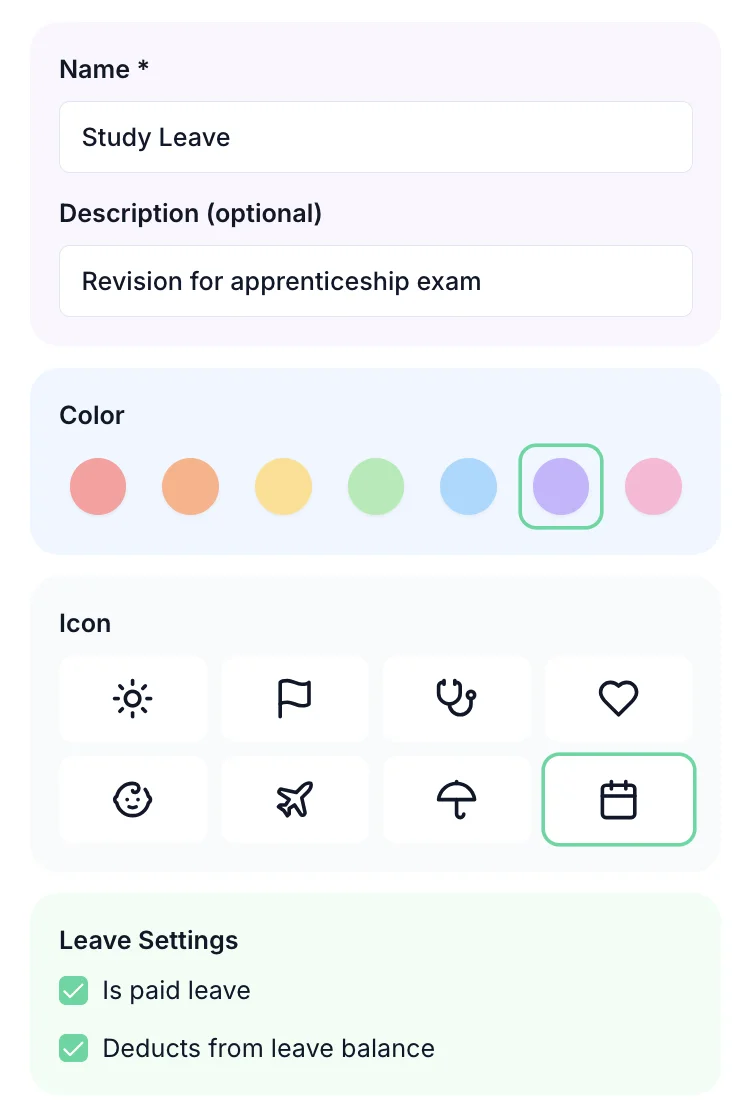
Create a custom “Unpaid Leave” type in TimeTally so unpaid absences are recorded separately from annual leave and other paid time off. This gives your payroll team clear data on which days to deduct, and gives managers accurate records for leave management.
Separate from paid leave
Unpaid leave appears in its own colour on the calendar — never mixed up with paid annual leave
Multiple unpaid types
Create separate types for unpaid parental leave, sabbaticals, career breaks, or general unpaid leave
Approval workflow
Unpaid leave requests go through the same approval process as all other leave types
Unpaid leave directly affects pay. Tracking it separately and accurately prevents payroll errors and employee disputes.
When unpaid leave is tracked separately, your payroll team knows exactly which days to deduct. No more guesswork or manual cross-referencing with managers.
Export unpaid leave data directly to your payroll software. TimeTally integrates with Xero and QuickBooks, or you can export via CSV for any other payroll system.
With a clear record of which days were unpaid, there are no surprises on pay day. Both employer and employee can see the data that payroll is based on.
Payroll integrations: TimeTally integrates with Xero and QuickBooks to streamline payroll processing. Learn more about our payroll integrations or explore our leave management software for the full picture.
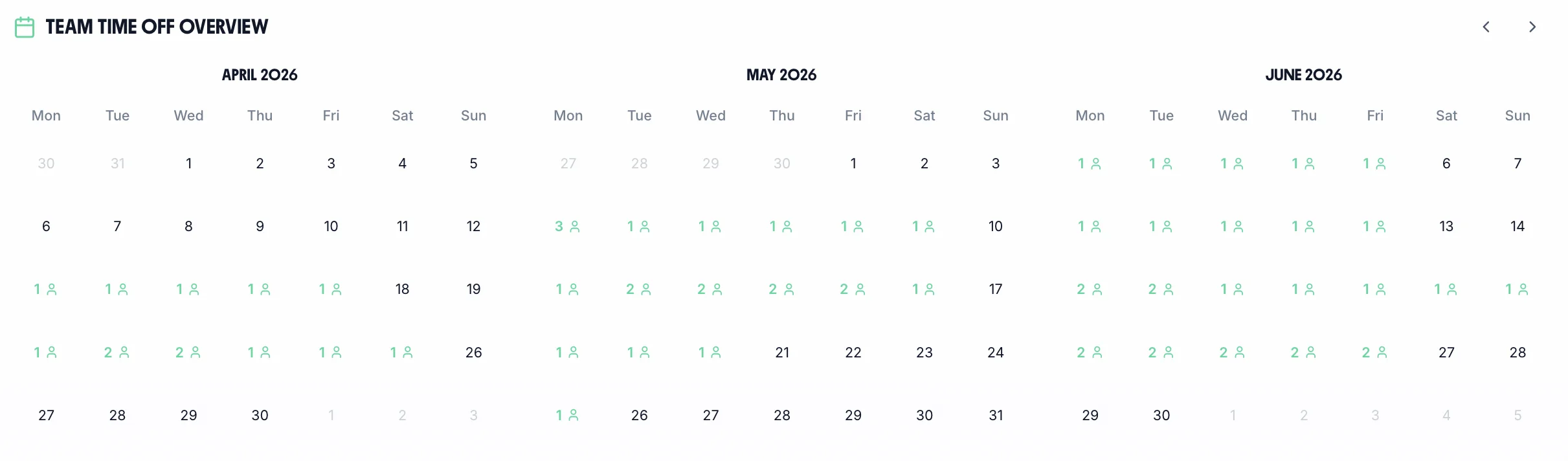
Unpaid leave, paid annual leave, sick leave, TOIL, compassionate leave — all visible on one team calendar with distinct colours. Managers get a complete view of who is off and why, regardless of whether the absence is paid or unpaid.
Without proper tracking, unpaid leave causes payroll headaches and confusion.
Unpaid days are recorded as annual leave or not recorded at all. Payroll processes them as paid, costing the business money and creating corrections later.
Nobody tells payroll about the unpaid days. The employee receives full pay and the correction has to be made the following month — frustrating for everyone.
Unpaid leave is agreed verbally but never logged. When questions arise about pay or entitlement, there is no evidence of what was agreed.
Unpaid leave is not visible on any shared calendar. Colleagues are surprised when someone does not show up, and cover is not arranged in advance.
Track statutory and contractual holiday entitlement, carry-over, and pro-rata calculations.
Record self-certified and doctor-certified sick leave. Track Bradford Factor scores automatically.
Accrue, request, and track time off in lieu from overtime and on-call callouts.
Create custom leave types for compassionate, bereavement, and other special circumstances.
Track maternity, paternity, and shared parental leave alongside regular annual leave.
Any custom leave type you need — configured with its own rules, entitlement, and approval flow.
One price. Every feature. No surprises.
UK unpaid leave law is more detailed than most managers realise. Here's what the rules actually say.
Employees with at least one year's service can take up to 18 weeks of unpaid parental leave per child, up to the child's 18th birthday. A maximum of 4 weeks can be taken per year unless the employer agrees to more.
Employees have a statutory right to unpaid time off to deal with an emergency involving a dependant — such as sudden illness, a bereavement, or unexpected childcare failure. There is no defined limit, though 1 to 2 days is typical.
Unpaid sabbaticals are purely contractual — there is no statutory right to one. Employers can offer sabbaticals of weeks, months, or longer. Terms must be agreed in writing, including what happens to the employee's role on return.
Garden leave and unpaid leave are frequently confused. Garden leave is paid — the employee remains on the payroll but does not work. Unpaid leave means no salary is paid. The distinction has significant legal and financial implications.
Most unpaid leave arrangements preserve continuity of employment for statutory rights purposes. For contractual sabbaticals, continuity should be explicitly confirmed in writing to protect the employee's access to statutory entitlements.
Pension auto-enrolment contributions typically pause during unpaid leave unless the employee opts to continue. Health insurance and other contractual benefits should be addressed explicitly in the unpaid leave agreement.
Statutory annual leave continues to accrue during statutory unpaid leave, such as parental leave. For contractual sabbaticals, whether holiday accrues depends on what the written agreement says — it should be stated explicitly.
All unpaid leave arrangements should be documented in writing. The agreement should cover start and end dates, the confirmed return date, continuity of employment, benefits during the period, and whether the employee's role is guaranteed on return.
Swipe to see more →
Whether you run a hospitality business, a construction company, or a healthcare organisation, TimeTally adapts to how your industry manages leave.
TimeTally lets you create a custom 'Unpaid Leave' type with its own colour and settings. When an employee takes unpaid leave, it is recorded against this type and appears on the team calendar alongside paid annual leave, sick leave, and other absence types. You can export the data via CSV or sync with Xero or QuickBooks for payroll processing.
There is no general statutory right to unpaid leave in the UK, though there are specific exceptions. Parents of children under 18 have the right to 18 weeks of unpaid parental leave per child. Employees also have the right to reasonable unpaid time off for dependant emergencies. Beyond these, unpaid leave is at the employer's discretion.
Unpaid leave days must be deducted from the employee's pay. Tracking unpaid leave separately from paid leave ensures your payroll team knows exactly which days to deduct. TimeTally's CSV export and Xero/QuickBooks integrations make it straightforward to pass this data to payroll.
Yes. You can create a custom leave type called 'Sabbatical' or 'Career Break' in TimeTally and record extended unpaid absences against it. This keeps sabbaticals separate from short-term unpaid leave for clearer reporting and team planning.
It depends on the type of unpaid leave. Statutory unpaid parental leave does not affect annual leave accrual. For discretionary unpaid leave, employers can choose whether to continue accruing annual leave during the absence — your company policy should make this clear. TimeTally tracks both types separately so you have accurate records for entitlement calculations.
Still have a question? See all FAQs
A real person replies within 24 hours. No ticket queues, no bots.
A UK company, ICO regulated. Your data encrypted and never sold.