
Holiday tracking for UK charities and nonprofits

Leave Management Built for Charity Teams

Track annual leave for a charity, community group or social enterprise that has no dedicated HR person. Staff book from their phone between visits, the request goes to whoever approves it, and the balance updates itself. Grant-funded posts that start part way through the year are pro-rated from their own start date. Extra hours at a fundraising event can be banked as time off in lieu when the budget cannot pay them. Replace the shared spreadsheet with a leave management system that gives trustees and funders a record to look at. Timesheets are included in the same £3 per employee per month, alongside your charity timesheets.

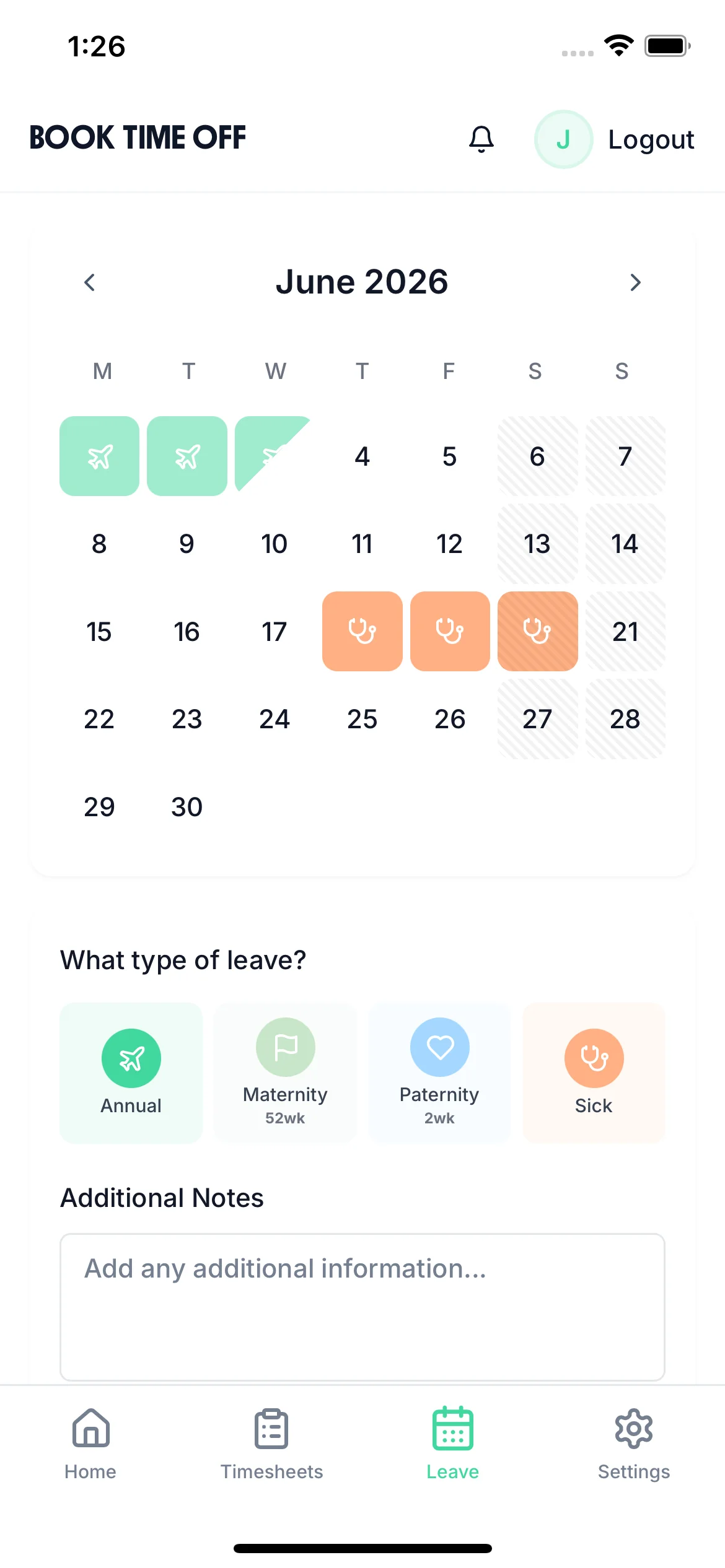
Charity project worker selecting days off and a leave type on their phone

The app is simple to use, reliable, and makes managing holidays, absences, and staff records straightforward. The system has saved us a significant amount of administration time.

CLI ManchesterJordan Ingoe, CLI Manchester

Pick the Days, Pick the Leave Type, Submit

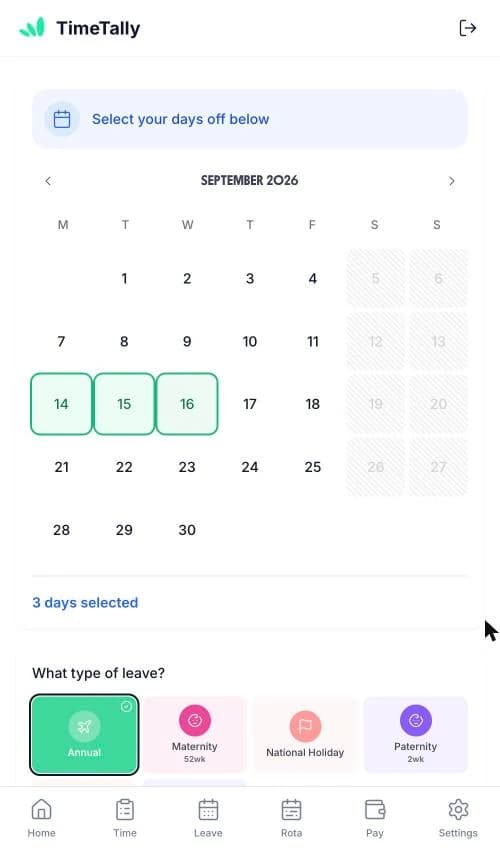
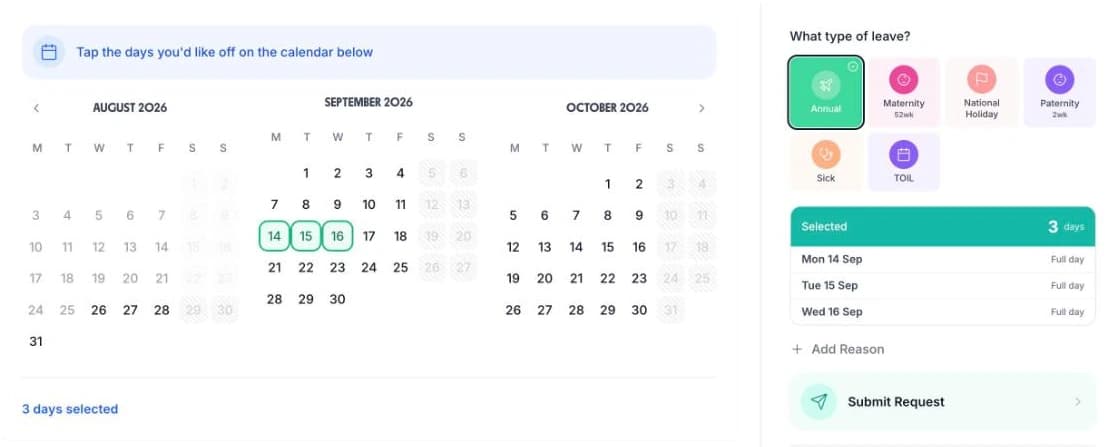
Booking leave is one screen. Staff tap the dates they want on the calendar, choose the type, add a reason if they want to, and send it. Their remaining holiday balance updates as soon as it is approved, and the request lands with the approver rather than in a mailbox.

Booking time off in TimeTally: three months of dates with 14 to 16 September selected, the leave type grid, and a submit button
  • Three months on one screen

    A fundraiser can see the run-up to a bid deadline and the week after it without scrolling

  • Tap the days you want

    Each date is listed as it is picked, marked full day or half day, with a running count

  • Pick the leave type

    Annual, sick, maternity, paternity, national holiday or TOIL, plus any type you added yourself

  • Add a reason, then submit

    The request reaches the approver with the dates, the day count and the leave type on it

Clear the Pending Requests in One Sitting

Pending requests sit in one list. Each row shows who asked, the dates, how many days it comes to, and which leave type it is — annual leave, sick leave, or a type you added yourself. A tick approves it and a cross declines it, so a chief officer with fifteen other things on can clear the queue in a few minutes.

  • Open a request to see the full detail before deciding: the person, their job title, the leave type, the day count and any reason they added.
  • A rejection can carry a written reason. A project worker who asked for the week of a funder visit knows why, and can resubmit for a different week without starting again.
  • Every request, approval, rejection and deletion is logged with a timestamp and the person who made it, which is the record a trustee or an auditor asks for.
  • Book leave for several people at once when the office closes between Christmas and New Year. Select all, pick the dates, and TimeTally skips anyone whose pattern says they do not work those days and names anyone short of allowance.
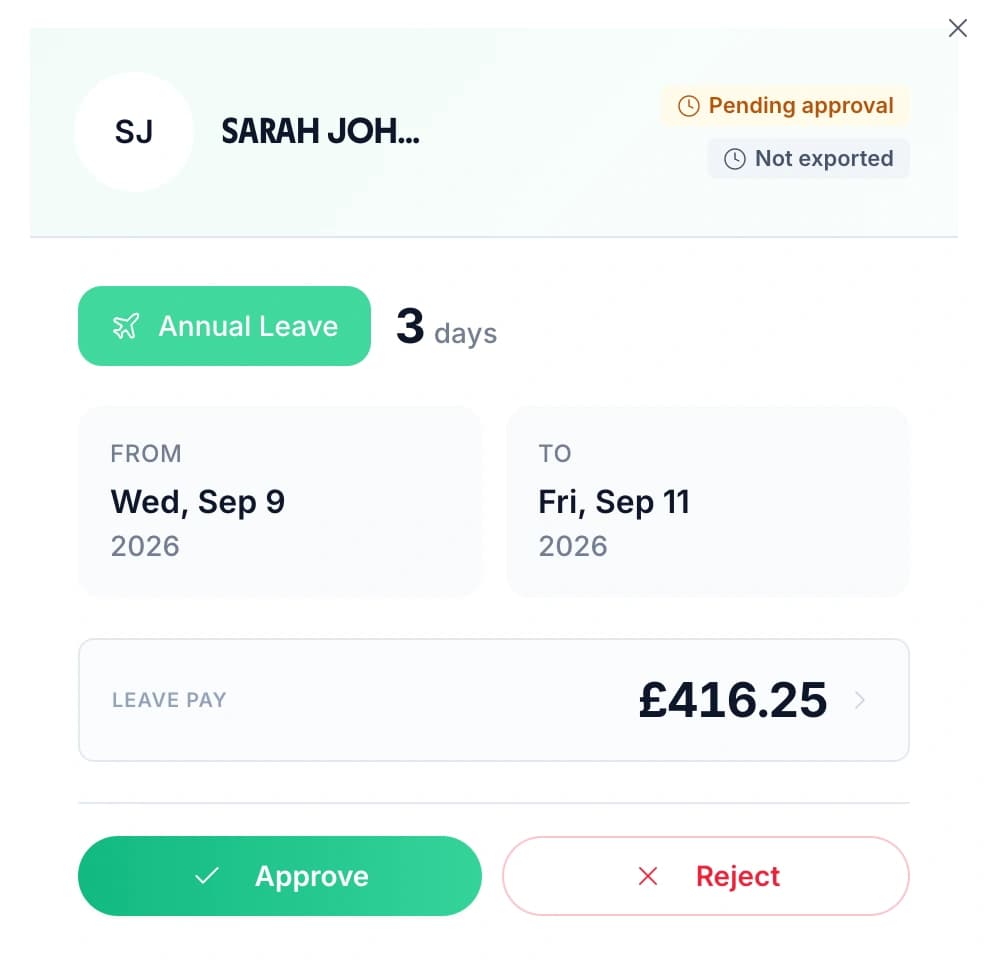
A charity manager approving a three-day annual leave request, showing the dates, the leave pay and Approve and Reject buttons

Staff book leave in seconds, not hours

Charity staff are often out delivering services, visiting beneficiaries, or working from home. With TimeTally, anyone can book time off from their phone in under a minute. The request goes straight to their manager for approval — no email chains, no paper forms, no waiting.

Whether you run a food bank with three paid staff or a national charity with teams across the country, the process is the same: request, approve, done.

  • Pick dates and submitStaff select their dates, choose the leave type, and submit — the whole process takes seconds
  • Managers approve with contextBefore approving, managers see who else is already off — so service delivery is never left short
A member of staff picking days off and a leave type on their phone

Staff check their own balance without asking HR

In most charities, there is no dedicated HR person. The manager who handles leave is also running programmes, managing funders, and supporting beneficiaries. Every “how many days do I have left?” question takes time away from the mission.

With TimeTally, each staff member can see their own leave balance, request history, and remaining entitlement at any time. Self-service means fewer interruptions for managers and more transparency for staff.

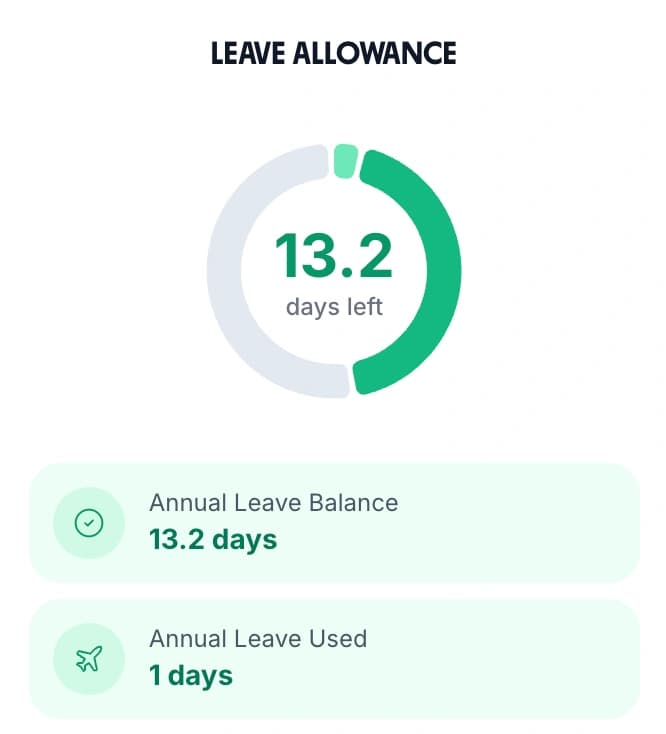
  • Live balance visible to each employeeStaff see exactly how many days they have used and how many remain — updated in real time after every approval
  • Export for funder reportingExport paid leave for a date range as CSV, or post it to Xero or QuickBooks — no manual collation from paper files
  • The card says when the year resetsSet the reset date to 5 April and every balance runs on your financial year instead of the calendar year
  • A projected balance, not just today'sStaff can see what they will have left once the leave they have already booked is taken off
An employee's leave allowance card showing the days left, the annual leave balance and the days already used

Managers get the full picture on desktop

While field staff book leave from their phones, charity managers and project leads can use the desktop view for a wider perspective. See team availability, review pending requests, and check the calendar across all programmes before making approval decisions.

  • Every programme in one view

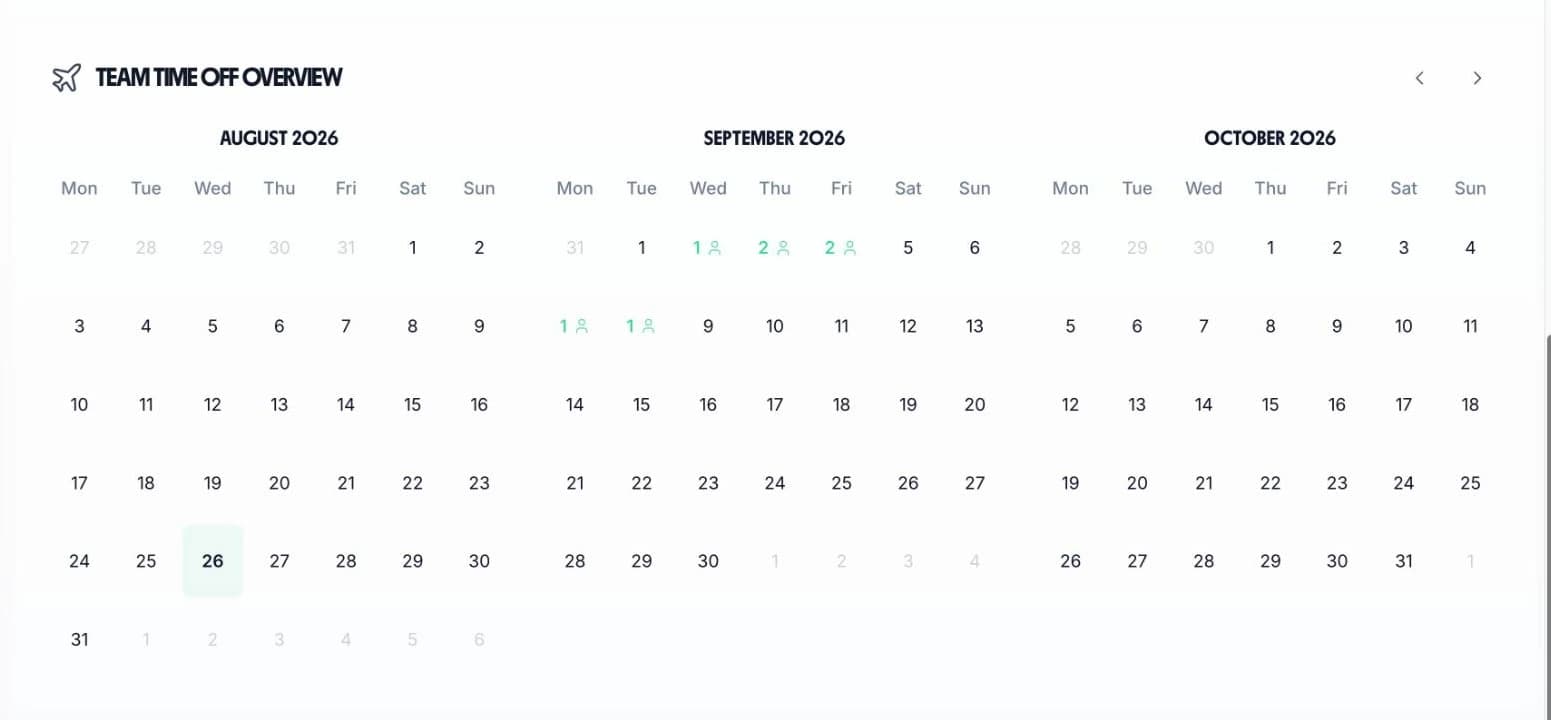
    Approved leave for the whole organisation on one three-month calendar, whatever fund or cost centre pays for the post
  • Staff visibility is a setting

    Letting employees see who else has booked time off is something you switch on, scoped either to their department or to the whole organisation
  • Plan cover before you approve

    See how many people are already off that week before you agree to the next request, which matters when a service runs on three staff
  • It shows you, it does not stop you

    TimeTally displays who is already off. It does not cap how many people can be off at once, so the cover decision stays with the approver
Three month team calendar showing how many charity staff are booked off on each day

Every leave scenario a charity has to handle

Tap a card to read the detail.

Start your free trial

14-day free trial · No credit card needed

See What Booking and Approving Leave Looks Like

A short loop of the leave screens. A member of staff taps three days, picks Annual Leave and submits. The request then appears in the approver's time-off list, is opened for the detail, and is approved.

Back

Book Time Off

Jul 2026

MTWTFSS12345678910111213141516171819202122232425262728293031

Aug 2026

MTWTFSS12345678910111213141516171819202122232425262728293031

Sep 2026

MTWTFSS123456789101112131415161718192021222324252627282930

3 days selected· excl. weekends

Family holiday, flights booked ✈️

Submit Request
Submitted

Leave Allowance

18

days left

Annual Leave Balance

18 days

Annual Leave Used

7 days

All Departments
Jun 2026
M
T
W
T
F
S
S
M
T
W
T
F
S
S
M
T
W
T
F
S
S
M
T
W
T
F
S
S
M
T
AR1

Amelia Roberts

Kitchen

JK2

James Kelly

Front of house

MP3

Maya Patel

Front of house

PS4

Priya Shah

Kitchen

TW5

Tom Wilson

Bar

Timesheet Requests

1
TW

Tom Wilson

37h 30m · Week of Jun 1

Time-off Requests

2
MP

Maya Patel

3d · Annual Leave

PS

Priya Shah

5d · Annual Leave

MP

Maya Patel

Front of house

Pending Approved
Annual Leave
3days

From

Thu, Aug 14

2026

To

Mon, Aug 18

2026

Notes

Family holiday, flights booked

Approve Approved
Reject

Why charity teams choose TimeTally

Charities face unique leave management challenges. Here is how TimeTally helps you handle them without a dedicated HR team or an enterprise software budget. If your work is delivered through registered care or supported housing, the absence management page covers the reporting side in more depth.

Cost

Affordable for any charity

£3 per employee per month with no setup fees. A charity with 10 paid staff pays £30 a month — less than a single hour of HR consultancy.

  • No minimum number of users and no annual contract, so a two-person team pays for two people
  • An admin who only approves leave and never submits a timesheet of their own is not billed
Admin

No HR team required

Designed for organisations where the manager handles leave on top of their main role. Self-service for staff, simple approvals for managers.

  • Staff read their own balance instead of asking, which removes the question from your inbox
  • There are two access levels, admin and employee, so there is nothing to configure before you start
Reporting

Funder-ready reporting

Export paid leave for a date range and a chosen set of staff, as CSV or straight into Xero or QuickBooks. Every request, approval and rejection is timestamped on the record behind it.

  • The export covers whichever period you pick, so it lines up with a grant reporting window
  • The leave calendar and each person's leave history stay on screen for anything the export does not carry
Patterns

Part-time made simple

Automatic pro-rata calculations for every working pattern. No more manual entitlement maths for staff on different contracted hours.

  • Contracted hours are set for each day of the week, so a two-day advice worker is not costed like a five-day manager
  • Entitlement is pro-rated from each person's own start date, which is what a mid-year grant-funded post needs
Funding

Group staff by programme or fund

Each employee carries a department you can name after a programme, a funding stream or a cost centre. It decides whose leave that person sees on the team calendar: their own department, or the whole organisation.

  • One staff list can hold a core-funded manager and three grant-funded posts on completely different terms
  • Approver access is organisation-wide either way — anyone you make an admin sees every department's leave
Payroll

Payroll integration

Export leave and timesheet cost to CSV, or post it to Xero or QuickBooks as a journal. No re-keying absence information into your payroll system at month end.

  • Xero and QuickBooks connect once and then take the journal directly
  • TimeTally does not run payroll or pay anyone — it hands the figures over
TOIL

Time off in lieu, not overtime pay

Charity budgets are fixed by the funder, so extra hours at a fundraising event are usually given back as time rather than paid. Turn TOIL on and approved overtime is credited to the person as leave.

  • You set the rate per hour of overtime, from 0.5x to 2x, or type your own figure
  • With TOIL on, those overtime hours are reported but no overtime pay is calculated for them
Volunteers

Volunteers alongside paid staff

Volunteers are not workers in UK law and build up no statutory holiday. TimeTally is a system for paid employees, and it bills per employee, so volunteers do not belong on the staff list.

  • Keep your volunteer rota where it is; put your paid team, sessional workers and bank relief staff in TimeTally
  • A volunteer coordinator on the payroll is a paid employee and is tracked like any other

The Two Leave Settings a Charity Actually Changes

Most of TimeTally works out of the box. These two are worth ten minutes on the day you set it up, because they are the two the third sector gets wrong.

TOIL

Bank overtime as time off in lieu when the budget cannot pay it.

Restricted funding sets the staff cost before the year starts, so extra hours at an event or a late night on a bid are usually given back as time. Turn TOIL on and every approved timesheet converts its overtime into a leave credit for that person.

You set the rate. The presets run from 0.5x to 2x per hour of overtime worked, and you can type your own figure. TOIL then appears as a bookable leave type alongside annual and sick, and each person's TOIL balance sits next to their annual leave balance.

Choose what happens to unused TOIL: it never expires, it is forfeited when the leave year resets, or it expires a set number of months after it was earned. One to twenty-four months.

Two limits worth stating plainly. While TOIL is on, those overtime hours are still reported but no overtime pay is calculated for them, because the same half hour cannot be banked and paid. And TOIL cannot run alongside the hours-worked accrual method — choosing that method switches TOIL off. Read how the balance is kept on time off in lieu software, or work a figure out in the TOIL calculator.

Leave year and carryover

Run the leave year on your financial year, then decide what carries.

The leave year runs January to December unless you change it. Set any reset date you like and the year starts the day after it, so a charity reporting to 31 March sets 5 April and every balance lines up with the accounts and the grant year.

Carryover is off by default. Turn it on and you can cap the number of days that carry, and set an expiry so carried days are used in the first weeks of the new year rather than during a delivery push.

Negative balances are off by default too. Turn them on, with a limit, for the fixed-term post that starts in November and wants a week at Christmas before it has been earned.

How leave years, carryover and balances work

Correct entitlements for every working pattern

Many charity roles are part-time or funded for specific hours. Calculating the correct pro-rata holiday entitlement manually is time-consuming and error-prone — especially when different grant-funded roles have different contracted hours.

TimeTally calculates it automatically. Set each employee's working pattern and start date, and the system works out their share of the full-time allowance you have set, including for mid-year starters. You can also use the leave entitlement calculator for quick checks, or the zero-hours holiday calculator for sessional and bank relief workers on irregular hours.

Example: a project coordinator funded for three days a week gets three fifths of whatever full-time allowance you set. TimeTally pro-rates the figure you chose — it does not decide the statutory one for you. The statutory floor for a three-day week is 16.8 days, so set your full-time allowance high enough that every part-time share clears it.

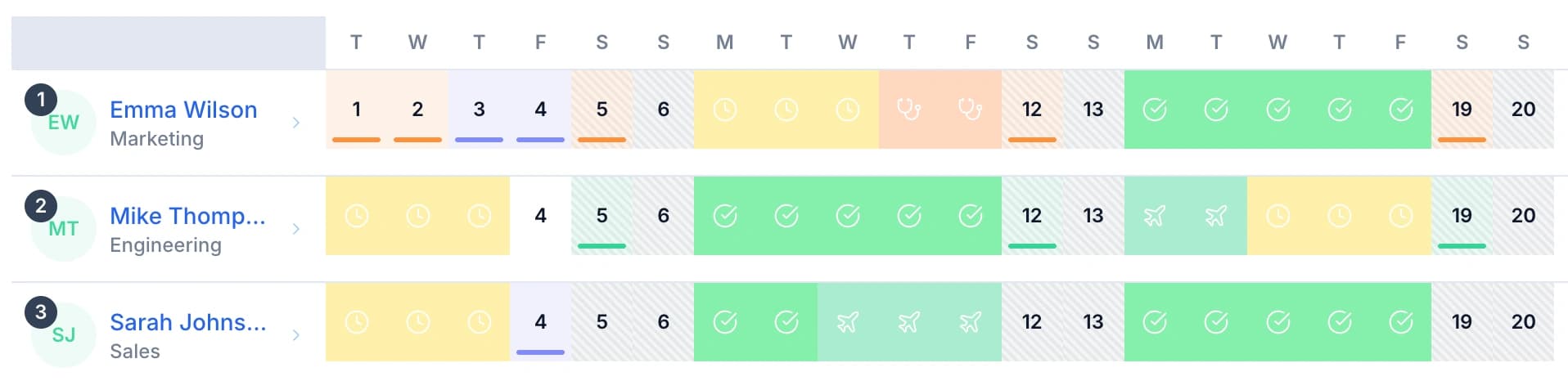
Staff rows across a fortnight, each with its own pattern of worked days, booked leave and sickness

Set the Accrual Method and Start Date on the Person

A grant-funded post rarely starts on 1 January. The accrual method, the accrual rate and the start date all sit on the individual employee, so a post funded from March accrues from March while the core-funded manager beside it keeps the full allowance from day one.

  • Four accrual methods, chosen per person

    Upfront, monthly, daily, or hours worked. Daily suits a fixed-term post because the balance grows every calendar day of the contract
  • A pro-rata switch on the start date

    Turn it on and the yearly entitlement is scaled to the part of the leave year the person is actually employed for
  • An end date for a fixed-term contract

    Record it and TimeTally stops allocating bank holidays past it and caps the allowance window at it
  • The TOIL balance sits on the same screen

    Hours banked in lieu are shown beside the annual leave balance, so nobody has to hold two figures in their head
UK compliance

Holiday Compliance for a UK Charity

TimeTally is a leave tracking tool, not a compliance system. It keeps the record that every one of these obligations rests on. Here is what the data supports in the third sector, and what it does not do.

Statutory Entitlement

Every paid worker in a UK charity gets 5.6 weeks of paid holiday, which is 28 days for someone on a five-day week. You set the full-time allowance for your organisation — the setup wizard starts you at 28 days and an admin changes it. TimeTally then works out each person's share of it from their working pattern and their start date. It does not decide the statutory figure for you, so check your own allowance clears the floor for your shortest working pattern.

Volunteers Are Not Workers

Volunteers are not employees or workers in UK law. They accrue no statutory holiday, and there is no volunteer record type in TimeTally. Billing is per employee, so adding volunteers to the staff list would charge you for people with no entitlement to track. Keep the volunteer rota where it is. Sessional workers and bank relief staff are a different matter — they are workers, they do accrue holiday, and they belong in TimeTally.

Sessional and Bank Relief Staff

For leave years beginning on or after 1 April 2024, irregular-hours workers accrue holiday at 12.07% of the hours worked in each pay period. That is the rate TimeTally applies when a person's accrual method is set to hours worked, and it is editable. The method is only offered when timesheets are switched on, and choosing it turns TOIL off. The zero-hours holiday calculator checks a figure by hand. Staff on a permanent contract who work only part of the year, such as term-time-only project staff, are a separate category: Harpur Trust v Brazel continues to apply to fixed part-year contracts, and their entitlement cannot be capped at 12.07%.

Time Off in Lieu

Where the funder has fixed the staff cost, extra hours are usually banked rather than paid. Approved overtime converts to a TOIL credit at a rate you set, and unused TOIL can be left to run, forfeited at the leave year reset, or expired a set number of months after it was earned. TOIL is a leave type staff book like any other. See time off in lieu software for the mechanics and the TOIL calculator to check a conversion.

Sickness and Records for Trustees

Sick leave is one of the seeded leave types, so an absence is recorded rather than remembered, and absence patterns are visible across every programme. Every request, approval, rejection and deletion is stored with a timestamp and the person who made it, which is what a trustee, an auditor or a funder monitoring visit asks to see. TimeTally does not calculate or pay Statutory Sick Pay — use the statutory sick pay calculator for that, and the sick leave tracker for how absence recording works.

What TimeTally Does Not Do

It does not calculate holiday pay from a 52-week average of earnings — that is a payroll job. It does not chase anyone automatically: there is no scheduled reminder, only a manual nudge you send to one person. It does not cap how many people can be off at once; it shows you who already is. And there are two access levels, admin and employee, with nothing in between, so a programme lead you make an admin sees leave across the whole organisation rather than their own funding stream.

Simple, Transparent Pricing

One price. Every feature. No surprises.

£3/employee/month

Billed monthly, incl. VAT. Cancel anytime.

Funder-ready absence reporting
Pro-rata calculations for part-time staff
Unlimited leave types
Timesheet tracking included
Get Started

No credit card required

In short

What is leave management software for a charity?

Leave management software for a charity records who has booked time off, how much holiday each person has left, and who is already off before the request is approved. TimeTally does this for UK charities, nonprofits and social enterprises from £3 per employee per month, so ten paid staff cost £30 a month. Staff book from the iOS app or any browser, in hours, half days or full days. One approver clears every request from a single list. Entitlement is pro-rated from each person's start date, which is what a grant-funded post starting mid-year needs, and the accrual method sits on the individual rather than the organisation. The leave year can start on any date, so it can run to your financial year rather than the calendar year. Approved overtime can be banked as time off in lieu instead of paid, at a rate you set. Volunteers are not workers, accrue no statutory holiday, and are not tracked. Timesheet tracking is included in the same price.

Price
£3 per employee a month
Booking
iOS app or any browser
Leave year
Any start date you choose
Overtime
Bankable as TOIL
Volunteers
Not tracked, not billed

Frequently Asked Questions

How does TimeTally handle a mix of paid staff and volunteers?

TimeTally is designed for paid employees and their statutory leave entitlements. Volunteers are not workers under UK law, so they build up no statutory holiday and there is nothing for TimeTally to track for them. There is no volunteer record type in the product, and billing is per employee, so adding volunteers as staff would cost you money for people who accrue no leave. Keep the volunteer rota where it already is, and put your paid team in TimeTally — including sessional workers and bank relief staff, who are workers and do accrue holiday. A volunteer coordinator who is on the payroll is a paid employee and is tracked like anyone else.

Can TimeTally help with funder reporting on staff absence?

Partly, and it is worth knowing where the line falls. TimeTally exports paid leave for a date range and a chosen set of employees, as a CSV or as a journal posted straight into Xero or QuickBooks. That file is built for payroll: it gives each employee's paid leave hours and what they cost for the period, so it lines up with a grant reporting window. It is not a line-by-line leave register — for who took what and when, use the leave calendar and each employee's own leave history, which stay on screen and carry a timestamped record of every request, approval and rejection.

How do we manage leave for grant-funded staff on different contract terms?

Each employee in TimeTally has their own profile with their own contracted hours, allowance, accrual method and start date. Staff funded by different grants can be on completely different terms on the same staff list — there is no requirement for everyone to match. Entitlement is pro-rated from each person's start date, which is what a post funded from October needs. You can also record an end date for a fixed-term post; TimeTally stops allocating bank holidays past it and caps the allowance window at it.

Does TimeTally work for small charities with limited HR budget?

TimeTally is specifically designed to be affordable for small organisations. At £3 per employee per month with no setup fee, no minimum user requirement, and no long-term contract, a charity with 10 paid staff would pay £30 a month. Timesheet tracking is included in the same price rather than sold as an add-on. There is also a free 14-day trial so you can test it properly before committing.

Can part-time charity workers calculate their correct holiday entitlement?

Yes. You set the full-time allowance for your organisation and TimeTally works out each person's share of it from their contracted hours. Someone working two days a week gets two fifths of it. The statutory floor is 5.6 weeks, which is 28 days for a five-day week and 11.2 days for a two-day week, so set your full-time figure high enough that every part-time share clears it. You can check any figure by hand with the pro-rata holiday calculator. One category to be careful with: staff on a permanent contract who only work part of the year, such as term-time-only project staff, cannot have their entitlement capped at 12.07% — Harpur Trust v Brazel continues to apply to fixed part-year contracts.

How does TimeTally handle leave for staff on different projects or funding streams?

Each employee carries a department, which you are free to name after a programme, a funding stream, an office or a cost centre. That department decides whose approved leave the person sees on the team calendar — either their own department or the whole organisation, which is a setting you choose. What it does not do is split management: TimeTally has two access levels, admin and employee, so anyone you make an admin sees leave across the entire organisation rather than one programme.

Can we give charity staff time off in lieu instead of paying overtime?

Yes, and it is the usual answer when a budget is fixed by the funder. Turn TOIL on and approved overtime is converted into a leave credit at a rate you set — the presets run from 0.5x to 2x per hour of overtime, and you can enter your own. TOIL then appears as a bookable leave type alongside annual and sick leave, and staff see their TOIL balance next to their annual leave balance. Decide whether it never expires, is forfeited when the leave year resets, or expires a set number of months after it was earned. One thing to be aware of: while TOIL is on, those overtime hours are still reported but no overtime pay is calculated for them, because the same half hour cannot be both banked and paid.

How does charity leave differ from any other sector?

The leave itself is the same statutory entitlement; what differs is the reporting. Charity leave has to be attributable — a grant-funded post, a restricted fund, a service. TimeTally records each person's department so leave and hours can be filtered and exported by funding stream. Among leave management services for nonprofits, that attribution is usually the part a spreadsheet cannot do.

Can we bank overtime as TOIL instead of paying it?

Yes, and small charities often do because budgets are fixed. Turn TOIL on and approved overtime is banked as time off in lieu rather than TOIL pay, then booked like any other leave. Note that TOIL and the hours-worked accrual method are mutually exclusive: choosing accrual by hours worked switches TOIL off.

Still have a question? See all FAQs

Better leave management for your charity team.

Try TimeTally free for 14 days. Manage annual leave, track sickness absence, bank overtime as time off in lieu, and produce funder reports — without needing a dedicated HR team.

No credit card required · Free 14-day trial · Cancel anytime