
Labour Cost Percentage: UK Calculator and Guide
Your labour cost percentageis what your staff cost you as a share of what you sell: total labour cost divided by sales, times 100. If a week's labour costs £2,669 and you sell £8,000 excluding VAT, your labour cost percentage is 33.4%. The calculator below works it out for one week, with the UK costs most calculators leave out: employer's National Insurance, pension contributions and holiday pay.
Labour cost percentage calculator
One week at a time. UK 2026/27 rates: employer NI 15% above £96 a week, pension 3% of qualifying earnings, holiday at 12.07%.
Excluding VAT
Pay for hours worked, overtime included
Used for the NI and pension thresholds
From payroll, if you have it. Leave blank to estimate.
Labour cost percentage
33.4%
Wages alone: 26.3%
- Wages
- £2,100.00
- Holiday pay accrued
- £253.47
- Employer's NI
- £266.62
- Employer pension
- £49.00
- Total labour cost
- £2,669.09
Formula: total labour cost ÷ sales excluding VAT × 100. £2,669.09 ÷ £8,000.00 × 100 = 33.4%. NI and pension are estimated on average pay per person and before Employment Allowance, so treat them as a guide, not a payroll figure.
Put in a week's figures and untick anything you already count elsewhere. If you have the real total from payroll, type it into the last box and the calculator uses that instead of its estimate. The rest of this guide covers what belongs in the number, what a sensible target is, and how to build a staff rota that lands on it.
How to Calculate Labour Cost Percentage
The formula is short:
Labour cost percentage = total labour cost ÷ sales excluding VAT × 100
Two decisions inside it change the answer more than people expect.
Use sales excluding VAT. If you sell food, drink or anything else standard-rated, a sixth of your takings is VAT you collect for HMRC. Divide wages by takings including VAT and your labour percentage reads lower than it is. £2,100 of wages against £9,600 of takings is 21.9%. Against the £8,000 you actually keep, it is 26.3%.
Use the same period on both sides. A week of wages against a week of sales. Monthly figures smooth out the bad weeks you most need to see, and payroll that runs on a different cycle from your sales report will make the percentage swing for reasons that have nothing to do with your rota.
What Counts as Labour Cost in the UK
Gross wages are the start, not the total. Every pound of pay brings costs with it, and they are the difference between a rota that looks affordable and one that is.
Wages, including overtime
Gross pay for the hours worked, with overtime and any premium rates included. If you pay time and a half on Sundays, that premium is labour cost; our overtime pay calculator works out what a premium adds per shift. The National Living Wage is £12.71 an hour from 1 April 2026 for workers aged 21 and over, which sets the floor under every rate on your rota.
Holiday pay: 12.07%
Workers are entitled to 5.6 weeks of paid holiday a year. For every hour someone works, 5.6 ÷ 46.4 of an hour of paid holiday builds up, which is 12.07%. You pay it later, when they take the time off, but you incur it now. If your wage figure covers only the hours worked, add 12.07% on top, or your labour percentage will be lowest in exactly the weeks people are building up holiday and highest in August when they take it.
Employer's National Insurance: 15% above £96 a week
In 2026/27 employers pay Class 1 National Insurance at 15% on each employee's earnings above the secondary threshold of £96 a week (£5,000 a year). It is worked out per person, so a team of part-timers costs less in NI than the same wage bill paid to fewer full-time staff. Many small employers can claim Employment Allowance, which takes up to £10,500 off the year's employer NI bill; once it is used up, the full 15% applies again. Our National Insurance calculator shows the employer figure for any salary.
Employer pension: at least 3%
Under automatic enrolment, employers pay at least 3% of each enrolled worker's qualifying earnings, which in 2026/27 means pay between £120 and £967 a week. Staff aged 22 to State Pension age earning over £192 a week (£10,000 a year) must be enrolled; most others can opt in. If your scheme pays more than the minimum, use your real rate.
Sick pay and other costs
Statutory Sick Pay is £123.25 a week, or 80% of average weekly earnings if that is lower, and since 6 April 2026 it is paid from the first full day off sick. In a week with sickness, that pay and the cover shift both land in labour cost. Training time, uniforms and agency fees can go in too. What matters is that you count the same things every week.
A Worked Example
A café takes £9,600 in a week, which is £8,000 excluding VAT. Six people worked that week, and their gross pay for the hours worked came to £2,100.
| Cost | Working | Amount |
|---|---|---|
| Wages | Gross pay for hours worked | £2,100.00 |
| Holiday pay accrued | £2,100 × 12.07% | £253.47 |
| Employer's NI | (£392.25 average − £96) × 15% × 6 | £266.62 |
| Employer pension | (£392.25 − £120) × 3% × 6 | £49.00 |
| Total labour cost | £2,669.09 ÷ £8,000 × 100 | 33.4% |
On wages alone the café is at 26.3%. Fully loaded it is at 33.4%. That seven-point gap is the most common reason a business that thinks it is inside its labour target is not. The average pay per person (£392.25) includes the holiday pay, because NI and pension are due on holiday pay when it is paid. The calculator above does the same thing.
A useful by-product is your on-cost factor: £2,669.09 ÷ £2,100 = 1.27. For this team, every £1 of wages costs £1.27. Once you know your own factor, you can price a rota quickly by multiplying its wage cost by it.
What Is a Good Labour Cost Percentage?
The guides that rank for this question quote 25% to 35% of sales for hospitality, lower for retail and higher for service businesses. Treat those as a rough sense of scale rather than a target. Some are wages only and some are fully loaded, which can be seven points apart as the example shows, and many are written for American businesses with different taxes on payroll.
A better target comes from your own margin:
- Start with gross margin: sales minus the cost of what you sold. A café whose food and drink cost 30% of sales has a 70% gross margin.
- Take off fixed overheads as a share of sales: rent, rates, utilities, insurance, software. Say 25%.
- Take off the profit you need. Say 10%.
- What is left is your labour ceiling. 70 − 25 − 10 = 35% of sales, fully loaded.
Those numbers are an illustration, not a benchmark; put your own in. If your ceiling comes out below what a safe, legal rota costs, the fix is in prices or opening hours, not in the rota.
Labour Cost Percentage in a Restaurant
Restaurants and pubs have three things that skew the number if you are not careful.
- Tips belong to staff. Since 1 October 2024, the Employment (Allocation of Tips) Act 2023 requires employers to pass on all tips to workers without deductions. Leave tips out of sales and out of labour cost; they are neither yours to count nor yours to spend.
- Front and back of house behave differently. Kitchen hours follow covers; bar and floor hours follow footfall and opening times. Work out a percentage for each, or a quiet kitchen will hide an overstaffed floor.
- Measure weekly, plan daily.A Tuesday at 45% and a Saturday at 22% average out to a good week that hides an expensive Tuesday. The daily figure is the one you can change on next week's rota.
How to Calculate Labour Cost Per Day
- Add up the paid hours on the day's rota, after unpaid breaks.
- Multiply each person's hours by their hourly rate and add them up. That is the day's wage cost.
- Multiply by your on-cost factor (1.27 in the café example) to get the day's labour cost.
- Divide by the day's sales excluding VAT and multiply by 100.
Salaried managers count too: divide their annual cost by the days they work. The hourly rate calculator turns a salary into an hourly figure, and the rota cost calculatortotals the wage bill for a whole week's rota if you are pricing one before it exists.
How to Plan a Rota to a Target Labour Percentage
Most businesses measure labour cost after the week has happened. It is more useful to work the target backwards into hours before you write the rota.
- Forecast next week's sales excluding VAT. The same week last year, adjusted for anything you know is different, is a decent start.
- Multiply by your target percentage. £10,000 × 30% = a £3,000 labour budget.
- Work out your loaded hourly cost. Someone on £13 an hour working 30 hours earns £390. Add holiday (£47.07), employer NI (£51.16) and pension (£9.51) and they cost £497.74, or £16.59 an hour.
- Divide the budget by it. £3,000 ÷ £16.59 ≈ 180 hours for the week.
- Spread the hours by demand. Give each day a share of the 180 hours in proportion to its share of forecast sales, then place shifts within the day around your busy hours.
The hours number is a budget, not an instruction. If 180 hours cannot cover your opening hours safely, the target is wrong for the forecast, and you are better off knowing that on Wednesday than on payday.
How to Bring a High Labour Percentage Down
- Rota to demand, hour by hour. Staggered starts beat everyone arriving at opening. A 12:00 start covers lunch without paying for a quiet 10:00 to 12:00.
- Cut unplanned overtime first. Premium hours are the most expensive hours on the rota, and they usually come from gaps rather than demand.
- Check long overlaps at handover. Fifteen minutes is a handover. An hour is two people being paid for one job.
- Compare planned with actual. A rota at 28% that becomes 33% on the timesheets means shifts are running long. That is a different problem from rota design.
- Look at absence. With SSP payable from the first day off, a sick day can mean paying for two people: the sick pay and the cover.
- Do not cut below safe or legal. Rest breaks, minimum wage and safe staffing are fixed costs of trading, not savings waiting to be found.
Seeing Labour Cost on the Rota in TimeTally
In TimeTally's online rota planner, the rota shows the paid hours and the wage cost for every day and for the week as you build it: each person's paid hours after their unpaid break, times their hourly rate. The cost row appears when Pay is switched on for your organisation, and only to admins who are allowed to see pay. You can also set a cost limit for a day, a week or a month, for a whole rota, a department or one person, and the rota flags anything over it above the grid and again before you publish.
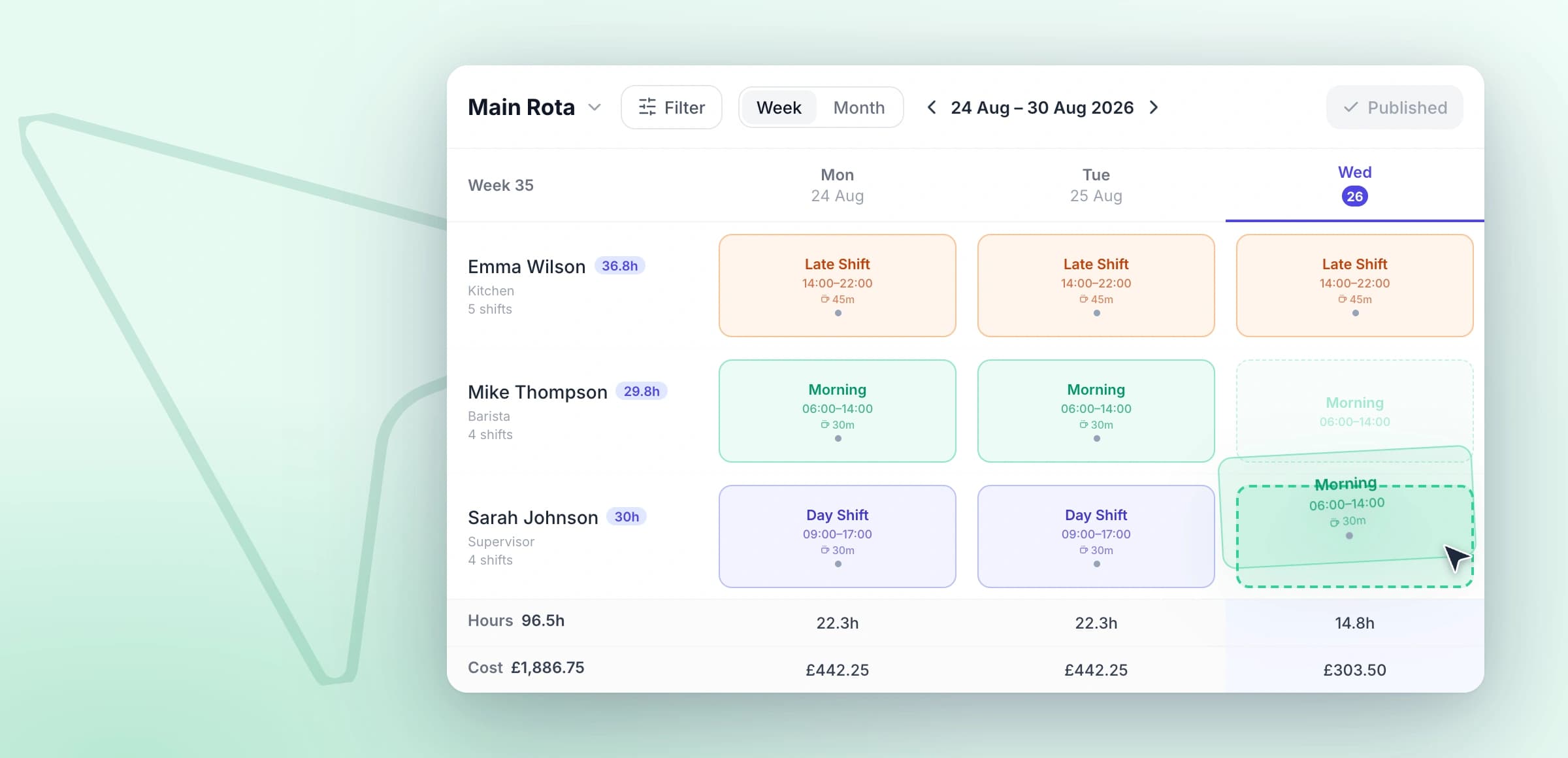
Two things it does not do. The rota does not know your sales, so it shows cost rather than a percentage, and its cost row is wages only, with no NI, pension or holiday on top. Multiply it by your on-cost factor from the calculator above, or set your cost limit at your labour budget divided by that factor. TimeTally costs £3 per employee per month, with timesheets and leave included.
“The app is simple to use, reliable, and makes managing holidays, absences, and staff records straightforward. The system has saved us a significant amount of administration time.”
 Jordan Ingoe, CLI Manchester
Frequently Asked Questions
What is a good labour cost percentage?
There is no single right number. The guides that rank for this quote 25% to 35% of sales for hospitality, but those figures mix wages-only and fully loaded costs and many are American. A good percentage is the one your margin can carry: take your gross margin, subtract your fixed overheads and the profit you need, and what is left is your labour ceiling.
What is the labour cost percentage formula?
Labour cost percentage = total labour cost ÷ sales × 100. In the UK, use sales excluding VAT, and count employer's National Insurance, employer pension contributions and holiday pay in the labour cost, not just gross wages.
What labour cost percentage should a restaurant aim for?
Restaurants are commonly quoted at 25% to 35% of sales, with quick-service lower and full-service higher. Work yours out on net sales (after VAT), leave tips out of both sides because they belong to staff, and track front and back of house separately so one does not hide the other.
How do you calculate labour cost per day?
Add up the paid hours on the day's rota, multiply each person's hours by their hourly rate, then multiply the total by your on-cost factor (for example 1.27 if NI, pension and holiday add 27% to wages). Divide that by the day's sales excluding VAT and multiply by 100 for the day's labour percentage.
Should labour cost percentage include VAT?
No. Use sales excluding VAT. VAT is collected for HMRC and is not yours to spend on wages, so dividing by takings that include 20% VAT makes your labour percentage look about a sixth lower than it really is.
Does labour cost include employer's National Insurance?
It should. In 2026/27 employers pay 15% National Insurance on each employee's earnings above £96 a week (£5,000 a year). Leaving it out understates labour cost, especially in teams of full-time staff. Many small employers can claim Employment Allowance, which takes up to £10,500 a year off the bill.
Sources
- Rates and thresholds for employers 2026 to 2027 — GOV.UK (employer NI)
- Workplace pensions: what you, your employer and the government pay — GOV.UK
Holiday entitlement, Statutory Sick Pay, Employment Allowance and the National Living Wage are as published on GOV.UK; the pension thresholds are The Pensions Regulator's 2026/27 figures. Last checked 2 October 2026.