
Rest Between Shifts in the UK: A Rota-Builder's Guide

The rules on rest between shifts in the UK are short enough to fit on a postcard: 11 hours off between working days, a 20-minute break in any day over 6 hours, and a day off each week. Where employers get caught is not the rules themselves. It is the rota: a late close followed by an early open, a seventh day in a row, a 17-year-old on a 9-hour shift.
This guide takes the rota-builder's view. It sets out the break and rest rules by shift length, shows where a normal-looking week quietly breaks them, and ends with a five-minute check to run before you publish. For the wider framework (the 48-hour week, opt-outs, holiday and record-keeping) see our complete guide to the Working Time Regulations.
The short answer
Adults are entitled to 11 hours' uninterrupted rest between working days, 24 hours off each week (or 48 hours each fortnight), and one 20-minute break in any day longer than 6 hours. Under-18s get 12 hours, 48 hours a week, and a 30-minute break after 4.5 hours. Breaks do not have to be paid unless the contract says so.
Rest Between Shifts UK: The Five Rules
All five come from the Working Time Regulations 1998, as set out by GOV.UK and Acas.
| Rule | Workers 18 and over | Under 18 (above school leaving age) |
|---|---|---|
| Break during the day | 20 minutes, uninterrupted, if the day is more than 6 hours | 30 minutes if they work more than 4.5 hours |
| Daily rest | 11 hours in a row between working days | 12 hours |
| Weekly rest | 24 hours each 7 days, or 48 hours (or two 24s) each 14 days | 48 hours each week |
| Maximum hours | 48 a week on average, normally over 17 weeks (can opt out) | 8 a day and 40 a week, no averaging |
| Night work | Average of 8 hours in 24 (no opt-out) | Usually not between 10pm and 6am, with limited exceptions in sectors such as hotels, catering, retail and hospitals |
Two details trip people up. The 20-minute break has to be one block in the middle of the day, not tacked onto the start or end, and the worker can spend it away from their workstation. And none of these breaks has to be paid: Acas is clear there is no entitlement to pay for the break unless it is in the contract or you have agreed it. When an unpaid break still has to be paid is covered in are breaks paid in the UK.
Breaks by Shift Length
This is the table most people searching for "break for an 8-hour shift" actually want. It shows the statutory minimum only. Your contracts, a collective agreement or your own policy may give more, and if they do, they bind you.
| Shift length | Adult (18+) | Under 18 |
|---|---|---|
| 4 hours | No statutory break | No statutory break |
| 5 hours | No statutory break | 30 minutes (worked more than 4.5 hours) |
| 6 hours exactly | No statutory break (the right starts above 6 hours) | 30 minutes |
| 8 hours | One 20-minute uninterrupted break | 30 minutes, and 8 hours is their daily maximum |
| 9 or 10 hours | One 20-minute uninterrupted break | Not allowed: under-18s are capped at 8 hours a day |
| 12 hours | Still one 20-minute break by law; your contract may give more | Not allowed |
Notice the 12-hour row. The law gives a 12-hour shift the same single 20-minute break as an 8-hour one. Most employers give more on a long shift, for safety and because tired staff make mistakes, but it is worth knowing where the legal floor actually sits when you write the contract. If you want to check a particular pattern, our break time calculator does the arithmetic.
The 11-Hour Rule and the Late-Then-Early Shift
The 11-hour daily rest is the rule rotas break most often, and almost always in the same way: someone closes, then opens. Hospitality calls it a "clopen". It looks fine on a weekly grid because each shift on its own is a normal length.
| Finish | Next start | Rest | Adult 11-hour rule |
|---|---|---|---|
| 23:00 | 07:00 | 8 hours | 3 hours short |
| 22:30 | 08:00 | 9.5 hours | 1.5 hours short |
| 22:00 | 09:00 | 11 hours | Meets it exactly |
| 07:00 (end of a night) | 14:00 the same day | 7 hours | 4 hours short: a common changeover mistake |
The simplest habit: for any late finish, add 11 hours and write the earliest legal start next to it. A 22:30 close means nobody on that shift starts before 09:30. For a 17-year-old it is 12 hours, so 10:30. The same arithmetic catches split shifts, where a lunch-and-dinner day finishing at 23:00 leaves less overnight rest than the rota suggests.
The night-to-day changeover in the last row is where compensatory rest comes in. Moving someone from nights to days often cannot be done without cutting a rest period short, which is exactly the situation the law allows for, provided the rest is given back.
Weekly Rest: 24 Hours a Week or 48 a Fortnight
Adults are entitled to 24 uninterrupted hours without work in each 7-day period. As the employer you can instead give two separate 24-hour periods, or one 48-hour period, in each 14-day period. The fortnightly option is what makes longer runs lawful: 12 days on followed by two full days off can meet it, as long as the 48 hours falls inside the same 14-day period.
Weekly rest sits on top of daily rest, not instead of it. Regulation 11(7) of the Working Time Regulations says the weekly rest cannot include any part of the 11-hour daily rest unless there is an objective, technical or work-organisation reason. In practice a "day off" between two working days normally means a gap of 35 hours (24 plus 11). Finish at 22:00, back at 06:00 two days later, and the gap is 32 hours: count the hours, not the days.
Under-18s are entitled to 48 hours' rest every week, with no fortnightly averaging.
Compensatory Rest: When You Can Move the Rest Instead
Some workers cannot always get their daily or weekly rest at the normal time. For them the law allows compensatory rest: a rest period of the same length as the one they missed, taken later. GOV.UK lists the situations where it may apply, including:
- Shift workers who cannot take daily or weekly rest between shifts, such as when changing shift pattern
- Workers with split working days, such as cleaners working mornings and evenings
- Security and surveillance work
- Jobs that need round-the-clock cover, such as hospitals
- Industries with seasonal peaks: agriculture, retail, postal services and tourism
- Workers whose job is far from home, or split across sites some distance apart
- Where a collective or workforce agreement changes the rest rules
Two points matter for a rota. Compensatory rest is not "no rest": Acas describes it as an equivalent period, the same length and type as the rest that was missed. And because you are relying on an exception, you need to be able to show the rest was given back. A rota that shows the changeover and the recovery days afterwards is the easiest evidence you will have.
Who the Rest Rules Don't Cover
GOV.UK lists workers who are not entitled to the general rest breaks: the armed forces, emergency services and police when dealing with an exceptional catastrophe or disaster; people who freely choose their own hours or whose working time is not measured, such as a managing director; and workers in sea, air and road transport, who have their own regimes. For almost every small business, these exceptions do not apply to anyone on the rota.
“The app is simple to use, reliable, and makes managing holidays, absences, and staff records straightforward. The system has saved us a significant amount of administration time.”
 Jordan Ingoe, CLI Manchester
The 5-Minute Rota Check Before You Publish
Run this every time, before anyone sees the rota. On a small team's week it is a few minutes' work, and it covers every rule above.
- Late finishes. Find every shift ending after 21:00. Add 11 hours (12 for under-18s) and check that person's next start.
- Changeovers. Anyone moving from nights to days, or lates to earlies: either leave the full rest, or plan the compensatory rest and write it on the rota.
- Days in a row. Anyone working 7 days in a row is relying on the fortnightly option: check their 48 hours (or two 24-hour breaks) falls inside the same 14-day period.
- Long days. Every shift over 6 hours (4.5 for under-18s) has a break in the middle of it, not at the end.
- Under-18s. No more than 8 hours a day or 40 a week, 12 hours between shifts, two days off.
- Weekly hours. Anyone whose hours keep you near 48 on average needs either a lighter run coming or a signed opt-out. Night workers cannot opt out of their 8-hour average.
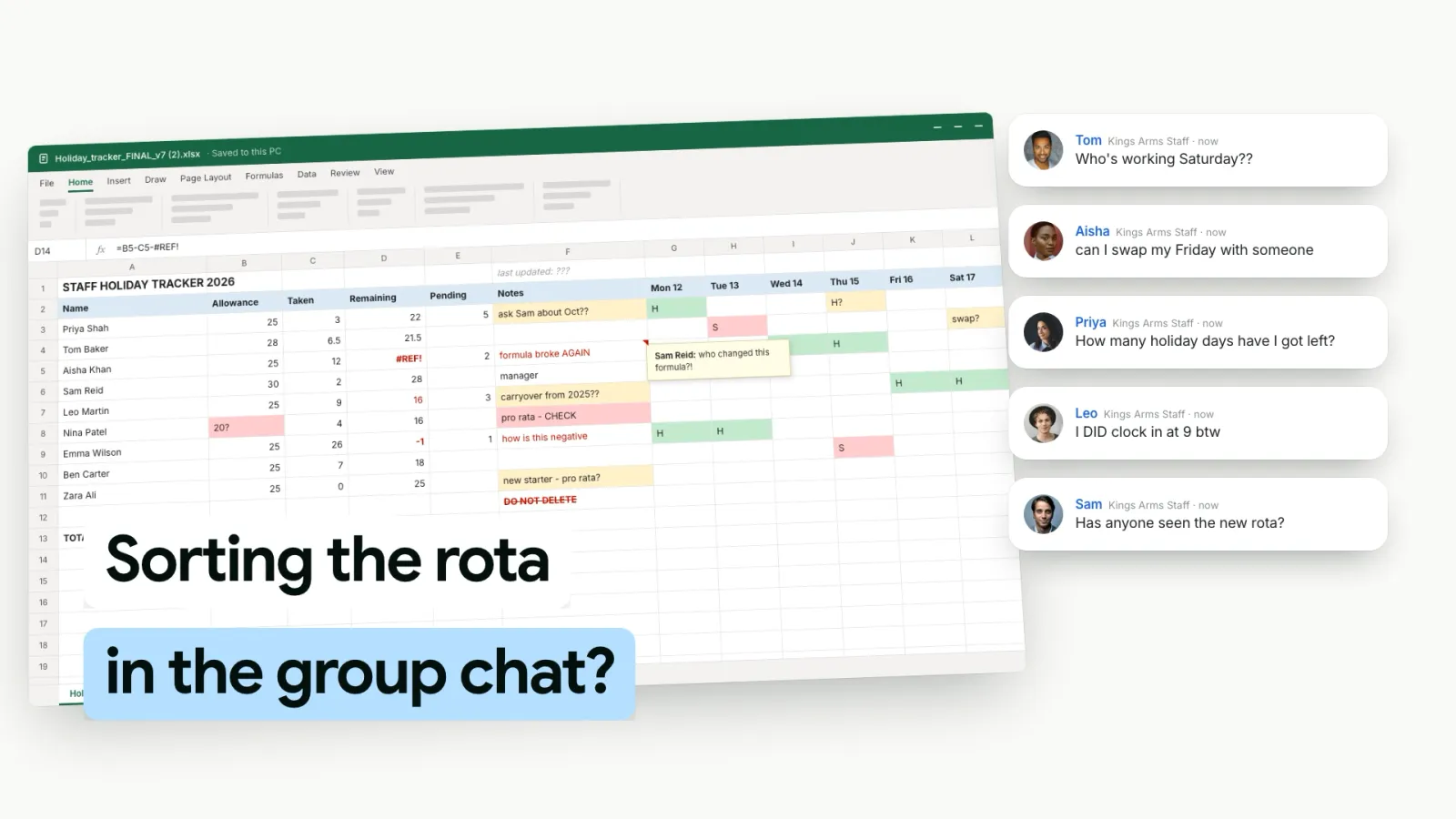
A paper or spreadsheet rota makes step 1 the slow one, because you are reading across columns to find the next day's start. On a rota planner where each person is one row, a late finish and an early start sit side by side and the problem is visible at a glance.
 TimeTally
A Rota You Can Check at a Glance
One row per person, one column per day. Set alerts for hours per employee per week, see them before you publish, then email the rota to your team. Staff see their shifts in the app and record breaks when they clock in.


£3 per employee per month • Free for 14 days • No credit card required
What Software Can and Can't Do Here
Be wary of any tool that promises to make you "compliant". What a good rota tool does is make breaches visible. In TimeTally you can set alerts on a rota (for example, flag any employee scheduled over 48 hours in a week) and they appear before you publish. Breaks are recorded when staff clock in and out, so the timesheet shows whether the 20 minutes was actually taken.
What TimeTally does not do is calculate the gap between one shift and the next for you. The 11-hour check is still a human one, and the point of laying the week out one row per person is to make it a five-second look rather than a five-minute search. If you run rotating patterns, our guide to managing shift patterns covers designing the rest into the pattern in the first place.
Key Takeaways
- Adults get 11 hours between working days, 24 hours a week (or 48 a fortnight) and a 20-minute break in any day over 6 hours
- Under-18s get 12 hours, 48 hours a week, a 30-minute break after 4.5 hours, and work no more than 8 hours a day
- Breaks must be one block in the middle of the day and do not have to be paid unless the contract says so
- The late-then-early shift is the most common breach: add 11 hours to every late finish
- Compensatory rest lets some shift, split-shift and round-the-clock workers move rest, but it must be given back in full
- Night workers average no more than 8 hours in 24, and cannot opt out of that limit
Frequently Asked Questions
Is it illegal to have 7 hours between shifts?
For most adult workers, yes, unless an exception applies. The right is to 11 hours' uninterrupted rest between working days, so 7 hours falls 4 hours short. Shift workers changing shift pattern, split-shift workers and some sectors that need round-the-clock cover can have the rest moved, but only by giving compensatory rest of the same length later. Under-18s are entitled to 12 hours.
How long should you have rest between shifts in the UK?
At least 11 hours in a row between finishing one working day and starting the next, for workers aged 18 and over. Workers under 18 get 12 hours. On top of that, adults get 24 hours off each week or 48 hours each fortnight, and under-18s get 48 hours each week.
Is it legal to only have 9 hours rest after work?
Not as a regular arrangement for most adults. Nine hours is 2 short of the 11-hour daily rest. It can be lawful where compensatory rest applies, for example a shift worker moving from lates to earlies, but the missed 2 hours must be given back as an equivalent rest period, and you should be able to show when.
Is it illegal to work 4 12-hour shifts in a row?
No, not on its own. Four 12-hour days is 48 hours, which sits within the 48-hour average limit. Each day still needs a 20-minute break, a 12-hour gap between shifts satisfies the 11-hour rest, and three days off covers weekly rest. Night shifts are different: night workers must average no more than 8 hours in 24 over the reference period, and nights involving special hazards or heavy strain are capped at 8 hours outright.
Are rest breaks paid in the UK?
Not by law. The 20-minute break does not have to be paid unless the employment contract says it is, or you have agreed with the worker that it is.
Can I make staff take their break at the end of a shift?
No. You can decide when the break is taken, but it has to be one uninterrupted block somewhere in the middle of the working day, not tacked on at the start or the end, and the worker can spend it away from their workstation.
Sources
Checked against GOV.UK and Acas on 2 October 2026.
- Rest breaks at work (with the taking breaks, compensatory rest, exceptions and young workers pages) — GOV.UK
- The right to rest: rest and breaks at work — Acas
- Maximum weekly working hours — GOV.UK
- Night working hours (and its young workers page) — GOV.UK
- Working Time Regulations 1998, regulation 11 — legislation.gov.uk