
Holiday Accrual UK: How to Work Out Accrued Annual Leave

Holiday accrual is how annual leave builds up as someone works through the leave year. On the UK minimum of 28 days, a full-time worker accrues 2.33 days a month. To find out how much has built up so far, multiply the yearly entitlement by the share of the leave year that has gone, then take off what's been used.
That's the whole idea. The detail is in the exceptions: new starters, part-timers, people on irregular hours, sick leave and leavers, and the fact that the law only requires accrual in someone's first year. This guide works through each with real numbers. For the entitlement itself (the 5.6 weeks, bank holidays, part-time pro rata) start with our UK annual leave entitlement guide.
The formula
Accrued holiday = yearly entitlement × (days of the leave year so far ÷ days in the leave year) − holiday taken
- 28 days a year builds up 2.33 days a month
- 3 days a week (16.8 days a year) builds up 1.4 days a month
- Irregular hours: 12.07% of the hours worked each pay period
What Is Holiday Accrual?
Every worker in the UK is entitled to 5.6 weeks of paid holiday a year, capped at 28 days for someone working five or more days a week. Accrual is the rule for when that leave becomes available to use. There are two broad approaches:
- Upfront: the full year's allowance is available on the first day of the leave year.
- Accrued: it builds up as the year goes on, monthly, daily, or from hours worked.
Both end in the same place: by the last day of the leave year, everyone has had the chance to take their full entitlement. Accrual only changes how much is available along the way.
Does Holiday Have to Accrue? The First-Year Rule
Only in one situation does the law set accrual: a worker's first year of employment. Under regulation 15A of the Working Time Regulations, statutory leave builds up at one-twelfth of the yearly amount on the first day of each month they work. Any fraction under half a day counts as a half day; anything over half a day counts as a whole day.
So a new full-time starter has 2.33 days on their first day, which rounds to 2.5 days they can book. On the first day of their third month they've built up 7 days. You can refuse a request beyond what has built up, but you don't have to: plenty of employers let new starters borrow ahead.
After the first year, the law sets no accrual. The full year is available from day one of the leave year unless the contract says leave builds up month by month, which many do. That's a lawful booking rule, as long as staff can still take all 5.6 weeks before the year ends. Irregular-hours and part-year workers are the exception: since April 2024 they follow their own hours-based rule (below) from the start.
Upfront vs Monthly vs Daily Accrual
Here's how the three main methods compare for a full-time worker on 28 days, in a January to December leave year, checked on 1 July:
| Method | How it builds up | Available on 1 July |
|---|---|---|
| Upfront | All 28 days on 1 January | 28 days |
| Monthly | 2.33 days at the end of each month (6 months done) | 14 days |
| Daily | 28 ÷ 365 days for every calendar day (182 days so far) | 13.96 days |
Upfront is simplest and what staff like most, but if someone takes the whole year by June and then leaves, you can only claw back the extra if the contract says you can. Monthly is the most common middle ground. Daily is the fairest and the hardest to do by hand, which is why it's mostly used in software.
How to Work Out Accrued Holiday: Three Examples
Example 1: full-time, April to March leave year
Priya works five days a week on 28 days a year. Her leave year runs from 1 April. On 30 September, 183 of the year's 365 days have passed.
- Accrued: 28 × 183 ÷ 365 = 14.04 days
- Taken so far: 8 days
- Built up and still to take: 6.04 days
Example 2: part-time, monthly accrual
Tom works three days a week. His entitlement is 3 × 5.6 = 16.8 days a year, so on monthly accrual he builds up 16.8 ÷ 12 = 1.4 days a month. Four months into the leave year he has accrued 5.6 days. Our pro rata holiday calculator does the yearly figure for any working pattern.
Example 3: irregular hours, 12.07%
Jess is on a zero-hours contract. For leave years starting on or after 1 April 2024, irregular-hours and part-year workers accrue 12.07% of the hours they work in each pay period. Last month she worked 120 hours, so she accrued 120 × 12.07% = 14.48 hours of holiday. Our guide to holiday pay for zero-hours workers covers the rules, including rolled-up holiday pay.
“The app is simple to use, reliable, and makes managing holidays, absences, and staff records straightforward. The system has saved us a significant amount of administration time.”
 Jordan Ingoe, CLI Manchester
Accrual in the Situations That Catch Employers Out
- Sick leave. Holiday keeps building up, even during long-term sickness, and leave someone couldn't take because they were ill can carry over. See holiday entitlement on sick leave.
- Maternity, paternity and adoption leave. All annual leave, statutory and contractual, keeps building up for the whole of the leave.
- Mid-year starters. Their first leave year is pro rata from their start date, and the first-year monthly rule decides how much they can use as they go.
- Leavers. They're owed the holiday built up to their last day, less what they've taken, paid in their final pay. The formula is in our guide to holiday pay when an employee leaves.
- Taken more than accrued. You can only take the difference back out of final pay if the contract allows it.
- Bank holidays. If your 28 days include the eight bank holidays, they come out of the accrued balance like any other day, and someone on monthly accrual can be short at Christmas.
When Does Accrued Holiday Reset?
Accrual starts again on the first day of the leave year. The contract should set it: 1 January and 1 April are the most common. If it doesn't, the leave year starts on the date the person started work and resets on each anniversary, which means a team of ten can have ten different leave years.
What happens to unused days when it resets depends on the type of leave and your policy. Our guide to annual leave carryover rules covers what has to roll over and what can be lost.
Common Accrual Mistakes
- Refusing all leave in the first month. A new starter has 2.5 days on day one under the first-year rule.
- Stopping accrual during sick or family leave. It keeps building up in both.
- Rounding balances down. The first-year rule rounds up to the half or whole day. Never round in your own favour.
- Using a 28-day figure for a part-timer. Work from 5.6 times their working week, then accrue that.
- Different rules in the contract and the spreadsheet. If the contract says upfront and the spreadsheet accrues monthly, the contract wins.
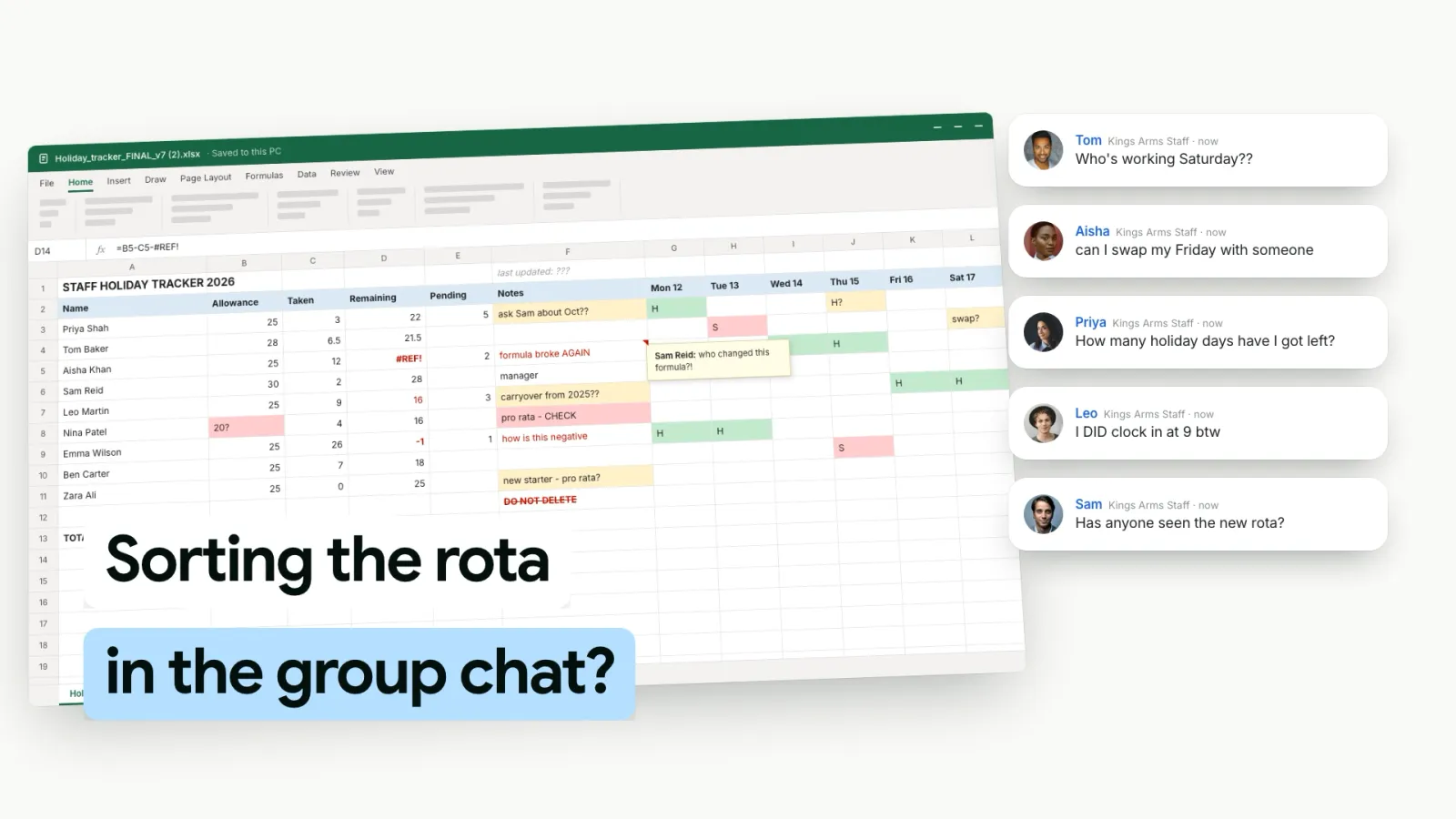
How TimeTally Helps
Working out accrual by hand for one person is fine. For a team on different patterns, start dates and methods, it's where spreadsheets go wrong. TimeTally works it out for everyone:
- Choose how leave builds up: upfront, monthly or daily for the business, with a different method for any one person.
- 12.07% from approved hours for irregular-hours staff, added each time you approve their timesheet.
- Starters and leavers handled: a starter's upfront allowance is pro rata from their start date, and a leaving date stops accrual on their last day.
- Balances on every phone. Staff see what they've built up before they ask for time off, and you see the same figure when you approve it.
One honest difference: TimeTally shows balances to two decimal places (14.04 days) rather than rounding them up to the half day, so check the rounding your contract promises for first-year staff. It costs £3 per employee per month; the leave tracking software page has more.
 TimeTally
Holiday That Builds Up by Itself
Pick upfront, monthly, daily or hours worked. Everyone's balance stays right, and staff can see theirs on their phone.
Free for 14 days • No credit card required
Key Takeaways
- Accrued holiday = yearly entitlement × share of the leave year gone − holiday taken
- 28 days a year builds up at 2.33 days a month; 3 days a week at 1.4 days a month
- The law only sets accrual in the first year: one-twelfth on the first day of each month, rounded up to the half or whole day
- After that, upfront, monthly and daily accrual are all lawful if the contract says which
- Irregular-hours and part-year workers accrue 12.07% of hours worked each pay period
- Holiday keeps building up during sick leave and maternity, paternity and adoption leave
Frequently Asked Questions
How many days holiday do you accrue per month in the UK?
On the statutory minimum of 28 days, a full-time worker builds up 2.33 days a month (28 ÷ 12). A part-timer on 3 days a week has 16.8 days a year, so builds up 1.4 days a month. If your contract gives more, divide the yearly total by 12.
How do I work out how much holiday I have accrued?
Multiply the yearly entitlement by the share of the leave year that has gone, then take off what's been used. On 28 days a year, 183 days into a 365-day leave year: 28 × 183 ÷ 365 = 14.04 days built up. If 8 days have been taken, 6.04 are left.
Can I take holiday before I have accrued it?
In the first year, the law only guarantees the leave that has built up, so an employer can refuse leave beyond it. After that, the full year's entitlement is available from the start of the leave year unless the contract says leave builds up month by month. Many employers allow leave in advance anyway.
Do you accrue holiday while on sick leave?
Yes. Statutory holiday keeps building up during sick leave, including long-term sickness, and leave that couldn't be taken because of illness can be carried over for up to 18 months after the end of the leave year it belongs to.
Do you accrue holiday while on maternity leave?
Yes. All annual leave, statutory and contractual, keeps building up during maternity, paternity, adoption and shared parental leave. If it can't be taken in the leave year because of the leave, it carries over.
When does annual leave reset?
On the first day of the leave year set in the contract, often 1 January or 1 April. If the contract sets no leave year, it starts on the date the person started work and resets on each anniversary.
Sources
- Working Time Regulations 1998, regulation 15A (leave during the first year) — legislation.gov.uk
- Holiday entitlement — GOV.UK
- Holiday pay and entitlement reforms from 1 January 2024 — GOV.UK
- Holiday, sickness and leave — Acas