
Holiday Rota: A Free 2027 Planner and the Rules That Stop Clashes

A holiday rota decides who can be off when, before anyone asks. Without one, leave is first come first served, the same three people get the school holidays every year, and you find out you're short-staffed when two requests land for the same week. This guide gives you a free 2027 staff holiday planner to download, the booking rules that stop clashes, and the UK notice periods that decide what you can refuse.
A holiday rota sits on top of your shift rota: plan leave first, then build the weeks around it. If you're starting from scratch, our guide to how to make a staff rota covers the shifts side.
Free download
Staff holiday planner 2027 (Excel)
- Every day of 2027 across the top, one row per person, 25 rows
- England and Wales bank holidays marked; Scotland and Northern Ireland on a second sheet
- Allowance, carried over, taken and remaining, worked out for you
- A cover check that flags any day with more people off than you allow
- A priority log for sharing school holidays and Christmas fairly
Free, no sign-up. Opens in Excel or Google Sheets (upload it to Drive and open with Sheets).
Rather plan it in your browser? The free staff holiday planneris the same wall chart online, with each person's days left worked out as you click.
What Is a Holiday Rota?
A holiday rota has two parts. The first is the calendar: everyone's approved leave for the year, in one place, so you can see at a glance who is off on any day. The second is the rules: how many people can be off at once, how far ahead people must book, and who gets priority for the weeks everyone wants.
Most clashes come from missing rules, not a missing calendar. If two people ask for the same August week and nothing says who wins, you end up deciding on the spot, and whoever loses assumes favouritism.
UK Bank Holidays 2027
These are the dates published on GOV.UK. Christmas Day 2027 falls on a Saturday and Boxing Day on a Sunday, so the bank holidays move to Monday 27 and Tuesday 28 December.
| Date | England & Wales | Scotland | Northern Ireland |
|---|---|---|---|
| Fri 1 Jan | New Year's Day | New Year's Day | New Year's Day |
| Mon 4 Jan | — | 2nd January (substitute) | — |
| Wed 17 Mar | — | — | St Patrick's Day |
| Fri 26 Mar | Good Friday | Good Friday | Good Friday |
| Mon 29 Mar | Easter Monday | — | Easter Monday |
| Mon 3 May | Early May | Early May | Early May |
| Mon 31 May | Spring | Spring | Spring |
| Mon 12 Jul | — | — | Battle of the Boyne |
| Mon 2 Aug | — | Summer | — |
| Mon 30 Aug | Summer | — | Summer |
| Tue 30 Nov | — | St Andrew's Day | — |
| Mon 27 Dec | Christmas Day (substitute) | Christmas Day (substitute) | Christmas Day (substitute) |
| Tue 28 Dec | Boxing Day (substitute) | Boxing Day (substitute) | Boxing Day (substitute) |
Planning the end of this year instead? Our Christmas rota guide has the 2026 festive dates and a timeline for allocating them.
Holiday Rota Rules That Prevent Clashes
Six rules cover almost every clash. Write them down, share them before the leave year starts, and apply them the same way to everyone.
1. Set how many people can be off at once
Work out the cover you need, then the most people who can be away on the same day. Set it by team or role, not just headcount: one chef off out of three is different from one of two. In the planner this is cell D2, and the cover row shows CHECK on any day you'd break it.
2. Decide who books first
For ordinary weeks, first come first served is fine. For the weeks everyone wants (summer school holidays, Easter, Christmas, half terms) open a booking window, say January for the summer, and decide between clashing requests by a rule you publish, not by who asked first.
3. Rotate the popular weeks
Keep a simple log of who had the most-wanted weeks this year. Next year, the person with the lowest score chooses first. The planner's Priority log sheet does the adding up. It is the only thing that stops the same people getting August every year, and the only evidence you'll have when someone asks why they didn't get it.
4. Put any blackout periods in writing
GOV.UK says employers can restrict when leave is taken, "for example at certain busy periods", but the restriction should be set out in the employment contract, and you can't stop people taking their leave altogether. If December is off-limits in your shop, say so in the contract and the holiday policy.
5. Set a use-it-or-lose-it deadline
Remind staff with days left in good time before the leave year ends. Otherwise everyone with leave to lose asks for the final weeks of the year. Our guide to carrying over annual leave covers what you must allow.
6. Pro-rate part-timers properly
Part-timers get 5.6 times the days they work each week (3 days a week is 16.8 days) and bank holidays need the same care. Use our pro rata holiday calculator for starters, leavers and part-timers, and put the result in the planner's allowance column.
UK Notice Rules for Booking Holiday
Unless your contracts say otherwise, these are the defaults set out on GOV.UK:
| Who | Rule | Example: one week (5 days) |
|---|---|---|
| Worker asking for leave | At least twice the leave, plus 1 day | 11 days' notice |
| Employer refusing it | As much notice as the leave, plus 1 day | 6 days' notice |
| Employer requiring leave on set dates | At least twice the leave | 10 days' notice |
Those minimums are short. Most holiday policies ask for more notice for anything over a week, and a booking window for the popular periods. Whatever you choose, put it in the policy so nobody is surprised. The last row is how a Christmas shutdown works: we cover it, and the opposite case, in making employees take annual leave.
Bank Holidays on the Holiday Rota
- No statutory right to the day off. GOV.UK says bank holidays "do not have to be given as paid leave". Whether someone works one depends on their contract.
- They can count towards the 5.6 weeks. If your contracts say "28 days including bank holidays", someone who takes a bank holiday off uses a day of allowance. Set cell D3 in the planner to Y and it deducts them.
- Part-timers can't be short-changed. A bank holiday that falls on a day a part-timer doesn't work shouldn't come out of their allowance. Our guide to bank holiday entitlement has the worked examples.
“The app is simple to use, reliable, and makes managing holidays, absences, and staff records straightforward. The system has saved us a significant amount of administration time.”
 Jordan Ingoe, CLI Manchester
Common Holiday Rota Mistakes
- Approving in the order requests arrive. Fine for a quiet week in March, unfair for August. Use a booking window for the popular weeks.
- Counting heads, not roles. Two people off is fine unless they're your only two keyholders.
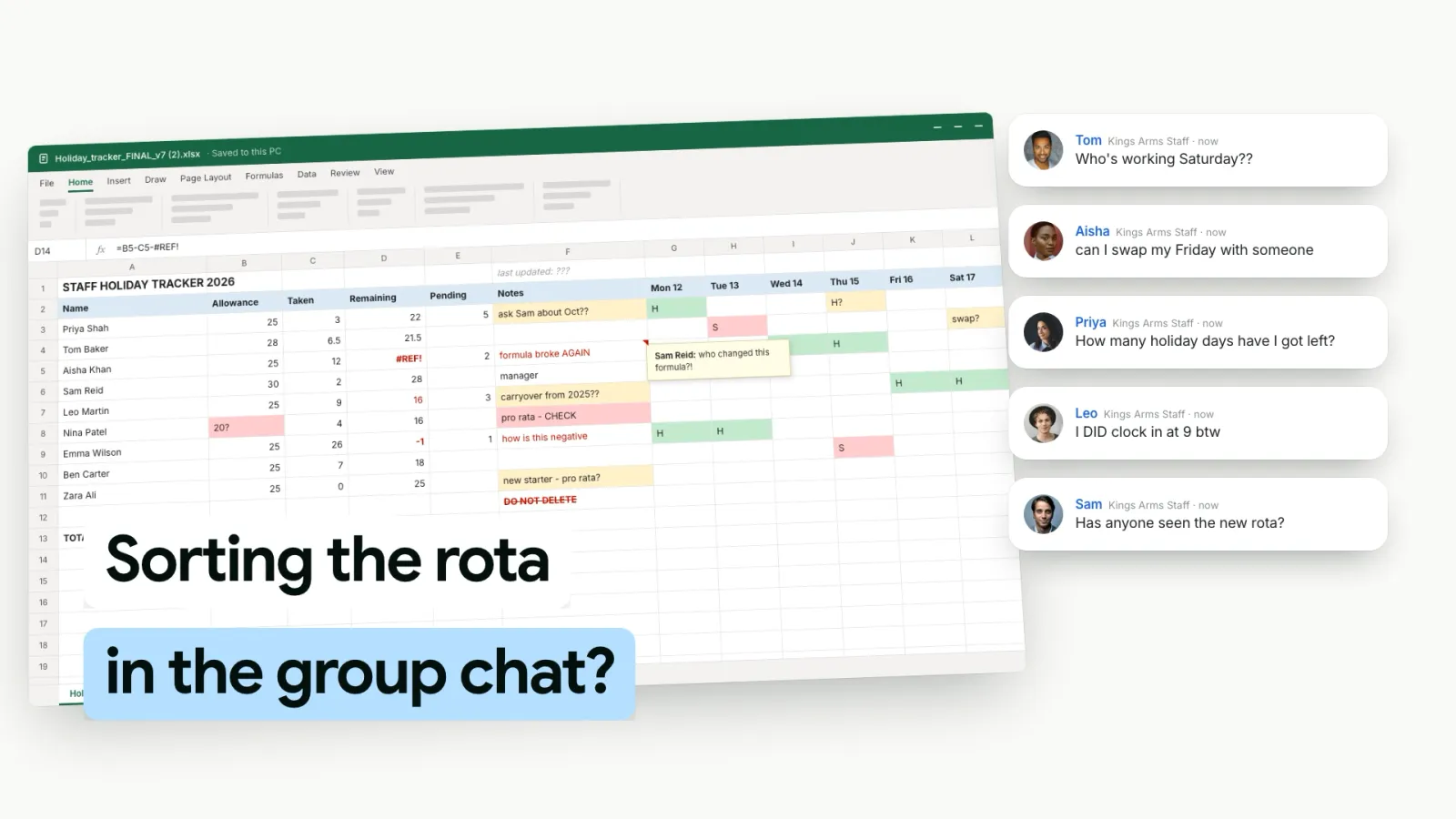
- Leave in one place, rota in another. Approve a week off in an email, forget it on the rota, and you roster someone who's on a beach.
- No record of who had what. Without it, next year's arguments start from memory.
- Refusing too late. A refusal needs as much notice as the leave asked for, plus one day. Decide on popular weeks early so nobody has already booked flights.
When two requests do collide, our guide to clashing holiday requests covers how to decide and how to say no well.
How TimeTally Helps With the Holiday Rota
A spreadsheet works for a small team that books a few weeks a year. Once requests come in by text, email and in passing, TimeTally keeps leave and the rota in one place:
- Requests from their phone. Staff ask for leave in the app and see their balance before they ask; you approve or decline.
- A team leave calendar. See everyone's approved leave on one calendar. You can let staff see colleagues' approved leave too, so they can pick weeks that are free.
- Leave on the rota. Approved holiday shows on the rota grid, and TimeTally asks before you put a shift on a day someone is off.
- Balances worked out. Allowances, pro rata for starters, and carry-over between leave years, so remaining days are always up to date.
One honest limit: TimeTally warns you when approving a request would double-book that person, but it doesn't enforce a team-wide "most people off at once" rule. Check the team calendar before approving the popular weeks. It costs £3 per employee per month; see the staff holiday tracker and leave tracking software pages for more.
 TimeTally
Holiday Requests and the Rota in One Place
Staff ask from their phone, you approve, and the leave shows on the team calendar and the rota.
Key Takeaways
- A holiday rota is a calendar of approved leave plus the rules for booking it
- 2027 bank holidays include Good Friday 26 March, and Christmas moves to Monday 27 and Tuesday 28 December
- Set the most people who can be off at once, by role, and check it before approving
- Use a booking window and a priority log for school holidays and Christmas
- Default notice: twice the leave plus a day to ask; the leave plus a day to refuse
- Bank holidays don't have to be given off, and can count towards the 5.6 weeks
Frequently Asked Questions
What is a holiday rota?
A holiday rota is the plan for who can be off when: a yearly calendar of everyone's approved leave, plus the rules for booking it, such as how many people can be off at once, who gets priority for school holidays and Christmas, and how much notice staff must give.
What is a rotating holiday?
A rotating holiday system shares the most popular periods in turn. Whoever had the summer school holidays or Christmas off this year goes to the back of the queue for them next year, so the same people don't get the best weeks every year.
Where can I find a staff holiday calendar for 2027?
Download the free 2027 staff holiday planner on this page. It has every day of 2027 across the top, England and Wales bank holidays already marked, the Scotland and Northern Ireland dates on a second sheet, and allowance, taken and remaining columns that work themselves out. GOV.UK publishes the official bank holiday dates.
Is 4 February 2026 a bank holiday?
No. There is no bank holiday in February anywhere in the UK. In 2026, England and Wales went from New Year's Day to Good Friday on 3 April; Northern Ireland had St Patrick's Day on 17 March in between, and Scotland had 2 January.
What is pro rata holiday?
Pro rata holiday is the statutory 5.6 weeks scaled to the days someone works. A part-timer on 3 days a week gets 3 × 5.6 = 16.8 days a year; someone who starts or leaves part-way through the leave year gets the share for the part they worked. Our pro rata holiday calculator does the sum.
How much notice do staff have to give to book holiday?
By default, at least twice as long as the leave plus one day: a week (5 days) off needs 11 days' notice. You can refuse with as much notice as the leave plus one day. Your contracts can set different rules, and most employers ask for more notice for long or popular periods.
Sources
- UK bank holidays — GOV.UK
- Holiday entitlement: booking time off — GOV.UK
- Holiday entitlement: bank holidays — GOV.UK