
Rota Laws UK: The Seven Rules Every Staff Rota Has to Follow

Search for "rota law" and you'll find plenty about the 48-hour week and very little about the rota itself. That's because the UK has no single rota law. A rota is legal when it fits seven separate sets of rules: the contract, working time limits, the extra limits for under-18s, Sunday working rights, equality law, minimum wage law and record keeping.
This guide puts all seven in one place, as they stand in October 2026, with what each one means when you sit down to write next week's rota. For the hours and rest rules in depth, see our Working Time Regulations guide.
The short answer
- There is no legal minimum notice for a rota yet. Notice for zero-hours workers is coming under the Employment Rights Act 2025, listed for 2027.
- You can only change fixed days or hours with the worker's agreement.
- Every rota must leave 11 hours' rest between days, a weekly day off and a 20-minute break in shifts over 6 hours.
- Under-18s, Sunday shop work and night work have stricter rules.
- Keep records of the hours people actually worked, not just the rota.
Rota Laws UK at a Glance
| Rule | What it means for the rota | Where it comes from |
|---|---|---|
| Notice | No legal minimum yet; set by the contract or your policy | Contract; Employment Rights Act 2025 (2027) |
| Changes | Fixed days and hours need agreement to change | Contract and written statement |
| Hours and rest | 48-hour average, 11 hours between days, a weekly day off, 20-minute break | Working Time Regulations 1998 |
| Under-18s | 8 hours a day, 40 a week, 12 hours' rest, limits on nights | Working Time Regulations 1998 |
| Sundays | Shop and betting staff can opt out | Employment Rights Act 1996 |
| Fairness | Patterns can't put carers, a religion or part-timers at a disadvantage without good reason | Equality Act 2010; part-time worker rules |
| Pay and records | Minimum wage for all working time; keep records of hours worked | Minimum wage law; WTR regulation 9 |
1. How Much Notice Do You Have to Give for a Rota?
Today, none set by law. No UK statute says a rota must be published a week, or two weeks, in advance. The notice you owe comes from the contract, a staff handbook that forms part of it, or what you've always done (a long, consistent practice can become an implied term).
What the law does require is a written statement on day one. Since April 2020 it has to say which days and hours the person must work, and whether those can vary and how. If you rota people week by week, the statement should say so. If it promises Monday to Friday, nine to five, a rota that says otherwise is a change of contract.
This is about to change for some workers. The Employment Rights Act 2025 gives zero-hours and similar workers a right to reasonable notice of shifts, and to a payment when a shift is cancelled or cut at short notice. The government lists both among its measures for 2027, and the notice period itself will be set in regulations. Our guide to shift notice under the Employment Rights Act tracks what's been decided.
Until then, a fair working rule is two weeks for regular staff and as much as you can manage for anyone on variable hours. Publishing late is legal. It's also the most common reason people swap, drop or no-show on shifts.
2. Can You Change a Rota After It's Published?
It depends on what the contract says about hours:
- Fixed days and hours. Changing them needs the worker's agreement. Moving someone from weekdays to weekends without it is a breach of contract, and repeated or serious changes can support a constructive dismissal claim.
- Hours that vary by rota. You can change the pattern, but a flexibility clause has to be used reasonably. Courts read in a duty not to destroy trust and confidence, so a habit of changes the night before is risky even where the contract allows them.
- Zero hours. There's no obligation to offer work, so shifts can be offered and withdrawn. Once the 2025 Act's provisions start, cancelling at short notice will cost a payment.
Whatever the contract, a shift someone has already started has to be paid for the time they were at work, at least at minimum wage. Sending someone home an hour into a shift doesn't make that hour free.
3. Hours and Rest: The Working Time Rules
The Working Time Regulations 1998 set the limits every adult rota has to fit:
- 48 hours a week on average, usually over 17 weeks. Staff can opt out in writing, and can't be made to.
- 11 hours' rest in a row between working days. A close at 11pm followed by a 7am open breaks it.
- 24 hours off each week, or 48 hours off each fortnight.
- A 20-minute break in any day over 6 hours, taken during the day, not tacked onto the end.
- Night workers average no more than 8 hours in 24, and must be offered a free health assessment.
Some jobs can move the rest to another time instead, as long as the worker gets equivalent rest later: our guide to rest between shifts covers those exceptions and the late-then-early trap. Whether the break is paid is a separate question, answered in are breaks paid in the UK.
4. Under-18s on the Rota
Young workers (over school leaving age but under 18) have tighter limits, and they can't opt out of them:
- No more than 8 hours a day or 40 hours a week
- 12 hours' rest between working days and 48 hours off each week
- A 30-minute break once they work more than 4.5 hours
- Night work is restricted, with limited exceptions for some sectors (GOV.UK lists them)
Children still of school age have stricter rules again, set partly by local councils, and usually need a work permit from the council. If your weekend team includes 15-year-olds, check your council's rules before they go on the rota.
5. Sunday Working
In England and Wales, shop workers and betting shop workers can opt out of Sunday work. They give written notice, and after 3 months they no longer have to work Sundays. If you didn't give them a written explanation of this right within 2 months of starting, the notice drops to 1 month. Shop workers employed before 26 August 1994 can usually refuse Sundays outright.
Two things follow for the rota. You can't treat someone worse for opting out: no losing shifts, no being passed over. And Sunday rota gaps need planning months ahead, not the week before. Scotland and Northern Ireland have their own versions of these rules. Outside shops and betting, there's no Sunday right unless the contract gives one.
6. Fair Rotas and Discrimination
A rota pattern can be discriminatory even if nobody meant it to be. Always putting the early shifts on the same people, refusing every Friday evening off, or making late finishes compulsory can put parents (still more often women), people of a particular religion or disabled staff at a disadvantage. That's indirect discrimination unless you can show it's a proportionate way to meet a real business need.
Part-time staff must not get a worse pattern just because they're part-time. And since April 2024 everyone can make a flexible working request from day one: two a year, with a decision due within two months. A request to change shift times is exactly that. Our guides to a fair rota system and flexible working requests go further.
“The app is simple to use, reliable, and makes managing staff records straightforward. The system has saved us a significant amount of administration time.”
 Jordan Ingoe, CLI Manchester
Check a rota before you send it
Build next week in the free rota maker. It flags anyone without 11 hours' rest, over 48 hours, or short of a break.
7. Pay and Records
Every hour someone is required to be at work counts for the minimum wage, rostered or not: the 15-minute handover before the shift, the briefing, cashing up after the last customer leaves. If the rota says 9 to 5 but staff have to arrive at 8:45, the rota is wrong, not the pay.
You must keep records that show you're within the 48-hour and night work limits (for two years), and minimum wage records for six years. A rota is a plan, not a record. If someone stays an hour late, the rota doesn't show it; their clock-in or timesheet does. Our guide to tracking employee hours legally explains what counts as a good record.
A Five-Minute Legal Check Before You Publish
- Contract: does anyone have fixed days or hours that this rota changes? If so, have they agreed?
- Rest: look for late-then-early pairs (11 hours, 12 for under-18s) and anyone without a day off this week.
- Hours: who is near 48 hours on average without an opt-out? Which under-18s are over 8 a day or 40 a week?
- Sundays: is anyone on a Sunday who has opted out?
- Leave: is anyone rostered on a day they've booked off?
- Fairness: are the worst shifts landing on the same people again?
- Notice: are you publishing in time to meet your own policy?
How TimeTally Helps
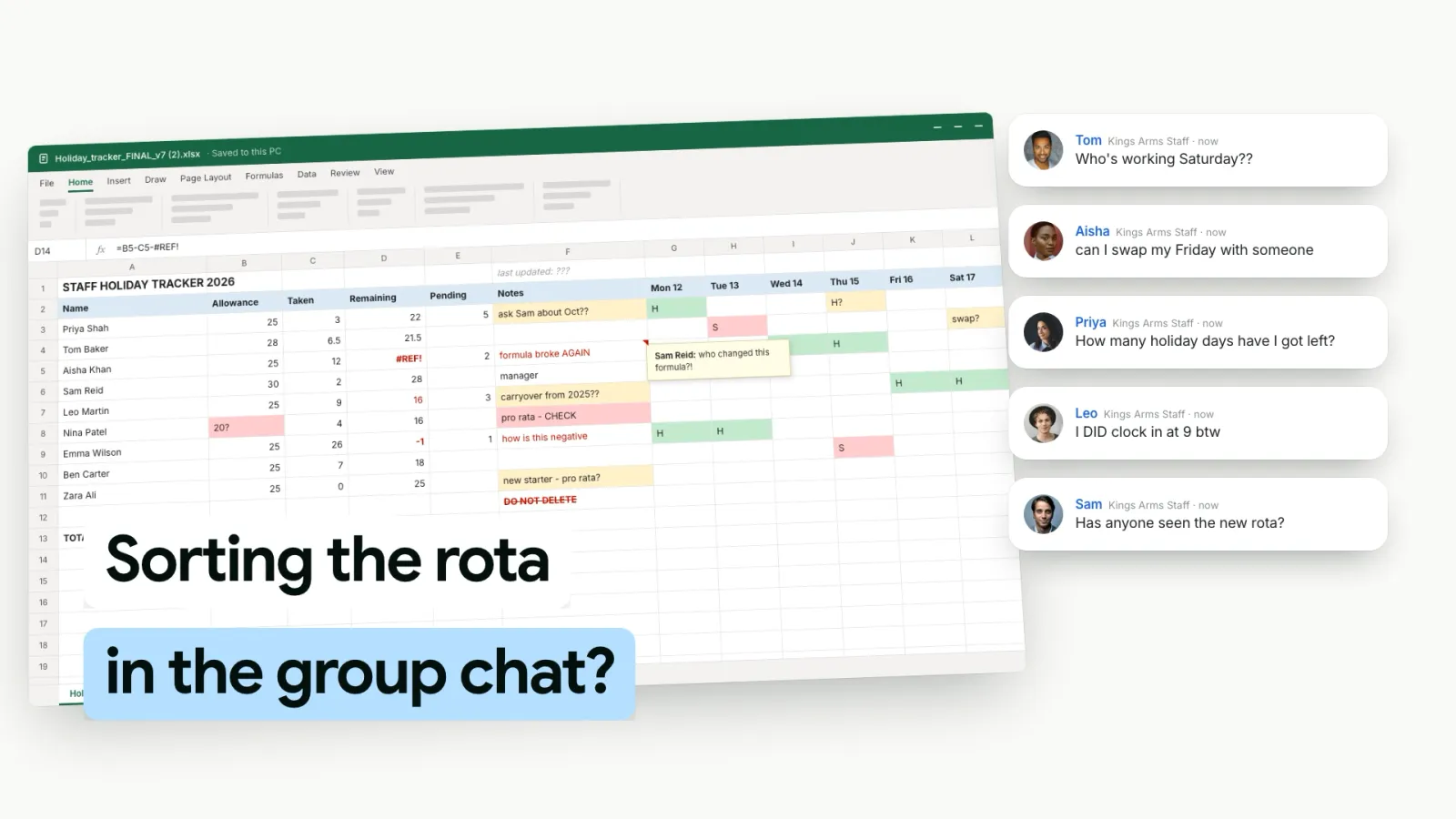
A rota in a spreadsheet or the group chat makes the checks above harder than they need to be. In TimeTally:
- Staff see their shifts on their phone in the staff rota app once you publish the week, and you can email the team to say it's out. Nothing goes live while you're still drafting.
- Leave shows on the rota. Approved and pending holiday appear on the grid, and TimeTally asks before you put a shift on a day someone has off.
- Swaps go through you. Staff can offer a shift or swap it with a colleague; it only changes once you approve, so the rota stays the record of who should be in.
- Actual hours are recorded. Staff clock in and out on their phone, and the app compares their start with the shift, so you keep a record of hours worked, not just hours planned.
One honest limit: the 11-hour rest, 48-hour and break checks are in the free rota maker, not yet in the app's rota. TimeTally costs £3 per employee per month; the rota planner page has the details.
 TimeTally
Publish the Rota to Everyone's Phone
Build the week, check who's on leave, publish it, and keep a record of the hours people actually worked.
Free for 14 days • No credit card required
Key Takeaways
- The UK has no single rota law; seven sets of rules decide whether a rota is legal
- No minimum rota notice exists yet; zero-hours notice and cancellation pay are listed for 2027
- Fixed days and hours can only be changed with the worker's agreement
- Every rota needs 11 hours between days, a weekly day off and a 20-minute break over 6 hours
- Under-18s: 8 hours a day, 40 a week, 12 hours' rest, a 30-minute break after 4.5 hours
- Shop and betting workers in England and Wales can opt out of Sundays
- Pay every hour staff must be at work, and keep records of hours actually worked
Frequently Asked Questions
What are the laws on rotas in the UK?
No single law covers rotas. A UK rota has to fit the contract (including the hours in the written statement), the Working Time Regulations (48-hour average week, 11 hours' rest between days, a weekly day off, a 20-minute break over 6 hours), the extra limits for under-18s, Sunday working rights for shop and betting workers, equality law, and minimum wage law.
How much notice does an employer have to give for a rota in the UK?
There is no legal minimum notice for a rota today. Notice comes from the contract or your own policy. The Employment Rights Act 2025 will give zero-hours and similar workers a right to reasonable notice of shifts and payment for short-notice cancellations, which the government lists among measures for 2027.
Can my employer change my rota without asking?
It depends on the contract. If it fixes the days and hours, changing them needs the worker's agreement. If it says hours vary or includes a flexibility clause, the employer can change the rota, but must use that power reasonably and give fair notice.
Is it legal to work 7 days in a row in the UK?
It can be. Adults are entitled to 24 hours off in each 7 days, or the employer can give 48 hours off in each 14 days instead. With the fortnightly option, up to 12 days in a row can be lawful, though the 48-hour average week and 11-hour daily rest still apply.
Can I refuse to work Sundays?
Shop and betting workers in England and Wales can opt out of Sunday working by giving written notice: 3 months, or 1 month if the employer didn't give them the written explanation of their rights within 2 months of starting. Other workers only have the right if their contract gives it.
Do you get paid if your shift is cancelled?
Not by law today, unless the contract says so or the worker was already at work. The Employment Rights Act 2025 will add payments for shifts cancelled at short notice for zero-hours and similar workers, once the regulations are made.
Sources
- Working Time Regulations 1998 — legislation.gov.uk
- Rest breaks at work and maximum weekly working hours — GOV.UK
- Employment rights for young people — GOV.UK
- Sunday working — GOV.UK
- Written statement of employment particulars — GOV.UK
- Employment Rights Act 2025 — legislation.gov.uk