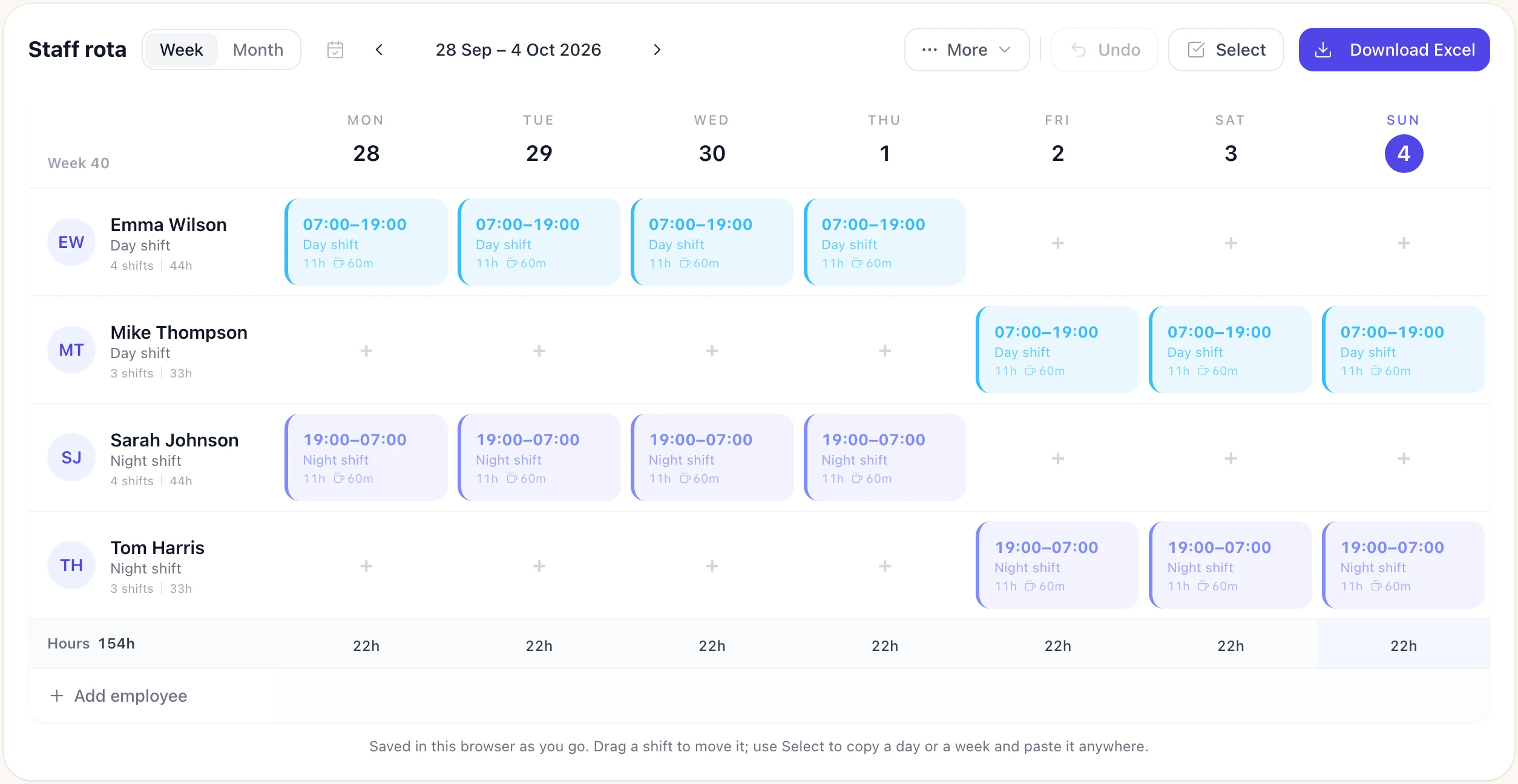
Four 12-hour shifts, then four days off, on an eight-day cycle. Here is how many days and hours that adds up to, how holiday and the rest rules work, and a 24/7 rota for four crews.
Free to use
No sign-up required
UK shift patterns built in
4-on-4-off Cycle
12h shifts
Day 1On12h
Day 2On12h
Day 3On12h
Day 4On12h
Day 5Off—
Day 6Off—
Day 7Off—
Day 8Off—
Avg 42h/week · 2,190h/year3.5 days/week
Running crews on 4 on 4 off?
Open the free rota maker with the eight-day cycle already laid out for the next four weeks: two day crews and two night crews on 12-hour shifts, so every day and night is covered. Rename each row to a person and the hours per person and per day add up as you go. It flags anyone left with less than 11 hours between shifts. No account needed to build it — sign up to print or download it and the rota comes with you.
A 4 on 4 off shift pattern is four shifts in a row followed by four days off, repeating every eight days. The shifts are almost always 12 hours, which is what lets the pattern cover a full day with two shifts and a full week with a small number of crews.
Because the cycle is eight days and the week is seven, the pattern drifts: if your first run starts on a Monday, the next one starts on a Tuesday, then a Wednesday. Your days off only land on the same weekdays again every eight weeks (56 days), which is the first thing people new to the pattern notice.
If I work 4 on 4 off, how many days a year do I work?
Half the days in the year: 182.5 shifts on average. A normal year is 45 full cycles (360 days, 180 shifts) plus five spare days, and those five days hold between one and four more shifts depending on where your cycle starts. So the real figure is 181 to 184 shifts, or 182 to 184 in a leap year.
The working
Shifts a week: 4 ÷ 8 × 7 = 3.5
Shifts a year: 365 ÷ 8 × 4 = 182.5 (183 in a leap year)
Hours a year on 12-hour shifts: 182.5 × 12 = 2,190
Average week: 3.5 × 12 = 42 hours
Shifts a month: 365 ÷ 12 ÷ 8 × 4 = 15.2 on average, 12 to 16 in practice
These are rostered shifts, before holiday. Take off statutory leave (19.6 shifts, see below) and the average worker on 4 on 4 off actually works about 163 shifts, or roughly 1,955 hours, a year. Compare that with around 233 days for someone on five days a week who takes the same 5.6 weeks off.
You may see 2,184 hours quoted instead of 2,190. That is 42 hours × 52 weeks, which leaves out the 365th day. Both are right for what they measure. To put your own hourly rate and shift length in, use the shift pattern calculator, which has 4 on 4 off as its default.
A 4 on 4 off rota for 24/7 cover
Covering every hour of every day with 12-hour shifts takes four crews. The common UK version is two days, two nights, four off, with each crew starting two days after the one before. Every day then has exactly one crew on days and one on nights. Here are the first 16 days:
Day
1
2
3
4
5
6
7
8
9
10
11
12
13
14
15
16
Crew A
D
D
N
N
—
—
—
—
D
D
N
N
—
—
—
—
Crew B
—
—
D
D
N
N
—
—
—
—
D
D
N
N
—
—
Crew C
—
—
—
—
D
D
N
N
—
—
—
—
D
D
N
N
Crew D
N
N
—
—
—
—
D
D
N
N
—
—
—
—
D
D
D is a day shift (say 07:00 to 19:00) and N a night shift (19:00 to 07:00). Going from days to nights this way leaves 24 hours between the last day shift and the first night, and the four days off start after the second night.
The other common version keeps crews on fixed shifts: two crews only ever work days and two only ever work nights. It is simpler to staff, but the night crews are permanent night workers, which brings the night work rules below into play for them all year. If you only need cover in the day, two crews on 4 on 4 off are enough.
Holiday on 4 on 4 off
Almost all workers are entitled to 5.6 weeks of paid holiday a year. On 4 on 4 off that is 5.6 × 3.5 = 19.6 shifts, which on 12-hour shifts is 235.2 hours. GOV.UK says statutory paid holiday "is limited to 28 days", but that cap only bites for people who work more than five days a week; 19.6 shifts is well under it.
Book it in hours, not days. A "week off" on this pattern might cost someone two shifts or four depending on where it falls in the cycle, so a day-based allowance quietly favours whoever books the right week. Deducting 12 hours per shift taken treats everyone the same. Our holiday calculator handles part-time and mid-year starters.
One check if staff are paid per shift worked rather than a salary: the number of paid hours changes from month to month (12 to 16 shifts). The irregular-hours rules, which accrue holiday at 12.07% of hours worked, apply where paid hours in each pay period are "wholly or mostly variable" under the contract (Working Time Regulations, regulation 15F). A fixed, contracted 4 on 4 off rota on an annualised salary is not that; if your contract is unclear, take advice.
Working time rules on a 4 on 4 off rota
48-hour average. Workers cannot work more than 48 hours a week on average, normally over 17 weeks, unless they opt out. At 42 hours the base rota is under it, with a margin of six hours a week. Regular overtime or long handovers can use that up.
Rest between shifts. The minimum is 11 hours between working days. A 12-hour shift leaves exactly 12, so a one-hour overrun puts you on the line. Each 12-hour shift also needs an uninterrupted 20-minute break, because the right applies to anyone working more than six hours a day. Weekly rest (24 hours a week or 48 a fortnight) is covered by the four days off. See our Working Time Regulations guide for the full rules.
Night work. Anyone who regularly works at least three hours between 11pm and 6am is a night worker, and must not work more than an average of eight hours in 24, usually over 17 weeks (regular overtime counts). A crew working four 12-hour nights every eight days averages six hours across the days in the period, or seven once the weekly rest days are taken out as regulation 6(5) requires, so it fits. The exception is work with special hazards or heavy physical or mental strain: those night workers cannot work more than eight hours in any 24-hour period, so 12-hour nights are out for them.
Overtime and pay.There is no legal overtime rate: GOV.UK says "Employers do not have to pay workers for overtime", as long as average pay across all hours worked does not fall below the National Minimum Wage. Because a month can hold 12 or 16 shifts, check the minimum wage over each pay period, not just on the annual figure.
Pros and cons of 4 on 4 off
Why people like it
Four full days off every eight
About 163 working days a year after holiday, against about 233 on five days a week
Four crews cover 24/7 at 42 hours a week each
Long blocks off for childcare swaps, study or a second job
What to watch
Four 12-hour shifts in a row is tiring, especially on nights
Days off drift through the week; weekends line up only every eight weeks
12 to 16 shifts a month makes hourly pay uneven
Little slack for overruns before the 11-hour rest is breached
You will find it wherever work runs every day: manufacturing and process plants, security, control rooms and emergency services, healthcare and care. Where staff want predictable weekends, the continental (2-2-3) pattern locks to the calendar every fortnight instead.
TimeTally does not generate an eight-day cycle for you, but the rotation only repeats against the calendar every eight weeks, so you build it once. Save your day and night shifts as templates (overnight shifts count correctly), save each week of the rotation as a week template and apply it to the weeks it belongs in, then publish the rota to your team's phones.
Set an alert for anyone rostered over a weekly hours limit, track holiday in hours, and let staff request shift swaps. £3 per employee per month.
You work four shifts in a row, then have four days off, and the cycle repeats every eight days. The shifts are usually 12 hours long, so it averages 3.5 shifts and 42 hours a week. Because the cycle is eight days rather than seven, your days off move through the week.
If I work 4 on 4 off, how many days a year do I work?
182.5 on average: half of the 365 days. In practice it is 181 to 184 rostered shifts in a normal year depending on where your cycle starts, and 182 to 184 in a leap year. That is before holiday. Statutory leave takes 19.6 shifts off that, so on average you actually work about 163 shifts a year.
How many hours a year is 4 on 4 off on 12-hour shifts?
About 2,190 rostered hours (182.5 shifts × 12), an average of 42 hours a week. Some tools multiply 42 by 52 weeks and get 2,184; the difference is the extra day in a 365-day year. Take away 235.2 hours of statutory holiday and you work about 1,955 hours.
How many days a month do you work on 4 on 4 off?
Between 12 and 16 shifts, about 15.2 on average. A 31-day month holds 15 or 16 shifts, a 30-day month 14 to 16, and February 12 to 16, depending on where the cycle falls. That uneven monthly total is why many employers pay 4 on 4 off staff an annualised salary.
How much holiday do you get on 4 on 4 off?
Statutory leave is 5.6 weeks. At 3.5 shifts a week that is 19.6 shifts, or 235.2 hours on 12-hour shifts. The 28-day cap does not come into it, because 19.6 shifts is well under 28 days. Many employers book leave in hours so that every shift counts the same.
Is 4 on 4 off legal under the Working Time Regulations?
Yes. 42 hours a week is under the 48-hour average, 12-hour shifts leave 12 hours of rest before the next one (the minimum is 11), and four days off covers weekly rest. Watch overruns, regular overtime and night work: night workers average 8 hours in 24, and those whose work involves special hazards or heavy strain cannot work more than 8 hours in any 24-hour period of night work.