








Free Shift Pattern Calculator

6 on 4 off shift pattern calculator

Six shifts on, then four days off, on a ten-day cycle. Enter your hourly rate to see average weekly hours, annual hours and gross pay, and how the pattern sits against the 48-hour limit.

  • Free to use
  • No sign-up required
  • UK shift patterns built in
Rota softwareLay the ten-day cycle out for both teams, publish it to their phones and let them swap shifts. £3 per employee a month.On your team's phones · £3 per employee

One 6-on-4-off cycle, day by day

  1. Day 110h
  2. Day 210h
  3. Day 310h
  4. Day 410h
  5. Day 510h
  6. Day 610h
  7. Day 7Off
  8. Day 8Off
  9. Day 9Off
  10. Day 10Off

10day cycle

Hours per shift

Enter it to see gross pay for a year and a month

Hours a week
42h
Hours a year
2,190h
Shifts a year
219

4.2 shifts a week on average · 42h a week · 2,184h over 52 weeks

Working Time Regulations: This pattern averages under the 48-hour limit. Overtime and cover shifts count towards the 17-week average, so check it if staff pick up extra shifts.

Put this pattern on a rota

Free rota maker, the next 4 weeks filled in. No sign-up needed.

How the 6-on-4-off cycle works

The pattern runs on a ten-day cycle: six shifts, then four days off. Ten days is three more than a week, so each new run starts three weekdays later than the last. It comes back to its starting weekday after seven cycles, or 70 days.

In those 70 days a worker does 42 shifts. On 10-hour shifts that is 420 hours over ten weeks, an average of 42 hours a week and about 2,190 hours a year.

No two neighbouring weeks are alike: from a Monday start they run 60, 40, 30, 50, 50, 30, 40, 60, 30 and 30 hours. Two weeks in ten go over 48, which is allowed, because the 48-hour limit is an average, normally over 17 weeks.

  • Cycle length10 days
  • Average week (10h shifts)42 hours
  • Annual hours (10h shifts)2,190
Ten weeks from a Monday start, until a run starts on a Monday again
  • Week 1: 60h
  • Week 2: 40h
  • Week 3: 30h
  • Week 4: 50h
  • Week 5: 50h
  • Week 6: 30h
  • Week 7: 40h
  • Week 8: 60h
  • Week 9: 30h
  • Week 10: 30h

Where it is used

Six-on-four-off gives a four-day break every cycle in exchange for a long run of shifts. It suits teams that value long breaks: some care, healthcare and site-based roles where staff travel a distance to work.

Covering every day on 10-hour day shifts takes two teams, with an overlap on some days you can use for handovers or training.

Two teams on 10-hour day shifts (D, 07:00 to 17:00), the second starting four days after the first. Every day has a team on, and on days 5 and 6 of every ten both are in: that is the overlap.

Two teams on 6 on 4 off: the first 20 days
Day1234567891011121314151617181920
Team ADDDDDD————DDDDDD————
Team B————DDDDDD————DDDDDD

6 on 4 off hours by shift length

Six shifts in every ten days is 4.2 a week on average, so each extra hour on the shift adds 4.2 hours to the average week. The dashed line is the 48-hour average limit.

6 on 4 off: average week and a year's hours on 8, 10 and 12-hour shifts, against the 48-hour limit
ShiftAverage weekA year48-hour limit
8 hours33h 36m1,752Under the limit
10 hours42h2,190Under, with 6 hours to spare
12 hours50h 24m2,628Over 48: needs a written opt-out

Working Time Regulations: what to watch

The 48-hour limit. On 10-hour shifts the pattern averages 42 hours, leaving 6 hours a week for overtime before the limit. On 12-hour shifts it averages 50.4 hours and needs a signed opt-out.

Daily rest. A 10-hour shift leaves 14 hours before the next one, comfortably over the 11 hours required. Overruns and long handovers are what eat into it.

Night workers. If the run is on nights, a night worker's normal hours should average no more than 8 in 24, and they must be offered a free health assessment. Six 10-hour nights every ten days average six hours a day, or seven once the weekly rest days are taken out of the reference period. Night work with special hazards or heavy strain is capped at 8 hours in any 24, which rules 10-hour nights out.

Holiday entitlement on 6 on 4 off

A week off can cost three to six shifts on this pattern, depending on where it falls, so counting leave in days is unfair.

Count it in hours. Statutory leave is 5.6 weeks, so a 42-hour average week gives 235.2 hours of paid leave a year. Take off the length of each shift as it is booked.

Our pro rata holiday calculator does the same sums for part-timers and mid-year starters.

Planning a 6 on 4 off rota?

Open the free rota maker with the ten-day cycle laid out for the next four weeks: six 10-hour shifts on and four off, with two teams so someone is on every day, and the hours per person and per day totalled as you go. No account needed to build it. Sign up to print or download it and the rota comes with you.
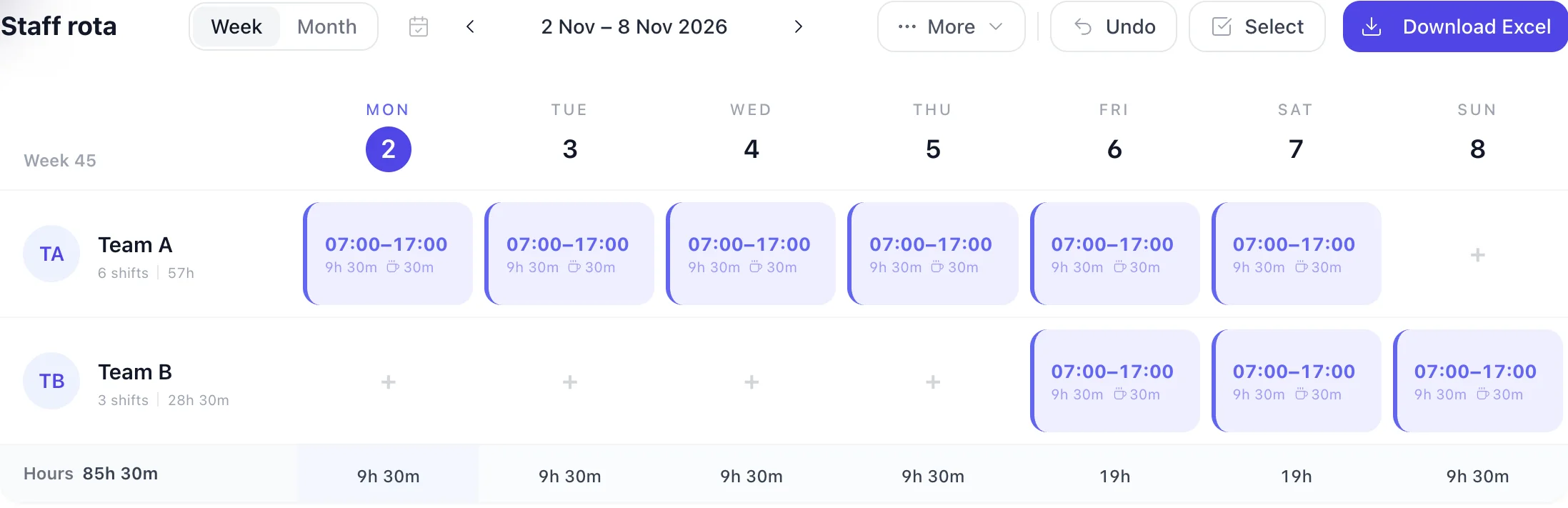
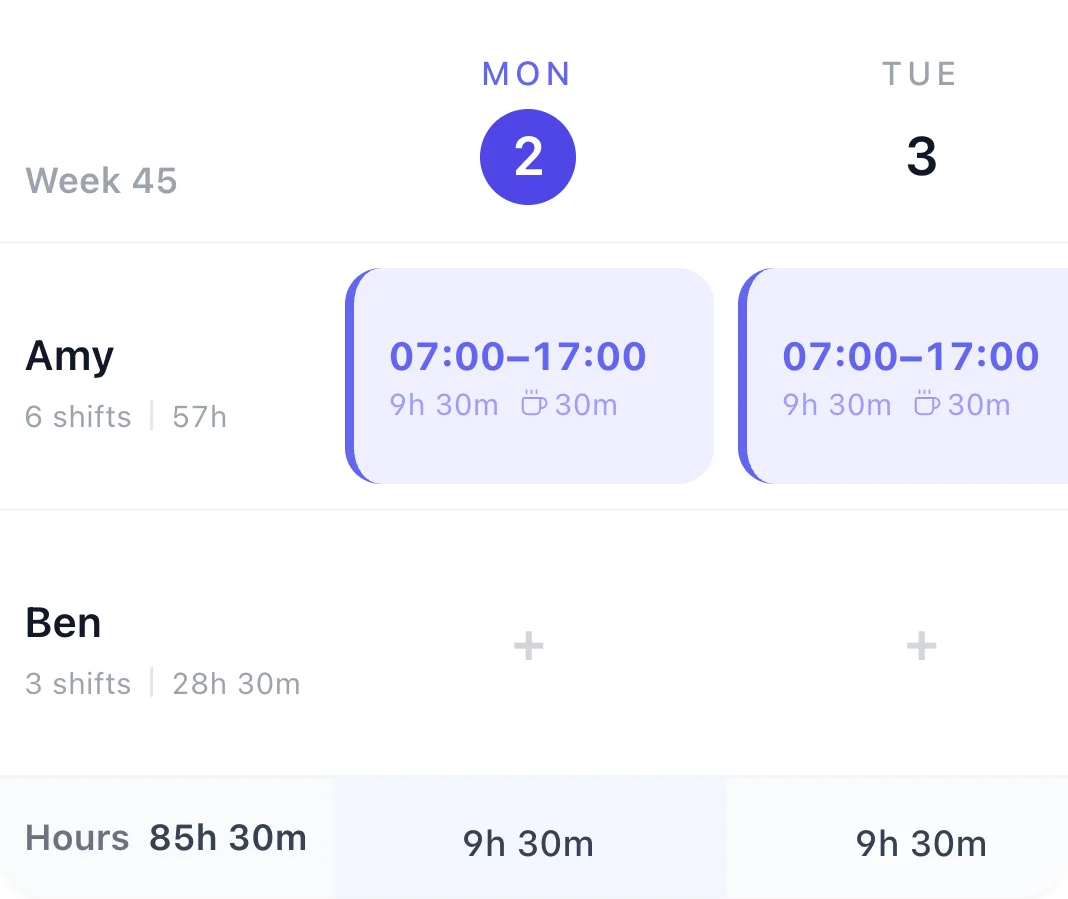
The free rota maker with 6 on 4 off laid out: two teams on 10-hour shifts, six on and four off, with hours per person and per day

Run the 6 on 4 off rota in one app

Publish the rota to your team's phones, let staff clock in against their shifts, and send approved hours to Xero, QuickBooks or a CSV. Leave can be booked in hours, so the cycle never distorts anyone's holiday. £3 per employee per month, free for 14 days.

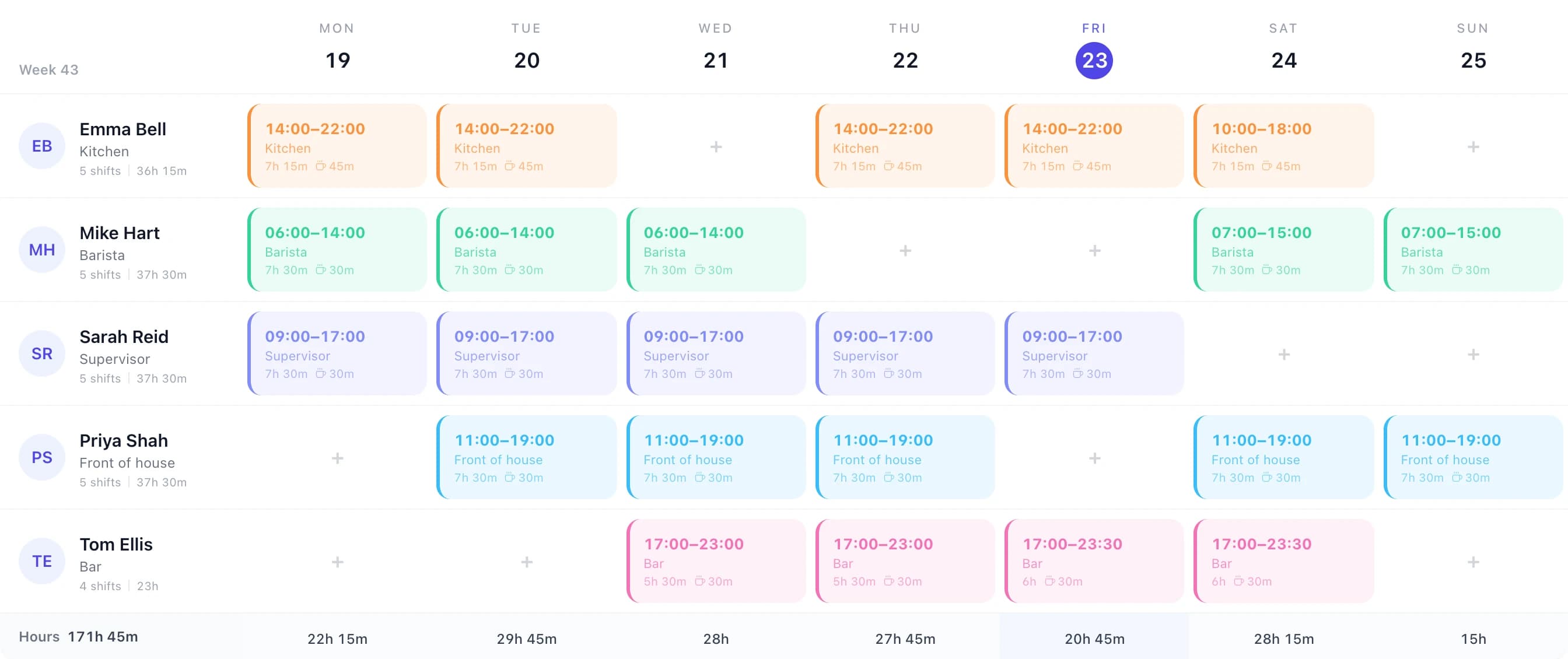
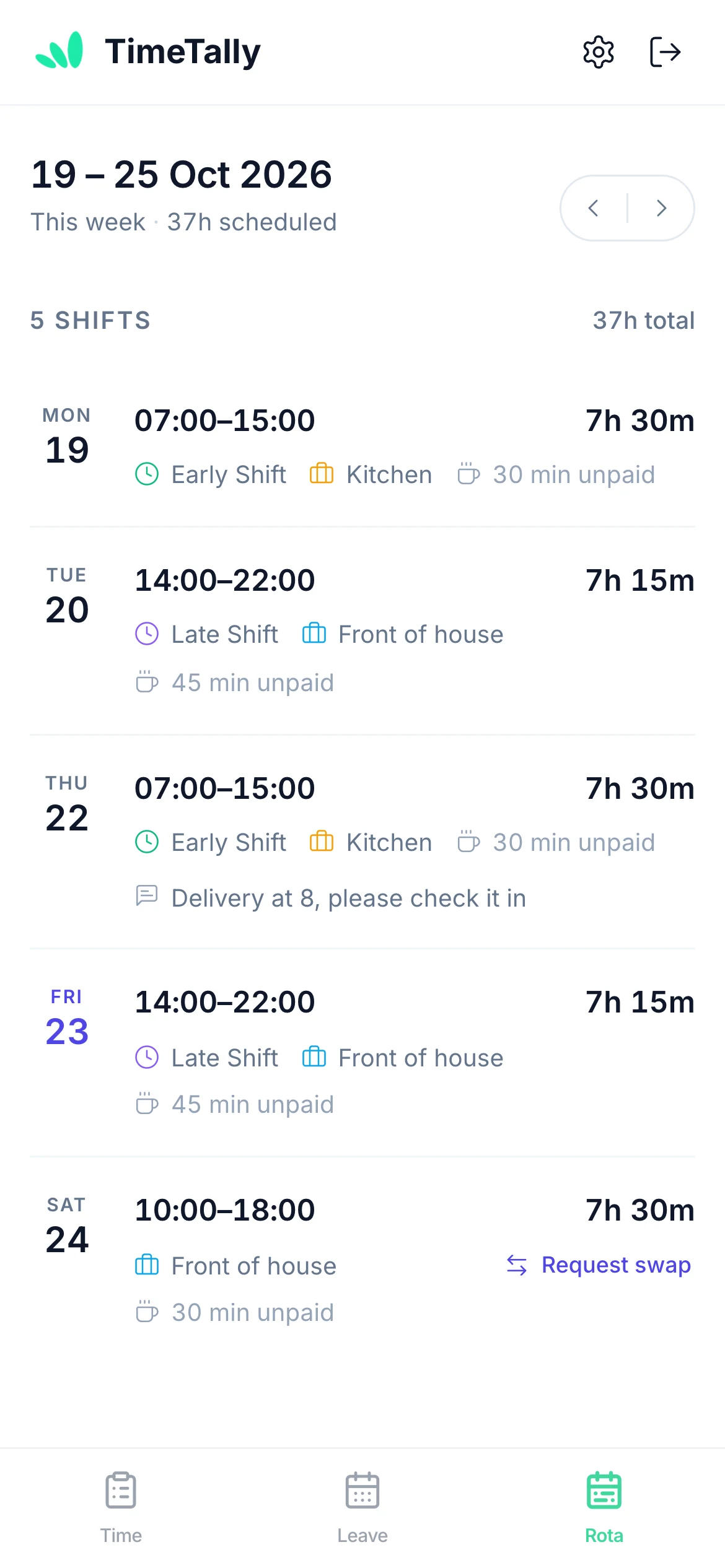
TimeTally's rota: a week of shifts for five people, with each person's shifts and hours and the hours per dayTimeTally's rota on a phone: a week of shifts with each person's hours
An employee's week of shifts in the TimeTally app, with times, hours and breaks