



Free Shift Pattern Calculator

5 on 3 off shift pattern calculator

Five shifts on, then three days off, on an eight-day cycle. Enter your hourly rate to see average weekly hours, annual hours and gross pay, and how the pattern sits against the 48-hour limit.

  • Free to use
  • No sign-up required
  • UK shift patterns built in
Rota softwarePut both teams on the eight-day cycle, publish it to their phones and turn the shifts into timesheet hours. £3 per employee a month.On your team's phones · £3 per employee

One 5-on-3-off cycle, day by day

  1. Day 18h
  2. Day 28h
  3. Day 38h
  4. Day 48h
  5. Day 58h
  6. Day 6Off
  7. Day 7Off
  8. Day 8Off

8day cycle

Hours per shift

Enter it to see gross pay for a year and a month

Hours a week
35h
Hours a year
1,825h
Shifts a year
228.1

4.38 shifts a week on average · 35h a week · 1,820h over 52 weeks

Put this pattern on a rota

Free rota maker, the next 4 weeks filled in. No sign-up needed.

How the 5-on-3-off cycle works

The pattern runs on an eight-day cycle: five shifts, then three days off. Because eight days is one more than a week, each new run starts one weekday later than the last. A run that starts on a Monday is followed by one that starts on a Tuesday, then a Wednesday, and so on. The pattern comes back to its starting weekday after seven cycles, or 56 days.

In those 56 days a worker does 35 shifts. On 8-hour shifts that is 280 hours over eight weeks, an average of 35 hours a week and about 1,825 hours a year. Over a year they work about 228 days, against 260 on a Monday-to-Friday week.

  • Cycle length8 days
  • Average week (8h shifts)35 hours
  • Annual hours (8h shifts)1,825
One 5-on-3-off cycle against the week

Day 8 ends the cycle, so the next run starts on a Tuesday.

  1. Run 1Mon
  2. Run 2Tue
  3. Run 3Wed
  4. Run 4Thu
  5. Run 5Fri
  6. Run 6Sat
  7. Run 7Sun
  8. Run 8Mon

Back on a Monday after 56 days, or 8 weeks.

5 on 3 off hours by shift length

The same eight-day cycle on longer shifts: 4.375 shifts a week on average, times the length of each shift. The dashed line is the 48-hour average limit.

5 on 3 off: average week and a year's hours on 8, 10 and 12-hour shifts, against the 48-hour limit
ShiftAverage weekA year48-hour limit
8 hours35h1,825Under the limit
10 hours43h 45m2,281Under the limit, with 4h 15m to spare
12 hours52h 30m2,738Over 48: needs a written opt-out

How many days a year do you work on 5 on 3 off?

Five days in every eight: 228 shifts on average. A normal year is 45 full cycles (360 days, 225 shifts) plus five spare days, and those five days hold between two and five more shifts depending on where your cycle starts. So the real figure is 227 to 230 shifts, or 228 to 230 in a leap year, before holiday.

Where is your cycle on 1 January?
Which year?

230shifts this year

1,840 hours before holiday. 45 whole cycles give 225 shifts, and the five days left at the end of December hold five more. Any start gives 227 to 230 a year; across them all it averages 228.1.

  1. January: 20 shifts
  2. February: 18 shifts
  3. March: 19 shifts
  4. April: 18 shifts
  5. May: 20 shifts
  6. June: 20 shifts
  7. July: 19 shifts
  8. August: 19 shifts
  9. September: 18 shifts
  10. October: 19 shifts
  11. November: 20 shifts
  12. December: 20 shifts

Months hold 18 to 20 shifts this year.

Planning a 5 on 3 off rota?

Open the free rota maker with the eight-day cycle laid out for the next four weeks: five 8-hour shifts on and three off, with two teams so someone is on every day, and the hours per person and per day totalled as you go. No account needed to build it. Sign up to print or download it and the rota comes with you.
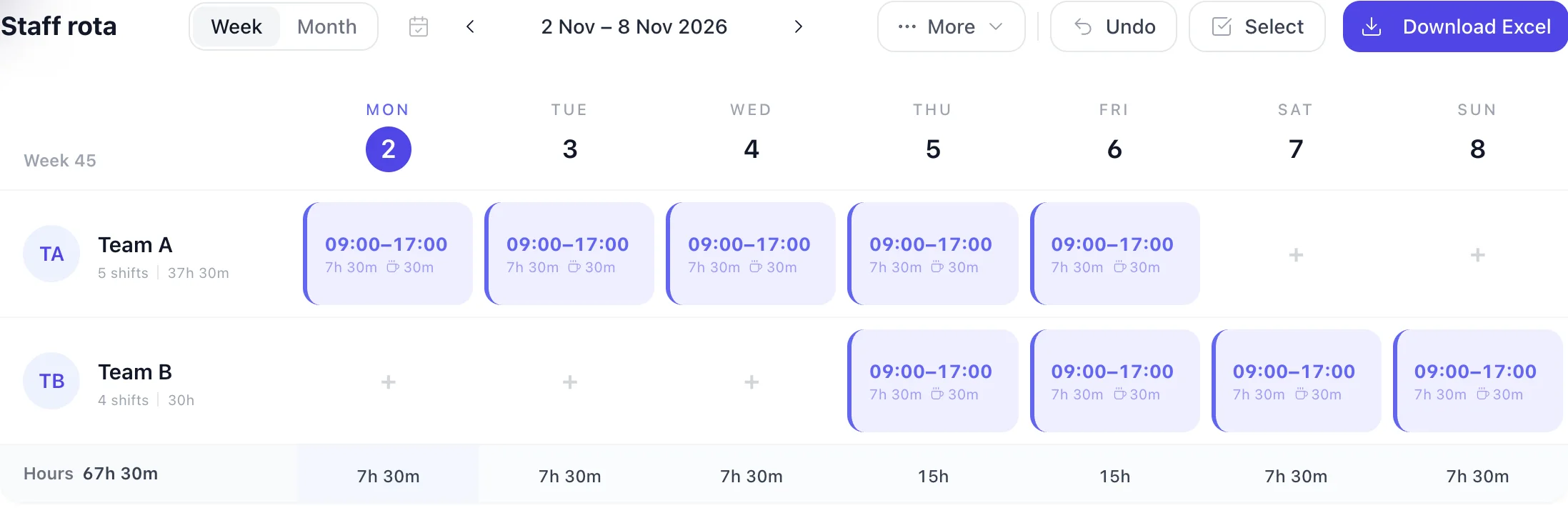
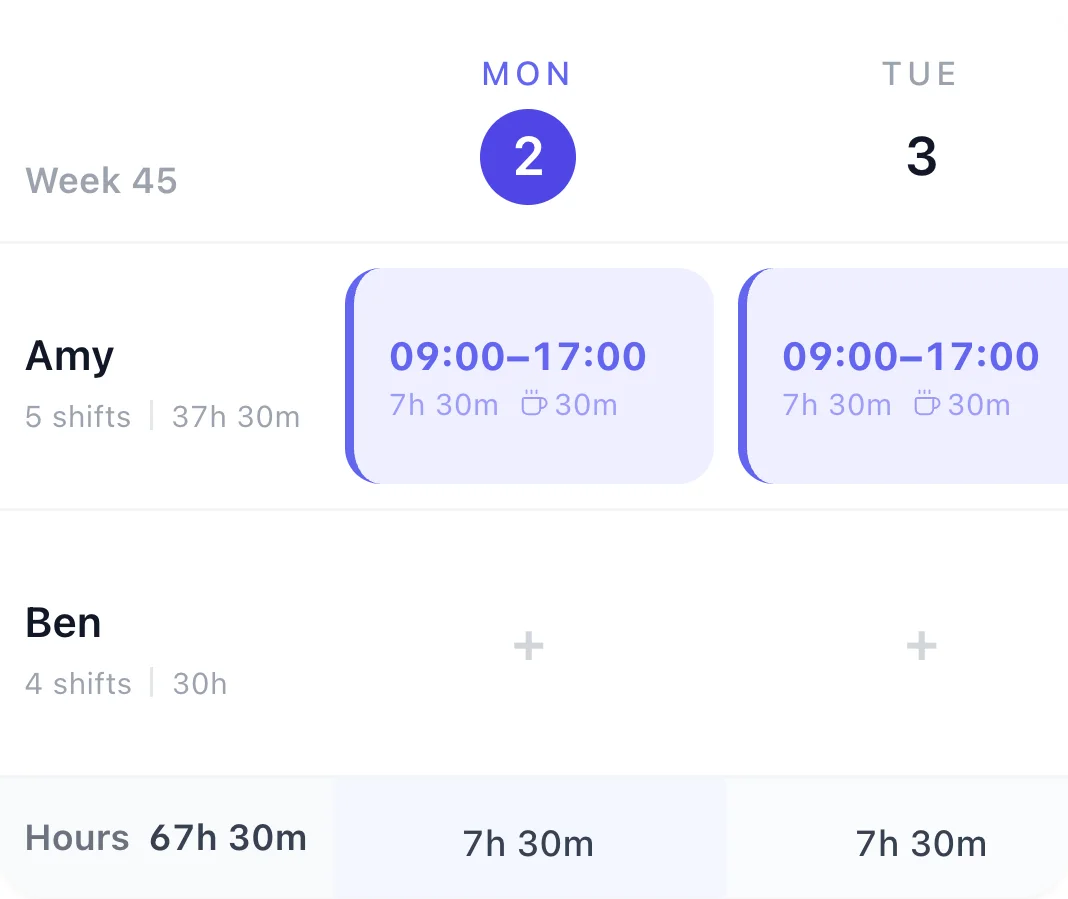
The free rota maker with 5 on 3 off laid out: two teams on 8-hour shifts, five on and three off, with hours per person and per day

Working Time Regulations: what to watch

The 48-hour limit. On 8 or 10-hour shifts the pattern sits under the weekly limit. On 12-hour shifts it averages 52.5 hours, and averaging over 17 weeks does not help, because no week on the pattern is under 48 hours. Anyone on the 12-hour version needs a signed opt-out, and can withdraw it.

Daily rest. Workers need 11 hours off in a row between shifts. If the five shifts rotate between earlies and lates, the change from a late to an early is where the 11 hours usually goes missing.

Night workers. If the pattern includes nights, a night worker's normal hours should average no more than 8 in 24, and they must be offered a free health assessment. Five 8-hour nights every eight days average five hours a day, or just under six once the weekly rest days are taken out of the reference period, so the 8-hour version fits.

Holiday entitlement on 5 on 3 off

Booking leave in days is unfair on this pattern. A week off can cost four shifts or five, depending on where it falls in the cycle.

Track entitlement in hours instead. Statutory leave is 5.6 weeks, so a 35-hour average week gives 196 hours of paid leave a year on 8-hour shifts, or 294 hours on 12-hour shifts. Take off the length of each shift as it is booked.

Our pro rata holiday calculator does the same sums for part-timers and mid-year starters.

Where it is used

Five-on-three-off is used where a site runs every day and needs a steady team on each shift: manufacturing lines, warehouses, contact centres and security contracts. It gives three days off together every cycle, which staff value, at the cost of days off that never stay on the same weekdays.

Covering every day takes two teams on 8-hour day shifts, and more if you also run lates or nights.

Planning a contact centre's staggered early, middle and late shifts instead? See call centre rota software.

Two teams on 8-hour day shifts (D, 09:00 to 17:00), the second three days behind the first: someone is on every day, and both are on two days in every eight, which is where handovers and training fit.

Two teams on 5 on 3 off: the first 16 days
Day12345678910111213141516
Team ADDDDD———DDDDD———
Team B———DDDDD———DDDDD

Run the 5 on 3 off rota in one app

Publish the rota to your team's phones, let staff clock in against their shifts, and send approved hours to Xero, QuickBooks or a CSV. Leave can be booked in hours, so the cycle never distorts anyone's holiday. £3 per employee per month, free for 14 days.

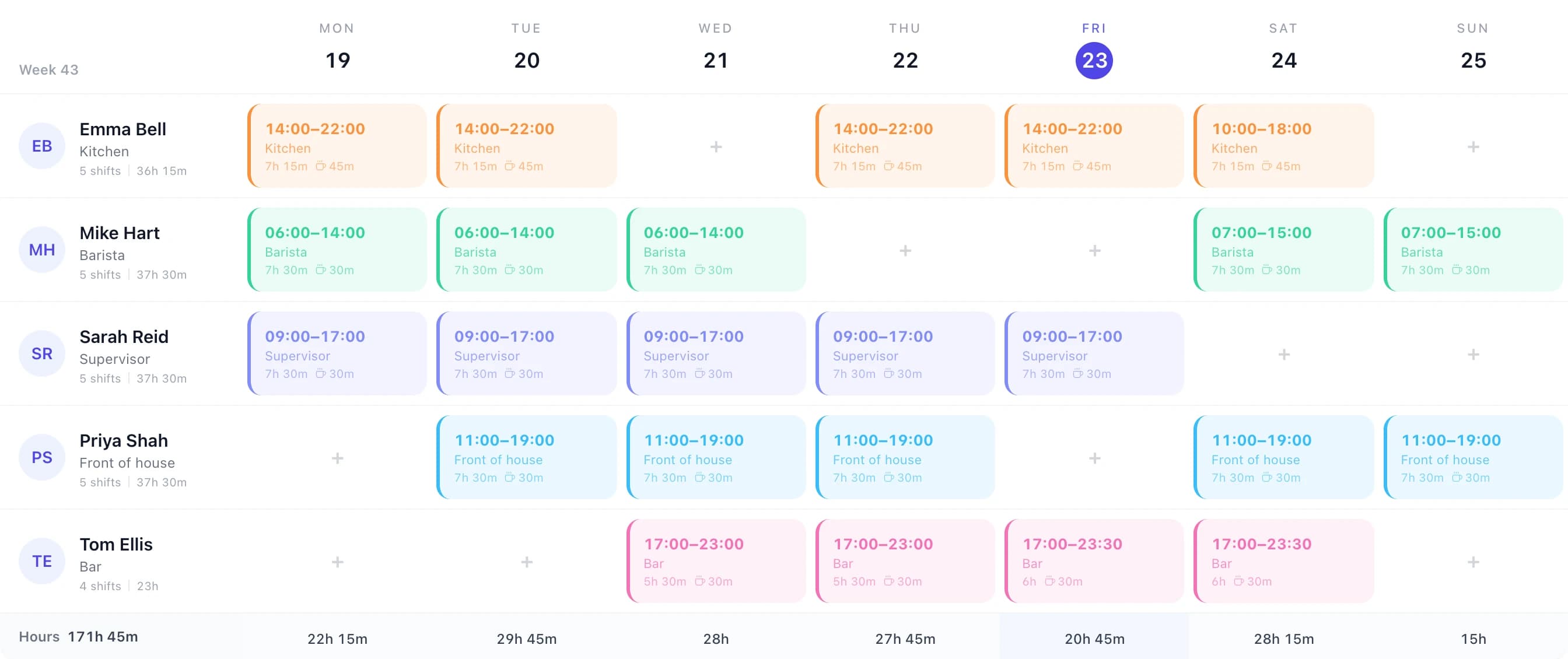
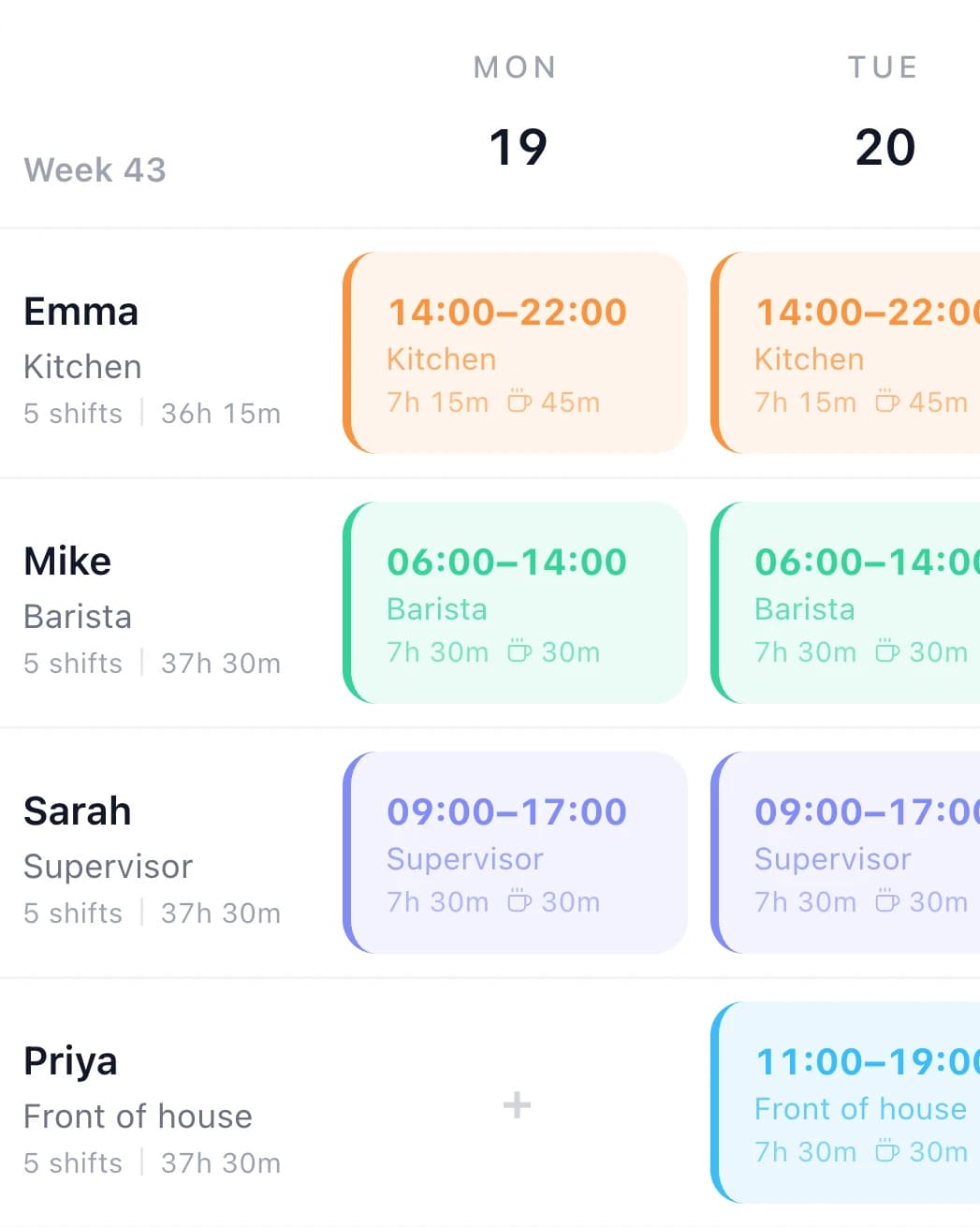
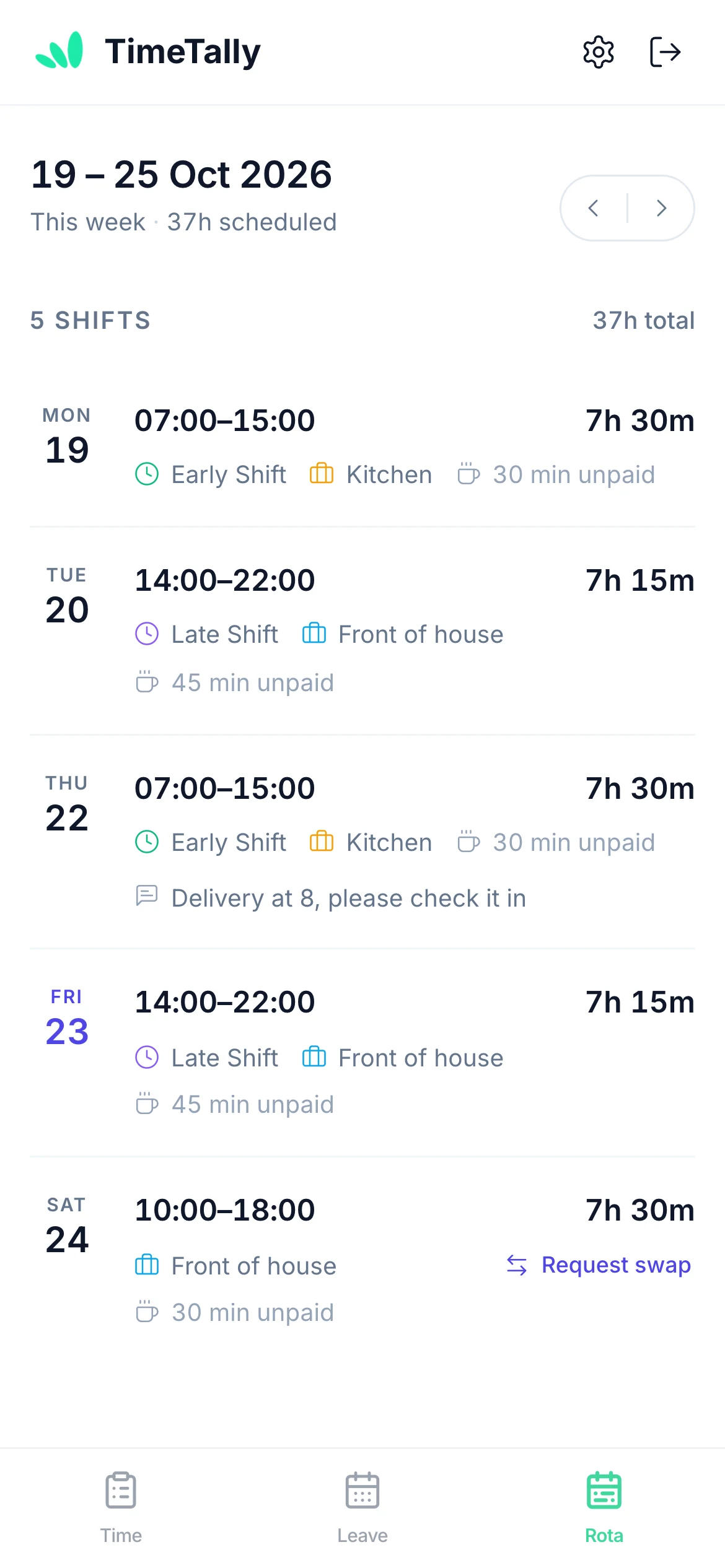
TimeTally's rota: a week of shifts for five people, with each person's shifts and hours and the hours per dayTimeTally's rota on a phone: a week of shifts with each person's hours
An employee's week of shifts in the TimeTally app, with times, hours and breaks