
HR for Small Businesses UK: What You Legally Need
A practical guide to HR compliance for UK small businesses. Covers employment contracts, payroll obligations, working time rules, holiday entitlement, record keeping, and when to use HR software.

Most small business owners didn't start a company to do HR admin. But once you employ your first person, UK law imposes a set of non-negotiable obligations — and ignoring them exposes you to HMRC investigations, employment tribunal claims, and unlimited fines.
The good news: the core compliance requirements aren't that complicated once you know what they are. This guide covers exactly what UK small businesses must have in place from day one.
Before Your First Hire — What You Must Set Up
Before you take on your first employee, there are four things you need to sort out. None of them are optional.
- Employer's liability insurance — This is a legal requirement for any business with at least one employee. You must hold a minimum of £5 million cover from an authorised insurer, and display the certificate at your workplace (or digitally). Failure to hold valid cover can result in a fine of up to £2,500 per day.
- Register as an employer with HMRC— You must register before your employee's first payday (and no more than two months in advance). Registering sets you up to run PAYE and make Real Time Information (RTI) submissions. You'll receive a PAYE reference number and Accounts Office reference you'll need for payroll.
- Written statement of employment particulars — Since April 2020, employees must receive this on their first day of work (not within two months, as was previously allowed). It must include: name and contact details for both parties, job title, start date, pay rate and pay frequency, working hours and location, holiday entitlement, notice periods, and sick pay terms. See our guide on new day-one rights under the Employment Rights Bill for the latest requirements.
- DBS checks where required — If your business operates in regulated sectors — care, education, working with children or vulnerable adults — you are legally required to carry out Disclosure and Barring Service checks before employees start. The level of check (basic, standard, or enhanced) depends on the role.
The Employment Documents You Must Have
Beyond the written statement of particulars, certain policies are either legally required or strongly recommended by ACAS to the point where their absence creates serious tribunal risk. At minimum, every employer should have:
- Written employment contract — The statement of particulars satisfies the legal minimum, but a more detailed contract protects both parties. It should cover probationary periods, confidentiality, intellectual property, and any restrictive covenants. Without a written contract, implied terms can be difficult to enforce.
- Holiday and annual leave policy — Employees are entitled to 5.6 weeks of paid leave per year (28 days for a full-time employee, including bank holidays). Your policy should set out when leave can be taken, how it's requested and approved, whether unused leave can carry over, and what happens on termination. Use our staff holiday tracker and holiday calculator to manage entitlements automatically.
- Sickness and absence policy — You have statutory obligations around Statutory Sick Pay (SSP) regardless of whether you have a formal policy. A written policy clarifies your expectations around reporting absence, self-certification, fit notes, and any occupational sick pay above the statutory minimum. See our statutory sick leave policy template and manage absences with our sick leave tracker.
- Disciplinary and grievance procedure— The ACAS Code of Practice on Disciplinary and Grievance Procedures is not legally binding, but employment tribunals take it into account when assessing unfair dismissal claims. Following the Code can reduce any award by up to 25%; failing to follow it can increase awards against you by the same amount. Your procedure doesn't need to be complex — it just needs to exist and be followed consistently.
None of these documents need to be elaborate. A clear, straightforward one or two-page policy for each is sufficient for most small businesses.
Payroll Obligations
Getting payroll wrong is one of the quickest ways to attract HMRC attention. Here's what you must do:
- Run PAYE and submit RTI on time — Every time you pay an employee, you must submit a Full Payment Submission (FPS) to HMRC on or before payday. Late or missing submissions trigger automatic penalties. See our HMRC timesheet requirements guide for what records support your RTI submissions.
- Pay at least National Minimum Wage — The rates change every April and vary by age. From 1 April 2026, the National Living Wage (21 and over) is £12.71/hour. Use our minimum wage calculator to check compliance for every worker, including part-time, zero-hours, and apprentices.
- Provide itemised payslips — Every employee must receive a payslip on or before payday. Since 2019, payslips for workers whose pay varies by hours worked must also show the number of hours paid. This applies to hourly-paid and zero-hours workers.
- Auto-enrol eligible employees — If an employee earns more than £10,000 per year, is aged between 22 and State Pension age, and works in the UK, you must automatically enrol them in a qualifying pension scheme and make employer contributions of at least 3% of qualifying earnings. The Pensions Regulator actively enforces this. Integrate your pension scheme with your payroll via our payroll integrations.
- Keep payroll records for at least 3 years — HMRC recommends keeping records for 6 years. Records must include pay, deductions, and the information used to calculate them.
Working Time Obligations
The Working Time Regulations 1998 (WTR) set minimum standards for working hours and rest. These apply to almost all workers, including part-time and zero-hours workers. Key requirements:
- Maximum 48-hour average working week — Calculated over a 17-week reference period. Employees can opt out in writing, but you cannot require them to do so. Workers under 18 cannot opt out at all.
- 20-minute rest break after 6 hours — Workers are entitled to a 20-minute uninterrupted rest break if their working day is longer than 6 hours. This is a minimum — your contracts may provide more.
- 11 hours' rest between shifts — Workers are entitled to 11 consecutive hours of rest in every 24-hour period. Breaching this — for example with back-to-back shifts across midnight — is a WTR violation.
- Keep records to demonstrate compliance — You must maintain adequate records to show the 48-hour limit is being met. Timesheets are the standard mechanism. Our labour compliance tools and Working Time Regulations guide cover this in detail.
WTR violations can be enforced by the Health and Safety Executive (HSE) and, for younger workers, local authorities. Employment tribunals can also award compensation where individual workers' rights have been breached.
Holiday Entitlement
Statutory holiday entitlement in the UK is one of the most frequently miscalculated employment rights. Here's what the law requires:
- Full-time employees — 5.6 weeks per year, equivalent to 28 days including bank holidays (or 28 days on top of bank holidays if you choose to be more generous). You cannot pay in lieu of statutory holiday while the employee continues to work for you.
- Part-time employees — Entitlement is pro-rata based on days or hours worked per week. A 3-day-a-week employee is entitled to 5.6 × 3 = 16.8 days. Use our pro-rata holiday calculator to get this right.
- Zero-hours and variable-hours workers — Since January 2024, the correct method is to accrue holiday at 12.07% of hours worked in the pay period, using a 52-week averaging method. Our holiday calculator handles both methods. Track all leave centrally with the staff holiday tracker.
- Carryover— Workers can carry over up to 4 weeks' leave if they were unable to take it due to sickness or statutory leave (maternity, paternity, etc.). From 2024, workers can also carry over leave if they were unable to take it because their employer failed to allow them to.
Absence Management
Sickness absence is one of the most disruptive things a small business faces — and also one of the most legally sensitive. Your obligations:
- Statutory Sick Pay (SSP) — From 6 April 2026, £123.25 a week or 80% of average weekly earnings, whichever is lower, paid from the first full day off sick. The Employment Rights Act removed the three waiting days and the minimum earnings test. Track SSP obligations with our statutory sick pay calculator.
- Occupational sick pay — You can offer more than SSP — for example, full pay for the first two weeks of absence. If you do, this must be documented in the employment contract or sick pay policy. Occupational sick pay is contractual and cannot be taken away without a contractual change process.
- Return to work forms — Not legally required, but considered good practice. A brief return-to-work conversation or form after any absence (however short) helps identify patterns, ensures the employee is fit to return, and demonstrates that absences are being managed consistently.
- Bradford Factor — A formula used to identify and compare patterns of short-term absence. A high Bradford Factor score flags frequent short absences (which are more disruptive than occasional long ones). Use our Bradford Factor calculator to monitor absence patterns across your team. Manage all absence records in one place with the sick leave tracker.
When absence becomes persistent, you have a duty to consider reasonable adjustments (especially if the condition may be a disability under the Equality Act 2010) before taking any formal action. Consult ACAS guidance or an employment lawyer before beginning a formal process.
Record Keeping — What You Must Retain and for How Long
Poor record keeping is both a compliance failure and a practical problem — you cannot defend an employment tribunal claim if you have no records. Here is what you must keep and for how long:
| Record type | Minimum retention period |
|---|---|
| Payroll and timesheet records | 3 years (HMRC recommends 6) |
| Working time records | 2 years |
| Employment contracts | Duration of employment + 6 years |
| Accident book | 3 years |
| Medical records | Duration of employment + 8 years |
The six-year recommendation for payroll records aligns with the Limitation Act 1980, which sets a six-year limitation period for most civil claims — meaning a former employee could bring a breach of contract claim up to six years after the event. Keep records for at least this long. Our timesheet approval software and small business timesheets maintain an automatic audit trail you can access at any time.
When Do You Need an HR System?
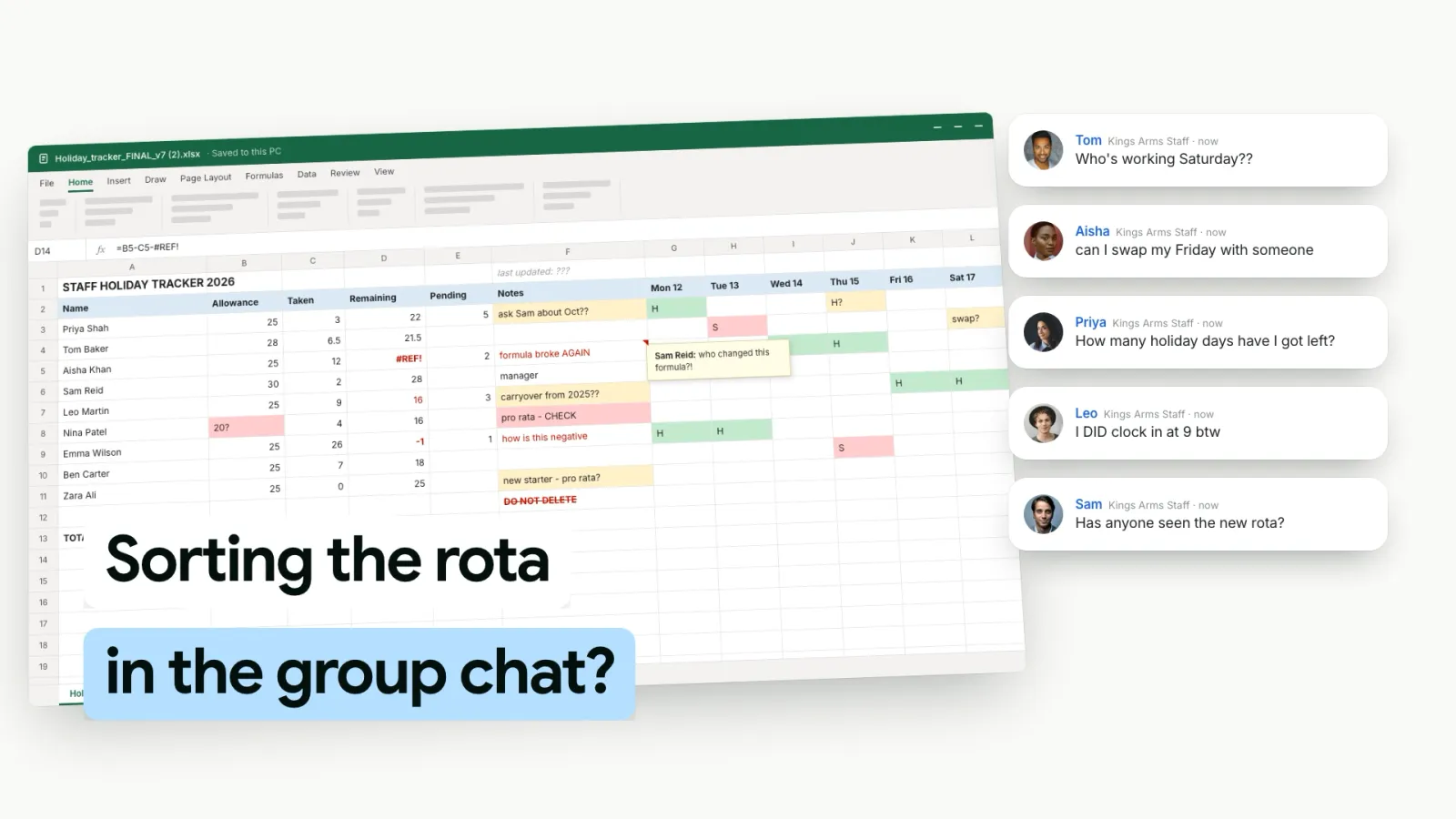
One of the most common questions from growing businesses is when spreadsheets stop being adequate. The honest answer depends on your risk tolerance and how much time you can afford to spend on admin — but here is a rough guide:
- 1–5 employees— Spreadsheets can work for basic holiday tracking and payroll records, but they require discipline to maintain. A single error — forgetting to update a leave balance, losing a file — can create a compliance gap. If you're not confident in your spreadsheet processes, start with purpose-built tools from day one.
- 5–15 employees — At this scale, manual processes become a genuine compliance liability. Holiday entitlement for part-time and variable-hours workers, SSP calculations, and working time records all require consistent, accurate tracking across multiple people. Errors become much more likely. A basic HR or timesheet system pays for itself quickly.
- 15+ employees — HR software is essentially essential. You need audit trails for employment tribunals, accurate leave balances visible to managers and employees in real time, payroll integrations to reduce data entry, and absence pattern reporting. Managing this on spreadsheets at this scale is not just inconvenient — it's a risk. Explore our employee time tracking software and small business time tracking to get started.
What TimeTally Handles for Small Businesses
TimeTally is designed specifically for small and growing UK businesses that need to be compliant without a dedicated HR team. Here's what it covers:
- Timesheet submission and approval — Employees submit timesheets on web or mobile; managers approve them. Every record is timestamped and stored — giving you HMRC-ready records and Working Time Regulations audit trails automatically. See our small business timesheets feature.
- Holiday tracking with automatic accrual — Full-time, part-time, zero-hours, and variable-hours entitlement calculated correctly. Employees see their balance in real time; managers approve requests without spreadsheets. Learn more about our leave tracking software.
- Absence management with Bradford Factor — Log and track sickness absences, view Bradford Factor scores, and identify patterns before they become a problem.
- Payroll export to Xero or QuickBooks — Approved timesheet data flows directly into your accounting software, eliminating manual data entry and reducing payroll errors. See all our payroll integrations.
- Mobile app for field and remote workers — Employees can clock in, submit timesheets, and request leave from their phone — making compliance easy for businesses with workers who are rarely at a desk.