

Click any feature to learn more.
14-day free trial · No credit card needed
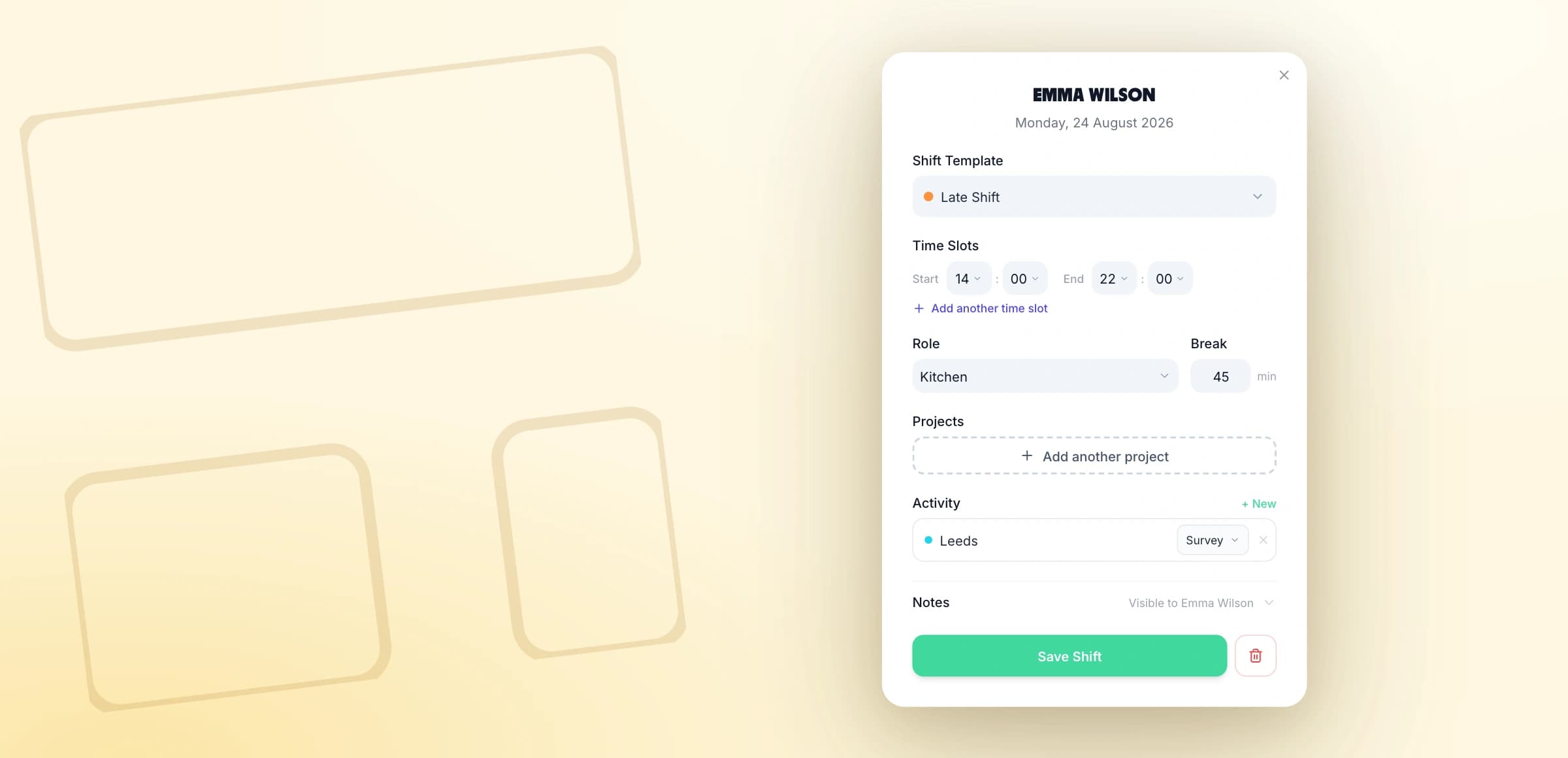
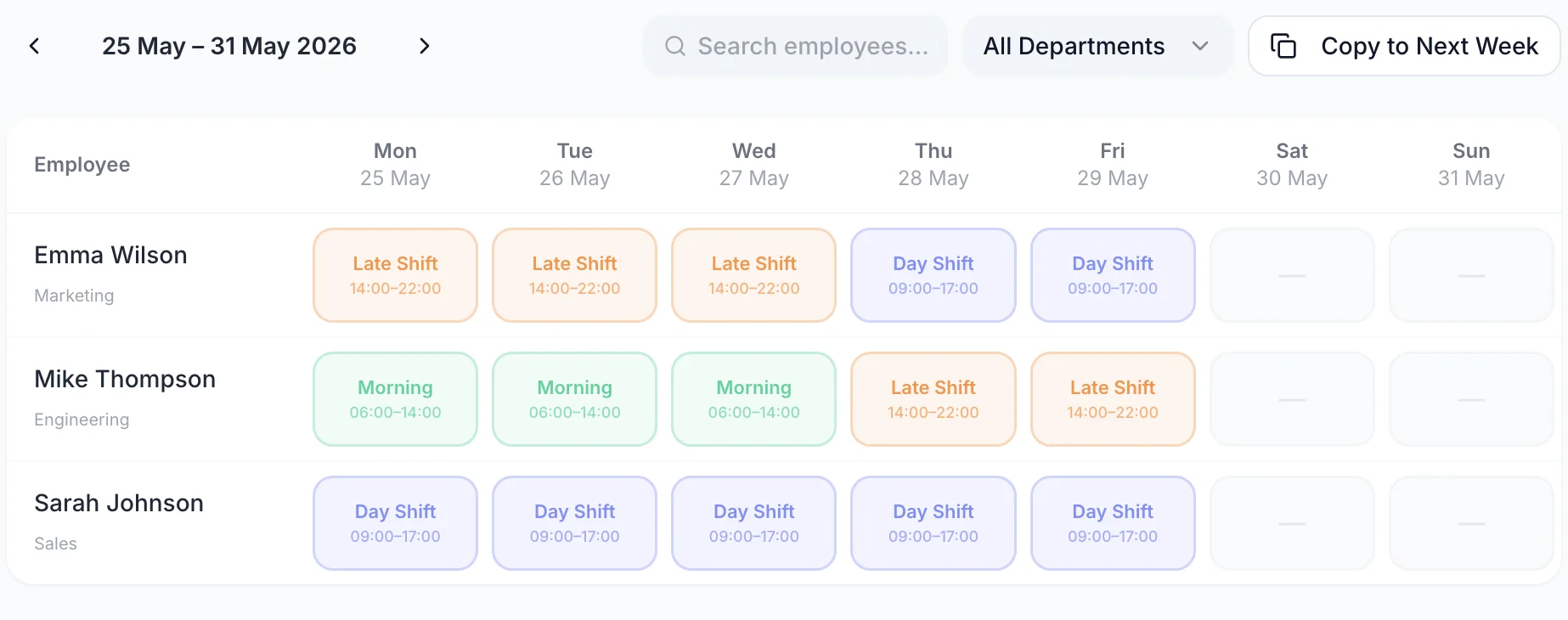
Create shifts, assign employees, set break times, and publish — all from the browser or mobile app. Copy last week's rota and adjust for leave or cover, saving time every week. Shift patterns are stored per employee so leave entitlements are always calculated correctly.
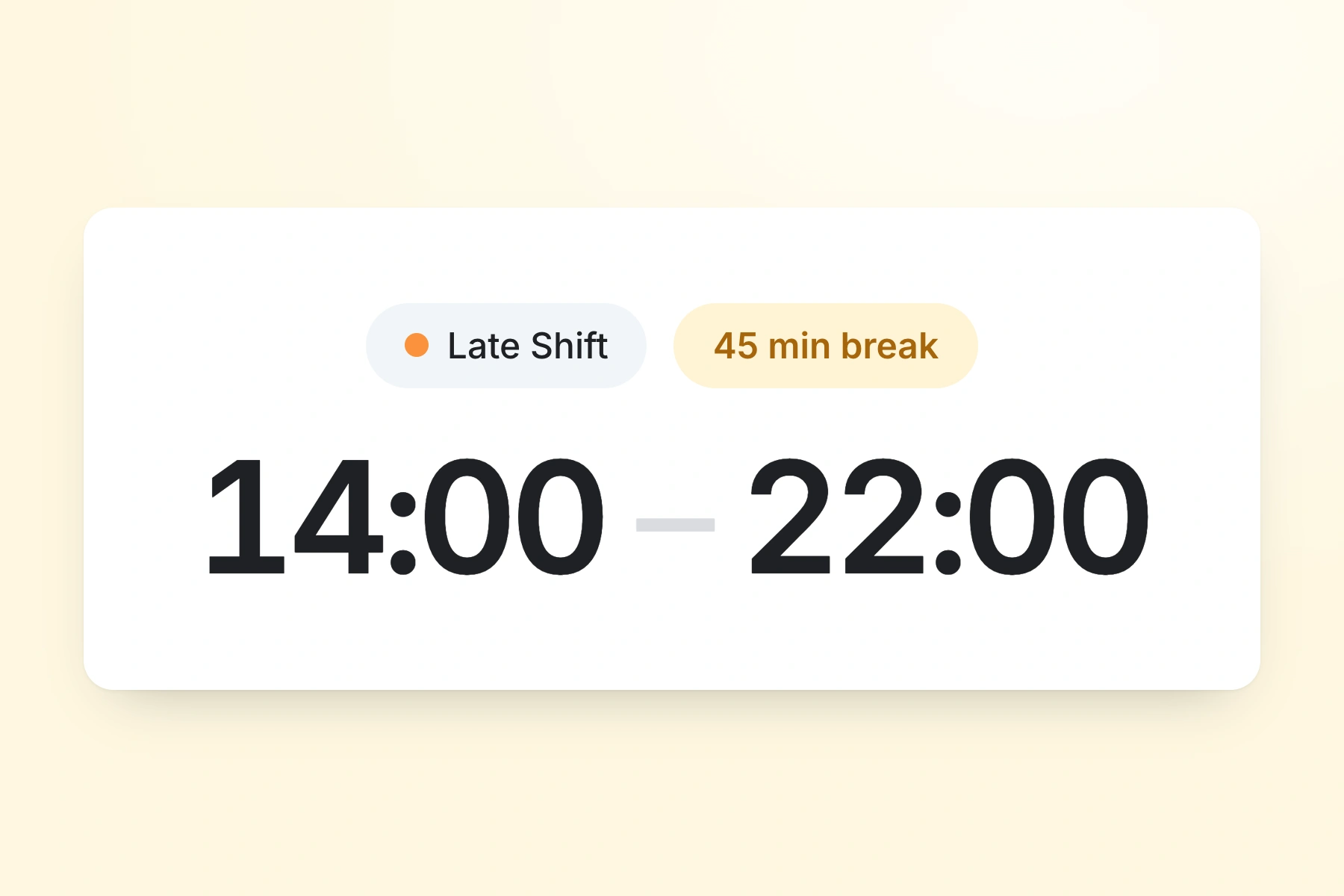
Any shift pattern
Days, nights, split shifts, rotating — full flexibility for any industry or team
Copy rotas week to week
Start from last week's schedule and adjust — build faster every time
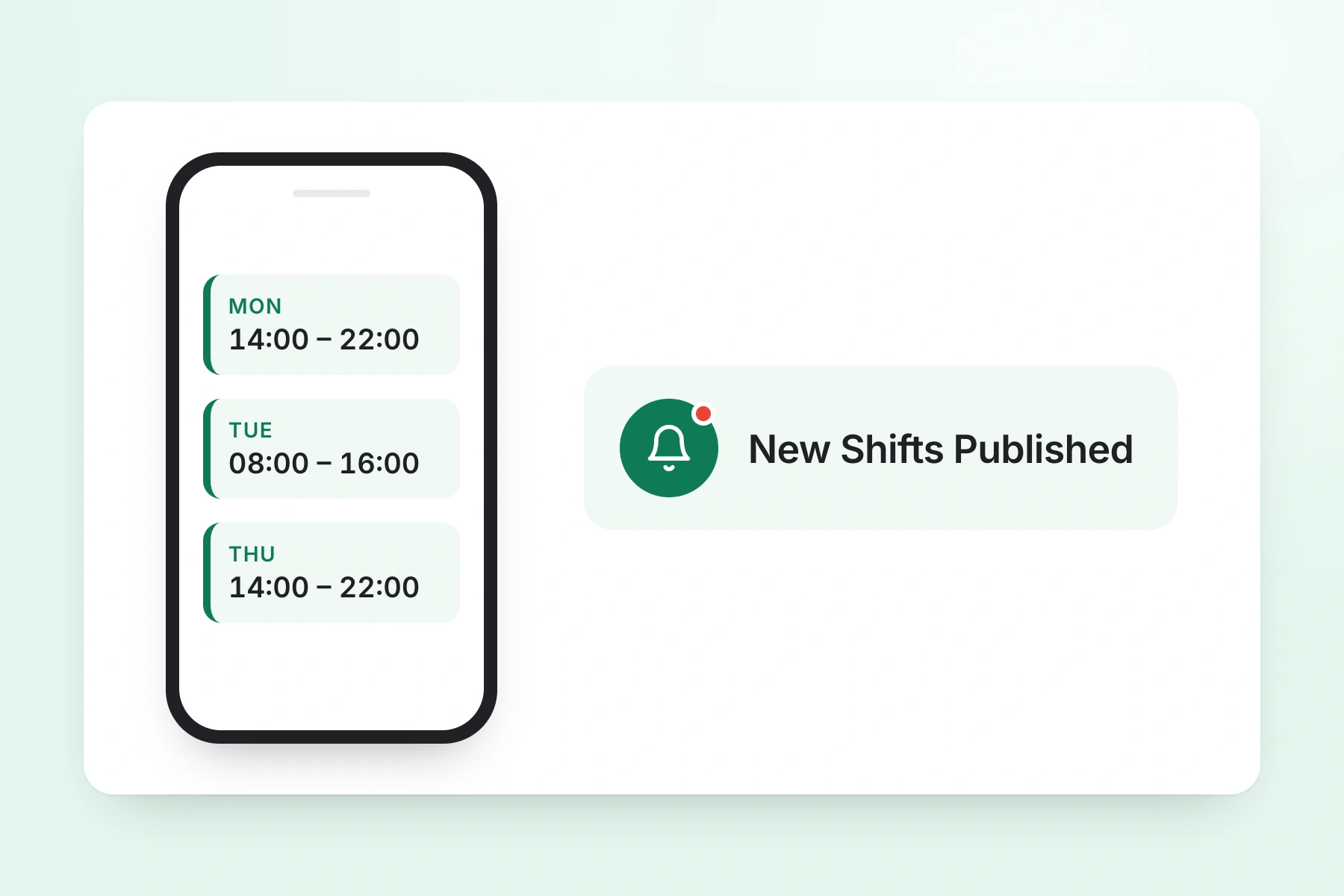
Instant staff notifications
Staff notified automatically when rotas are published or shifts change
Day Shift
09:00 – 17:00
Late Shift
14:00 – 22:00
Morning
06:00 – 14:00

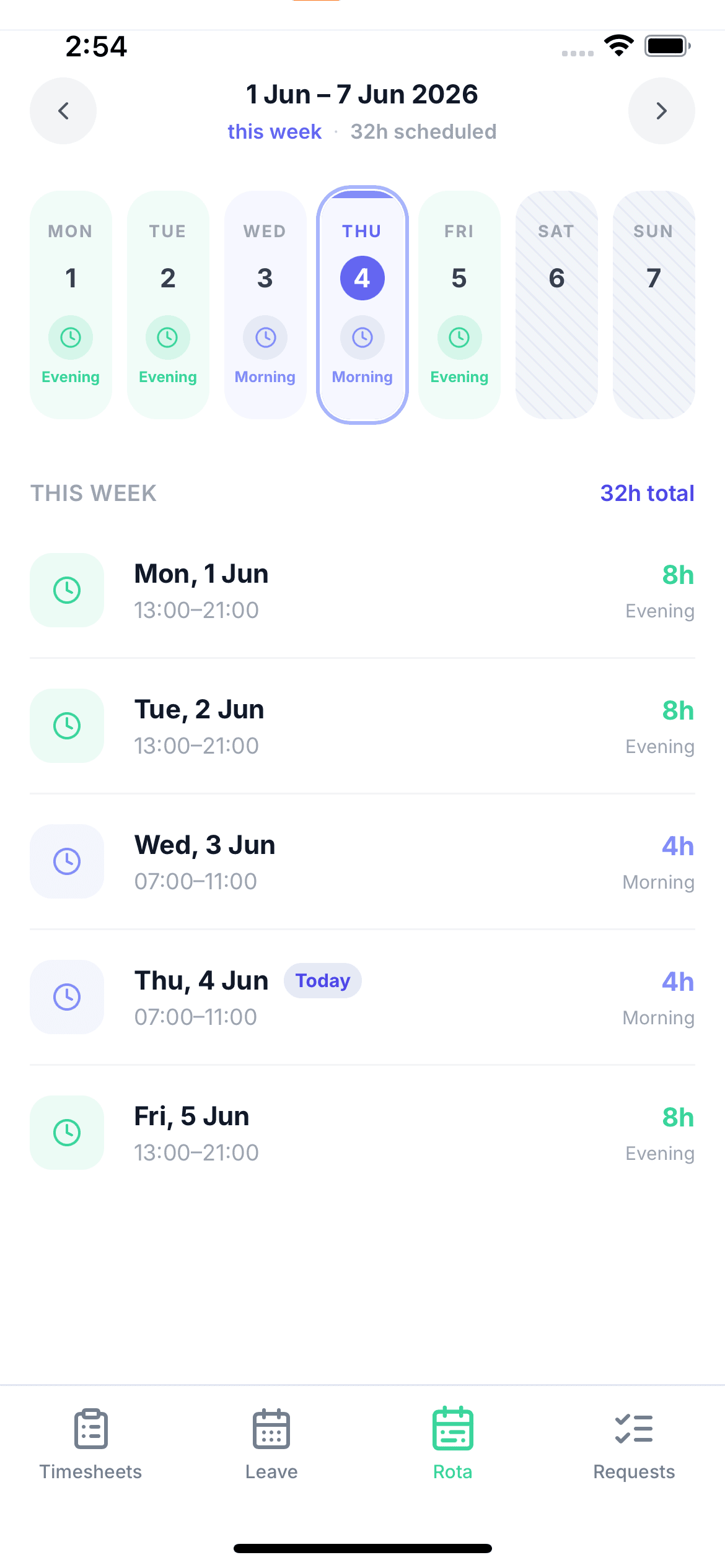
Every assigned employee sees their upcoming shifts in the TimeTally app immediately. Request leave, check balances, and view the team calendar — all from the same app they use to view shifts. TOIL balances and absence history are visible alongside the rota for full context.
iOS app and web browser
Staff access their rota from any device — no specific phone or app required
Leave requests in the same app
Staff request annual leave and TOIL without switching to a different system
Timesheet confirmation built in
Confirm actual hours worked against the scheduled shift — accurate payroll data
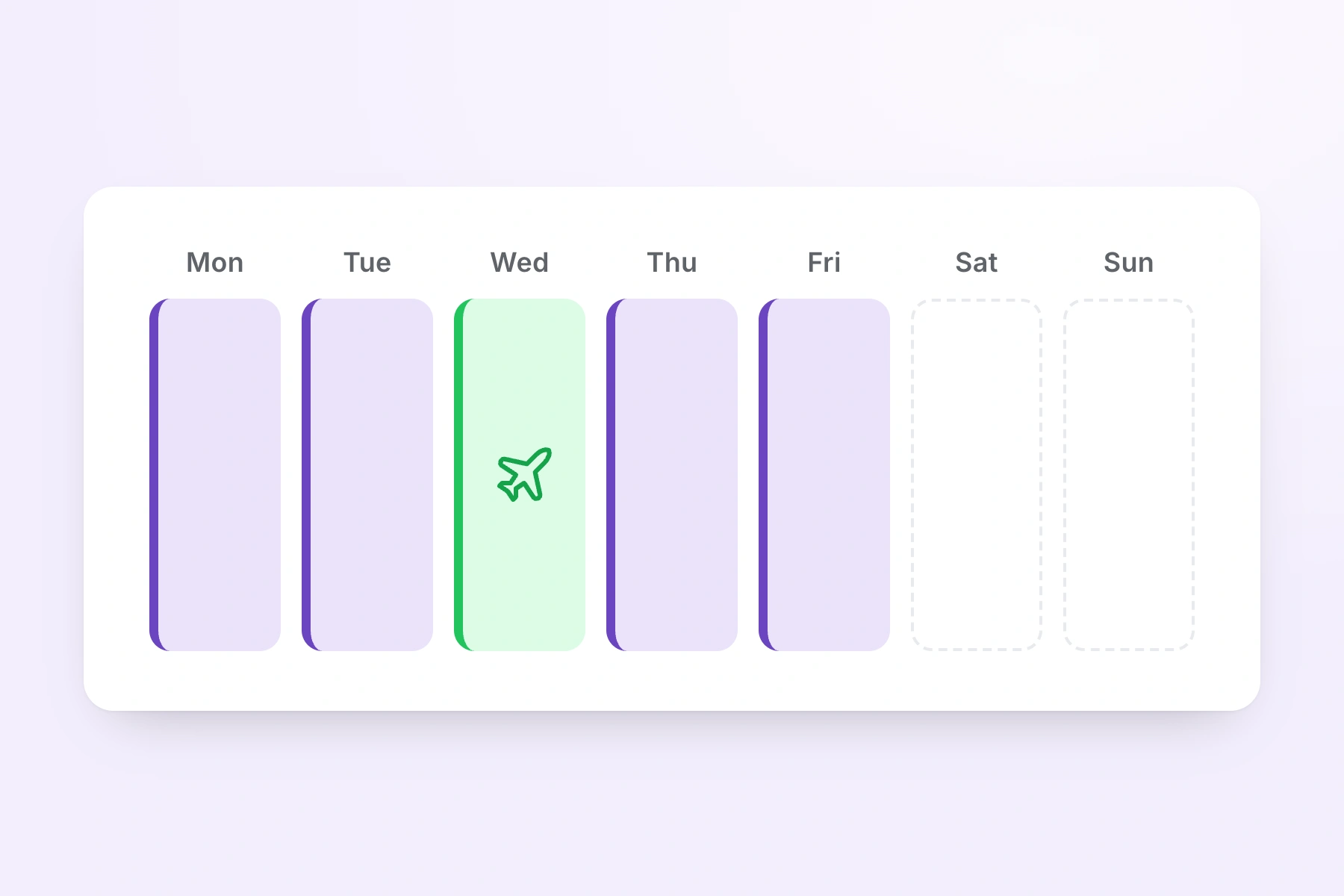
See shift patterns, annual leave, sick leave, and TOIL together. Build rotas that reflect actual availability — no more scheduling people who are already booked off.
No blind spots — see shifts and all leave types on one integrated calendar
Check shift coverage before approving leave — never leave a gap in the rota
Export hours and absence data — Xero, QuickBooks, or CSV for any payroll system

"We used to have people showing up on days they'd already booked off because the rota and the leave were in two different places. That just doesn't happen anymore."
Claire B.
Operations Manager, hospitality
"Publishing the rota used to mean sending a spreadsheet and then fielding twenty 'when am I working?' messages. Now I hit publish and everyone just knows."
Tom H.
General Manager, retail
"I can approve leave and check the rota at the same time. It's obvious once you've used it — why would you want them in separate systems?"
Priya S.
Manager, care sector
Shift-based teams face different rota challenges depending on their sector. Here's how rota management software helps across the industries that rely on it most.
Pubs, restaurants, cafés, and hotels run on shift-based schedules that change weekly — or sometimes daily. The rota challenge in hospitality isn't just building the schedule; it's making sure it's accurate when someone calls in sick, leave is approved at short notice, or a shift needs covering at 6am.
Paper rotas and group chats create confusion about who's working when. Rota software gives every team member visibility of their schedule in advance, reduces no-shows from miscommunication, and makes it straightforward to see who's available to cover a gap.
For hospitality employers, the Working Time Regulations also apply — split shifts, on-call cover, and zero-hours contracts all carry specific obligations around rest breaks and maximum weekly hours. See our guide to hospitality staff time tracking for a full breakdown.
Care homes, domiciliary care providers, and healthcare support services operate 24/7 across day, late, and night shifts. Rota management in the care sector is more complex than most: staffing ratios must be maintained, specific employees may be assigned to specific service users, and continuity of care matters.
Gaps in care rotas aren't just an operational problem — they can be a compliance issue, especially for CQC-registered providers. Rota software that shows leave and absence alongside shifts means managers can see gaps the moment they appear, rather than discovering them on the day.
Night shift workers also have specific protections under the Working Time Regulations, including the right to health assessments and limits on average night hours. Rota management systems should record night shift patterns to make compliance straightforward to demonstrate.
Retail teams are often a mix of full-time, part-time, and zero-hours staff with varying contracted hours. Building a weekly rota means managing multiple availability patterns, ensuring contracted hours are met, and balancing weekend and bank holiday cover fairly.
Spreadsheet rotas are common in retail but break down quickly as team size grows. When leave is tracked separately from the rota, it's easy to schedule someone who's already booked off — and the resulting gaps are often only discovered when a shift starts.
Bank holiday entitlements are a common source of disputes in retail. Rota software with integrated leave tracking means bank holidays are visible on the rota, leave balances include bank holiday entitlement, and approval decisions can be made with full context.
Security teams and facilities management operations rely on rotas where every shift must be filled — uncovered posts aren't optional. These sectors also tend to have complex shift patterns: 4-on-4-off, continental shifts, or 12-hour rotating days and nights.
The Working Time Regulations 48-hour weekly limit applies to security workers unless they've signed an opt-out agreement — and the opt-out must be documented. Rota management software should track hours against these limits to prevent inadvertent breaches, especially for workers who regularly cover additional shifts.
TOIL is also common in these sectors: when an employee covers a shift at short notice, time off in lieu is often offered in place of overtime pay. TOIL management integrated into the rota system ensures accrued hours are visible when scheduling future shifts.
One price. Every feature. No surprises.
Managing staff rotas means more than filling shifts — UK employers must navigate zero-hours rights, shift change notice periods, and discrimination risks from unfair rota allocation.
Workers on zero-hours contracts have no obligation to accept shifts offered, and employers cannot require exclusivity (preventing workers from working elsewhere). However, "use it or lose it" allocation is common — workers who regularly decline shifts may find fewer offers. This must not cross into penalisation for refusing shifts. From day one, zero-hours workers have rights to holiday pay calculated at 12.07% of hours worked. Rota management systems must track offers, acceptances, and refusals to demonstrate fair allocation.
Unless the contract specifies otherwise, employers should give reasonable notice of shift changes. What's reasonable depends on the industry and the employee's circumstances (e.g., childcare commitments). In hospitality and retail, 48 hours is often considered minimum; in professional services, a week or more. Last-minute changes repeatedly forced on employees may breach the implied duty of trust and confidence. Employment tribunal cases have found constructive dismissal where rota changes made employment untenable. Clear notice policies in rota management systems reduce risk.
Workers required to be on standby must be paid for that time under National Minimum Wage rules, even if not actively working. Whether on-call time counts depends on restrictions: if workers must remain at or near a particular location or cannot use the time freely, it's working time. Simply being contactable by phone is not usually working time. When on-call workers are called out, travel time from home to site counts as working time. Rota systems should separately track on-call hours, callout hours, and standard hours for accurate pay calculations.
Many businesses allow employees to swap shifts informally. However, employers remain responsible for ensuring workers don't exceed Working Time Regulations limits, receive proper breaks, and are paid correctly. Shift swaps that result in excessive hours or inadequate rest expose employers to liability. Best practice: require manager approval for all swaps and track them in the rota management system. Purely informal swap arrangements create gaps in working time records and payroll errors.
Although the UK has not introduced the “predictable scheduling” laws seen in some US states and other jurisdictions, there is growing political and union pressure for similar rights. Proposals include minimum advance notice of rotas (typically two weeks), compensation for last-minute cancellations, and the right to request a predictable schedule. Employers in sectors with variable rotas (hospitality, retail, care) should anticipate possible legislation. Rota management practices that already provide advance notice and minimise late changes will adapt more easily.
Unfair rota allocation can amount to indirect discrimination if it disproportionately disadvantages a protected group. For example: always scheduling Muslim employees on Friday evenings (Jummah prayer time), giving women with children only unsociable shifts, or consistently rostering disabled employees for unfavourable hours. Even if not intentional, systemic unfairness creates tribunal risk. Rota management systems should enable periodic reviews of shift allocation by protected characteristics to identify and correct any patterns before complaints arise.
Not all rota software is built the same way. For UK businesses with shift-based teams, here are the six questions worth asking before you commit.
This is the single most important question. If your rota software and your leave management are separate systems, you'll schedule people who aren't available. The rota needs to reflect annual leave approvals, sick leave, and TOIL in real time — not in a separate spreadsheet you have to manually cross-reference.
Printed rotas and email attachments get missed. Rota software should give every employee a way to see their current and upcoming shifts from their phone without needing to log into a desktop system. Push notifications when the rota changes or a new week is published remove the need to chase managers for schedule updates.
Fixed 9–5 teams are easy. If your team works rotating shifts, split shifts, 4-on-4-off, or a mix of contracted and zero-hours arrangements, check that the software handles this without manual workarounds. Leave entitlement calculations also need to reflect actual shift patterns — not just assume a standard 5-day week.
A rota shows who is scheduled to work — but payroll needs to know who actually worked, including any early finishes, late starts, or overtime. Look for software that connects the rota to timesheet confirmation and exports actual hours to your payroll provider via Xero, QuickBooks, or CSV.
If your team works beyond their contracted hours — covering callouts, staying late, working on days off — that time needs to go somewhere. TOIL (time off in lieu) is common in shift-based roles. Rota software that tracks TOIL alongside shifts means managers can see accrued balances when building next week's schedule, not discover them retrospectively.
Rota software pricing varies significantly. Some tools charge per admin seat, some per employee, and some have a flat monthly fee regardless of team size. For growing teams, per-employee pricing that covers all features is usually more predictable. Be wary of per-feature pricing where rota, leave, and time tracking are sold as separate modules — the integration between them is often where the value is.
Most UK small businesses start with a spreadsheet rota. Here's where the cracks tend to appear as teams grow.
| Feature | Spreadsheet | Rota software |
|---|---|---|
| Staff see their rota on mobile | ✕ | ✓ |
| Automatic notifications when rota changes | ✕ | ✓ |
| Leave visible alongside shifts | ✕ | ✓ |
| Prevents scheduling staff on approved leave | ✕ | ✓ |
| TOIL and overtime tracking built in | ✕ | ✓ |
| Timesheet confirmation against schedule | ✕ | ✓ |
| Payroll export (Xero, QuickBooks, CSV) | ✕ | ✓ |
| Multiple teams / departments | Manual | ✓ |
| Working Time Regulations hour tracking | Manual | ✓ |
Rota management software lets you build shift schedules digitally, assign employees to shifts, and publish rotas so staff can see their schedule on their phone or computer. TimeTally goes further by combining rota management with leave tracking, TOIL management, and time tracking — so everything is in one place.
Yes. You can organise employees into teams or departments within TimeTally and create separate rotas for each. Managers can view one department's rota or the whole organisation's schedule, depending on their access level.
Once published, staff can view their shifts in the TimeTally iOS app or web browser. They receive a notification when a new rota is published or when their shifts change.
Yes. You can edit and republish rotas at any time. Affected employees are notified automatically when their shifts change — no need to call or message everyone individually.
TimeTally exports timesheet data — actual hours worked — in CSV format, and integrates directly with Xero and QuickBooks. Your payroll provider uses this data to calculate pay based on actual hours, not just scheduled hours.
TimeTally is £2 per employee per month, all features included — rota management, leave tracking, TOIL, time tracking, and payroll exports. No setup fees, no per-feature charges.
From the blog
How to Create a Staff Rota in the UK
Step-by-step guide to building a fair, compliant staff rota
Managing Shift Patterns in the UK
How to manage rotating shifts, fixed patterns, and irregular hours
Best Rota Software UK 2026
Honest comparison of rota software options for UK small businesses
Working Time Regulations UK
48-hour limit, rest break rules, and employer obligations for shift workers
Hospitality Staff Time Tracking
How to track shift workers' hours accurately in pubs, restaurants, and hotels
How to Manage TOIL in the UK
Time off in lieu rules, accrual, expiry, and best practices for employers