

Rota planning for UK residential and nursing homes

Rota Software for Care Homes

Care home rota software for residential and nursing homes in the UK. Build the week by dragging long days, waking nights and sleep-ins onto a grid, run a separate rota for each unit, and publish it to your care staff a week at a time. Approved annual leave and sickness sit in the same grid as the shifts, so you can see the gaps before you publish rather than after. Built on the same staff rota software the rest of TimeTally uses, at £3 per employee per month with timesheets and leave included.

Week of 16 June

All departments
Publish Rota Published
Employee
Mon16
Tue17
Wed18
Thu19
Fri20
Sat21
Sun22
AR

Amelia

Kitchen

Open

Open

Evening

Close

Open

JK

James

Front of House

Close

Early

Mid

Open

Open

Early

PS

Priya

Kitchen

Leave

Mid

Close

Open

Early

MP

Maya

Front of House

Early

Close

Leave

Mid

Close

TW

Tom

Bar

Open

Open

Mid

Open

Close

Templates

Open
Close
Mid
Early
Evening

Rota Published!

Your team has been notified

Shift Templates

New Template New Template

Open

09:00–17:00

Close

12:00–20:00

Mid

10:00–18:00

Early

06:00–14:00

Evening

17:00–22:00

New

New Template

Evening

Start

17:00

End

22:00
Save Template Saved!

Shift Swap Request

Awaiting your approval

JK

James K.

Open · Thu

PS

Priya S.

Early · Sat

Approve Approved!

Shifts published!

Week of 16 Jun

Swap approved

James ↔ Priya

Evening added

Wed · 17:00–22:00

9:41

16 Jun – 22 Jun

this week · 40h

Mon

16

Tue

17

Wed

18

Thu

19

Fri

20

Sat

21

Sun

22

This week

40h total

Mon, 16 Jun

09:00–17:00

8h

Open

Tue, 17 Jun

09:00–17:00

8h

Open

Wed, 18 Jun

Today

17:00–22:00

8h

Evening

Thu, 19 Jun

12:00–20:00

8h

Close

Fri, 20 Jun

09:00–17:00

8h

Open

The app is simple to use, reliable, and makes managing holidays, absences, and staff records straightforward. The system has saved us a significant amount of administration time.

CLI ManchesterJordan Ingoe, CLI Manchester

Build next week's care home rota by dragging shifts onto the grid

The rota is a grid: one row per member of care staff, one column per day. Click an empty cell to put a shift on somebody. Drag a shift to a different day when a medication round or an appointment moves it, or drop it onto a different name to hand it over. A week that took a morning in a spreadsheet takes a few minutes here, and the parts that do not change week to week are copied rather than retyped.

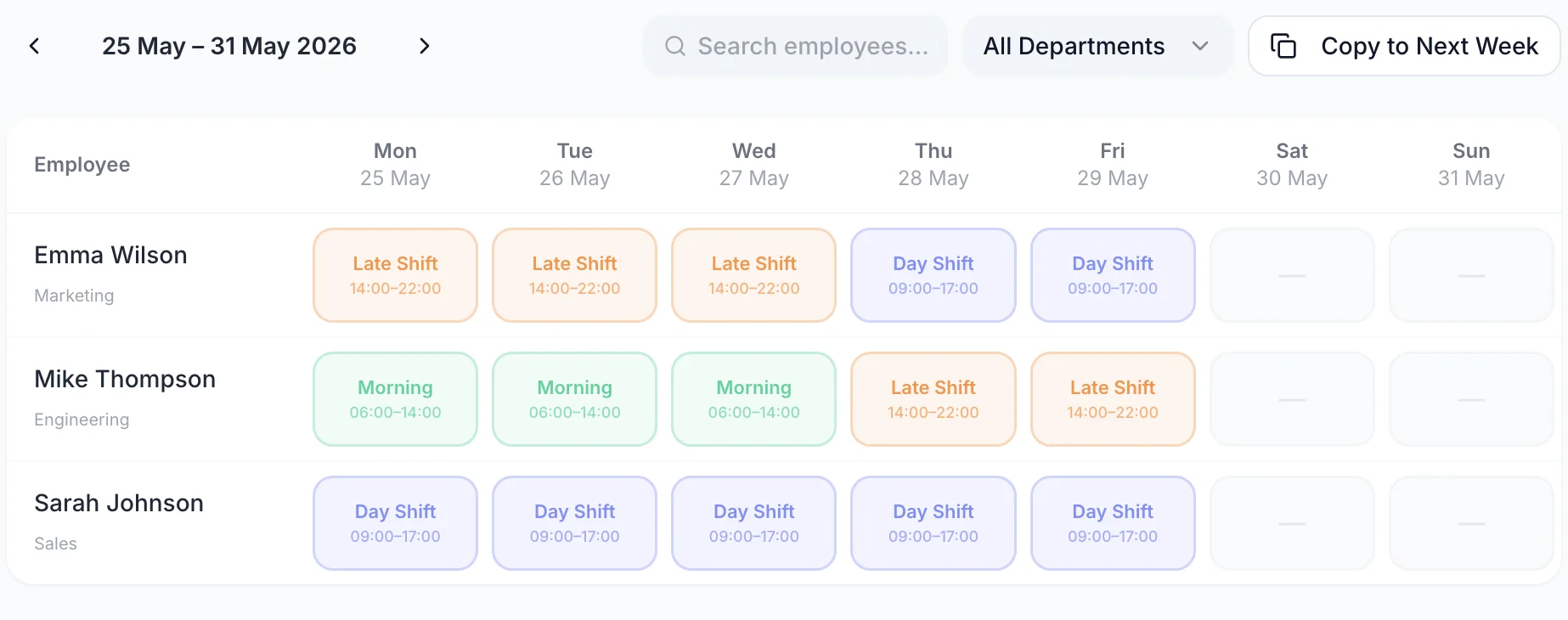
A week of the rota with one row per person and a shift on each day they are working
  • Click a cell to add a shift

    One click puts a care assistant on a day, and dragging moves the shift to another day or another name

  • Empty cells stay visibly empty

    An uncovered Sunday night shows as a dashed outline, not a blank you scroll past

  • Hours total under every column

    Paid hours per day and for the week, with each role's unpaid break already taken off

  • Publish a week at a time

    The week stays a manager-only draft until you publish it, then you choose whether to email the team

See Who Is on Each Shift Before You Publish

Every member of care staff on the unit has a row, and every day of the week has a column. A covered day carries a coloured shift block with the times on it. An uncovered day carries a dashed outline. Approved annual leave, sick leave and TOIL are drawn in the same grid on the days they fall, so you are not reading a rota in one place and a holiday sheet in another. The picture of the week is one screen.

  • Filter the grid to a single job role and only those people are listed — the nurses, the seniors, or the care assistants on their own. The hours total under the columns recalculates to match what is on screen.
  • Hide anyone who is not relevant to this week and the grid gets shorter without deleting them from the rota.
  • A shift block shows its job role colour and its location, so a care assistant covering the first floor is distinguishable from one on the ground floor at a glance.
  • TimeTally counts hours, not heads. There is no headcount row: the number of people on a Tuesday is what you read off the Tuesday column, and no rule anywhere checks it against a target.
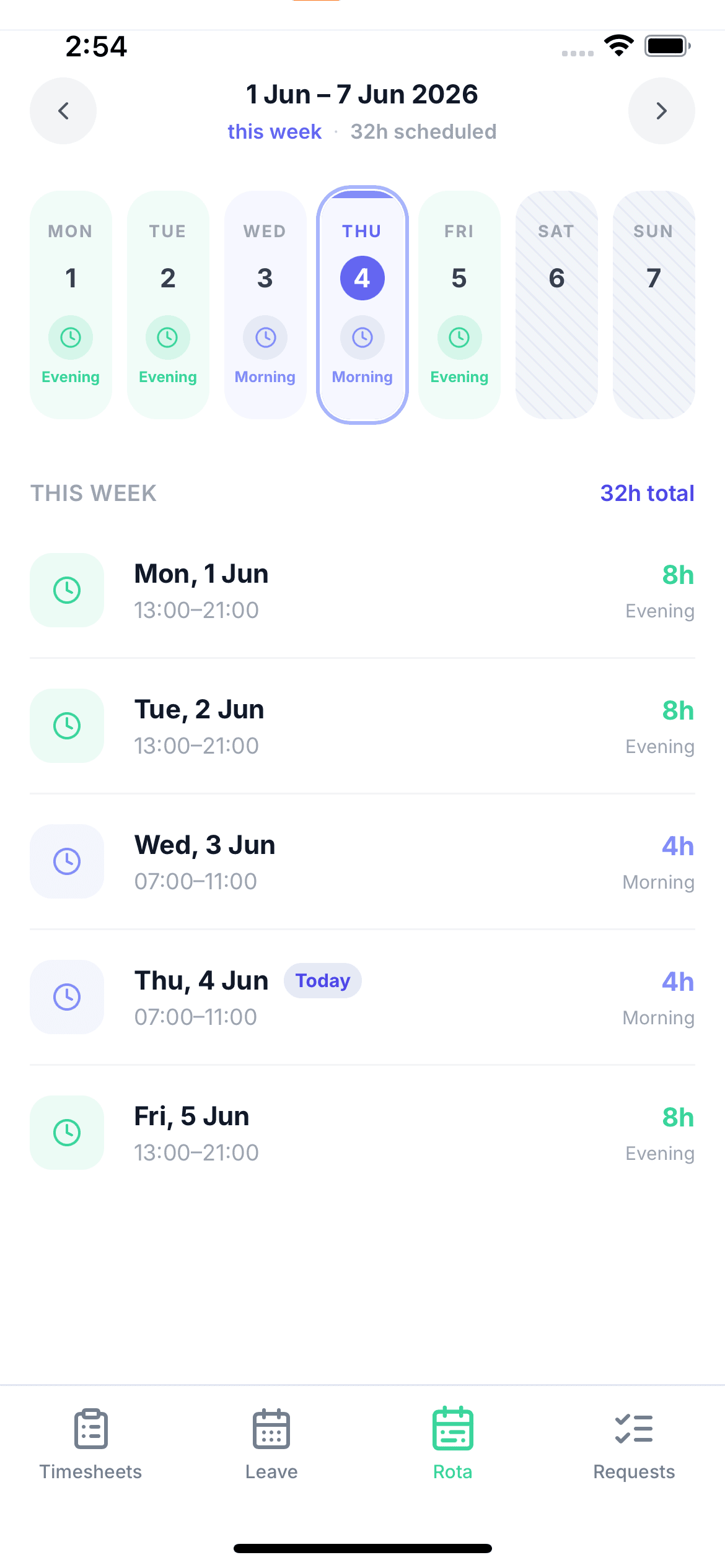
A member of staff viewing their upcoming shifts on their phone

Every shift carries its role, its break and its location

A shift in TimeTally is more than a start and an end time. Open one and you can set the job role it is worked in, the unpaid break, the location, and the time blocks it runs across. That is what makes a care home rota readable weeks later: the record says a senior care assistant worked a waking night on the dementia unit, not that somebody worked 20:00 to 08:00.

  • Job role on the shift

    A nurse covering a care assistant shift is recorded as working that role, and the role's unpaid break is what comes off the paid hours
  • More than one time block

    A split shift is one shift with two blocks, which is also how a long day plus a sleep-in on the same date is recorded
  • Require a clock-in on site

    A shift can require the carer to be inside a GPS radius before they can clock in, set per shift or on the template. The radius is 25 metres to 5 kilometres and GPS is a paid add-on. The site itself comes from the job the shift is attached to, not from a location field on the shift.
  • Copy, move or clear it

    Duplicate a shift onto another day, reassign it to a colleague, or clear the cell — the week is marked as having unpublished changes until you publish again
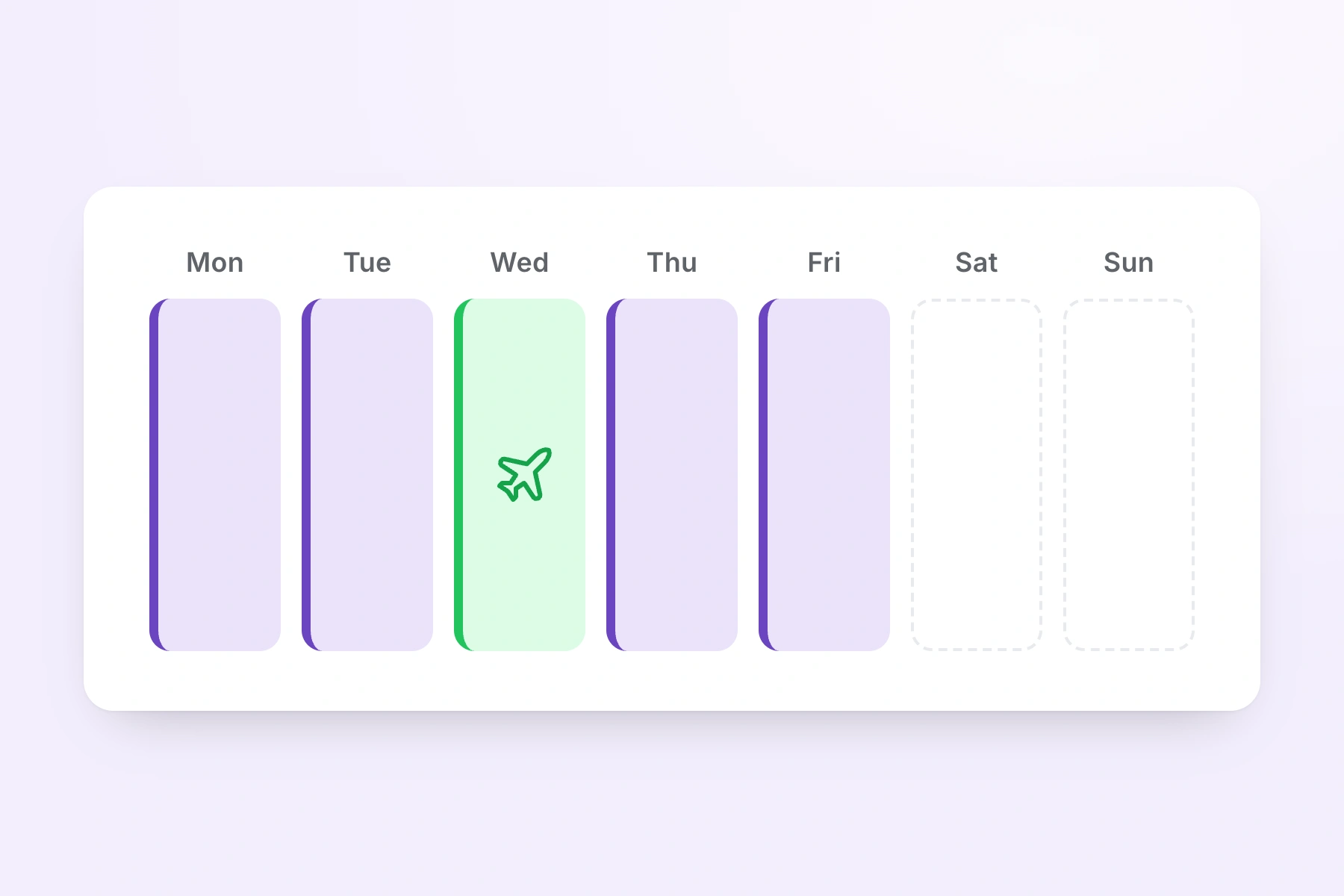
A week of shifts with one day showing booked annual leave in place of a shift

Save your long days, waking nights and sleep-ins as templates

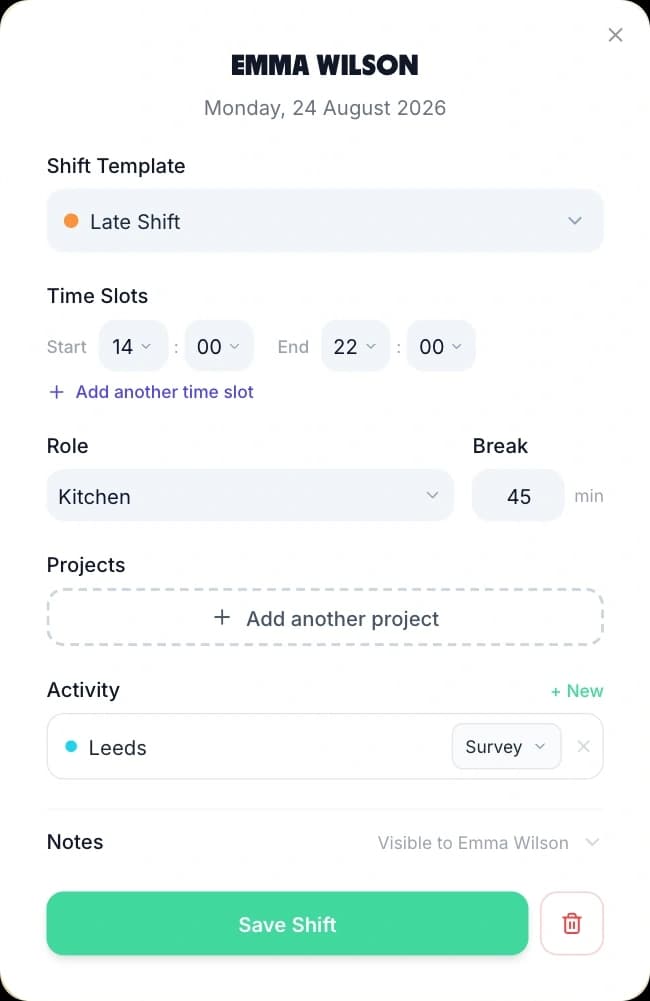
Most care homes run the same handful of shifts every week. Save each one once and it becomes a chip you click onto the grid. A template holds a name, a start and end time, a colour, an unpaid break, a job role and a location — and it is allowed to cross midnight, so a waking night that runs 19:30 to 08:30 saves without a fight.

Creating a shift from a saved template: the template picker, start and end times, role, break and a Save Shift button
  • Overnight templates are allowed

    The database check that rejected a 19:30 to 08:30 template was removed after a care provider reported it failing on a waking night

  • A colour per shift type

    Waking night, sleep-in, long day and twilight each get their own colour, so the shape of the week is legible without reading a single time

  • Save a whole week too

    A week template stores the full pattern and drops it onto any future week, which is how a four-week rolling cycle is set up once

  • Role and break travel with it

    The job role and unpaid break come from the template, so the paid hours are right without anyone editing the shift after placing it

Everything a care home rota has to handle

Click any feature to learn more.

Drag & Drop Scheduling
Start your free trial

14-day free trial · No credit card needed

What makes a care home rota harder than most

A care home runs every hour of every day, and the building does not close when somebody rings in sick. That is why rota management software for care homes has to do four things a generic scheduler does not: handle shifts that cross midnight, show approved leave in the same view as the shifts, keep separate units apart, and make cover easy to arrange the moment a gap appears. Holiday entitlement itself is a different job — the care home leave management page covers accrual, carryover and balances.

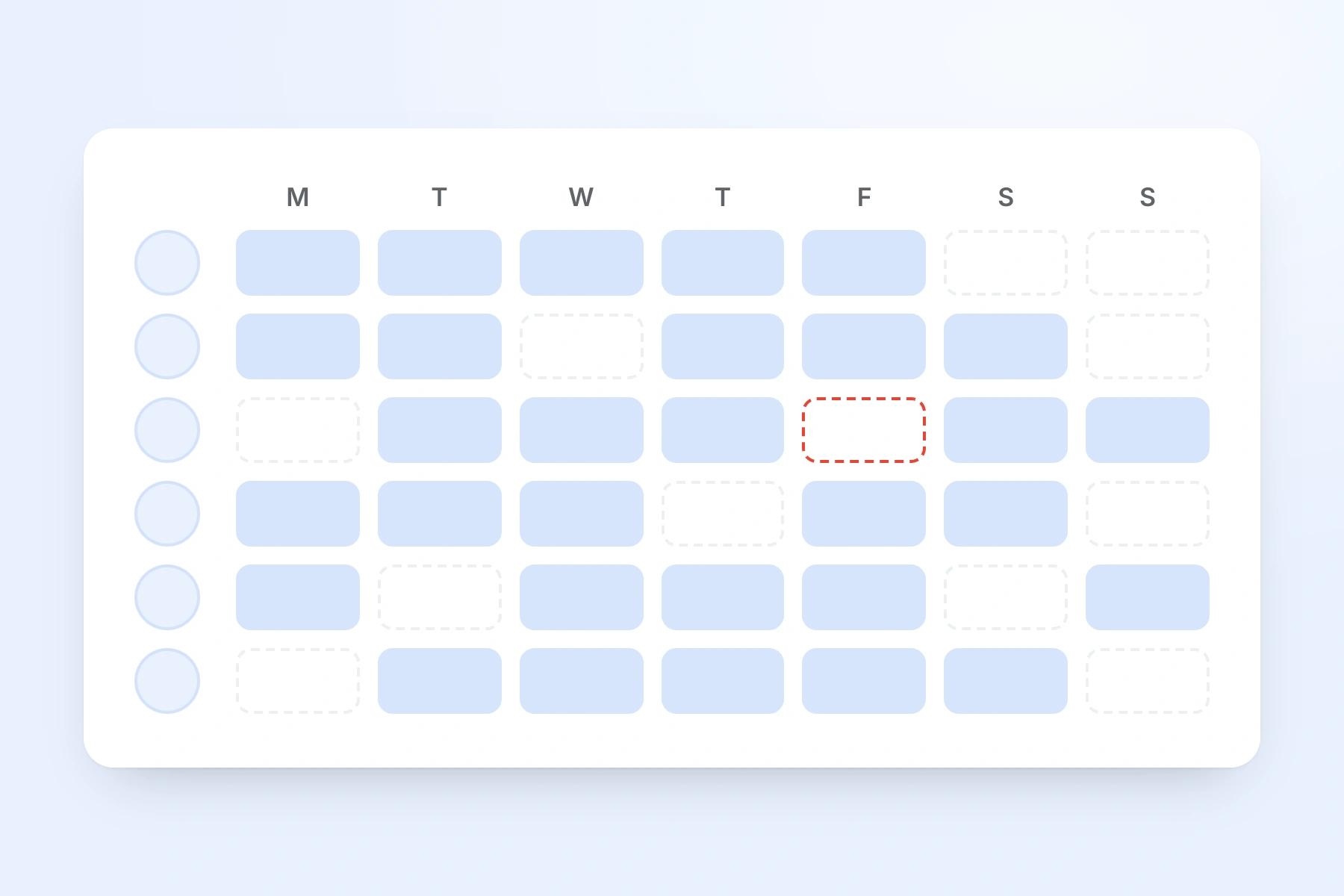
A week of shifts across the whole team, one row per person, with an unfilled shift outlined in red
Nights

Waking nights and sleep-ins

A night in a care home is not one thing. A waking night runs 20:00 to 08:00 with the care assistant awake for all of it. A sleep-in is a different shift with different pay, and it crosses midnight either way.

  • Shift templates are allowed to cross midnight — the check that rejected 19:30 to 08:30 was removed after a care provider hit it saving a waking-night template
  • Each template carries its own colour, so a waking night and a sleep-in are two different blocks on the grid rather than two similar times you have to read
  • The unpaid break sits on the template and on the job role, so a twelve-hour night is not costed as twelve paid hours
Cover

Cover the moment leave is approved

Approving leave and re-covering the rota used to be two jobs, and shifts sat assigned to people who were on holiday. TimeTally now joins them up.

  • Approve a leave request and TimeTally lists the shifts that person is already rostered on across the approved days
  • Against each shift it lists the colleagues who are actually free: no shift of their own that day, and no leave of their own, pending requests included
  • Choosing someone rewrites the shift and publishes that week, so the new name is live rather than sitting in a draft
Units

Nursing, residential and dementia units

A home with three units is three rotas, not one grid with thirty rows. TimeTally lets you name a rota per unit or per floor and switch between them from one dropdown.

  • Each rota has its own member list, so a care assistant only appears on the unit they work
  • Somebody who floats between two units can be a member of both and shows up on each
  • Every employee has a default job role with its own colour, and the grid can be filtered to one role to read nurse or senior cover on its own
Bank

Bank staff and agency cover

Bank and agency workers go on the staff list like anyone else, join the units they cover, and appear on the same grid as permanent care staff.

  • A bank care assistant can sit on several units' rotas and be dropped onto whichever one is short
  • With payroll switched on, the wage cost of putting a bank worker on Saturday night is visible while you are still deciding
  • There is no separate agency record type and no link to an agency booking system — an agency worker is an employee on your list at the same £3 a month

The Two Rota Settings a Care Home Manager Actually Changes

Most of TimeTally works the way you would expect out of the box. These two are worth ten minutes on the day you turn the rota on, because they are the two that residential and nursing homes have opinions about.

Swaps and visibility

Decide whether care staff can arrange swaps, and whether they can see who else is on.

Shift swaps are on by default. A care assistant picks a colleague and a shift in the app and sends the proposal; the manager sees both shifts and approves or rejects it in one tap, and approving rewrites the rota. Nothing changes without that approval.

If you would rather every change went through the manager on duty, swaps can be turned off for the whole organisation. That is not a cosmetic switch — the rule is enforced in the database as well as in the app, so turning it off actually stops the requests rather than just hiding the button.

Whether staff can see who else is on a shift with them is a separate setting, and it is off by default. Turn it on and a care assistant opening tomorrow's early sees the names of the colleagues rostered alongside them, which is useful when handover matters and awkward if you would rather people did not compare rotas. Leaving it off is the safer default and is why it ships that way.

The rota as a whole is opt-in too. A new organisation starts with it switched off, so you turn it on when you are ready to move off the spreadsheet rather than finding a half-built grid on day one.

What a day off costs

Price a day of annual leave off the rota rather than a flat week.

By default a day of leave costs whatever that weekday is worth in the employee's working pattern. That is fine for an office and wrong for a care home on long days: a Wednesday off in a week of three twelve-hour shifts is not the same as a Wednesday off in a five-day week.

Switch the leave basis to the rota and a day off costs the paid hours of the shift that was assigned on that date, with the unpaid break already taken off. Days with no shift on them fall back to the working pattern, so a rota with holes in it does not produce nonsense.

This exists because rotas run two-week, four-week and monthly cycles that a flat seven-day working pattern cannot represent. It only takes effect when the rota is switched on, it applies at the moment a request is booked, and it does not re-price requests that are already in the system.

How leave, allowances and carryover work for care homes

Care home rota examples: three patterns and how each one is built

These are the three shapes most UK homes end up with. Each one is described as the set of shift templates it needs and the order you build the week in, so you can copy the approach rather than a picture of somebody else's week. If you want a spreadsheet grid to sketch on first, the staff rota template is a free download.

A small residential home on earlies and lates

Around twenty residents, no nursing, and a team of care assistants with a senior on each shift. You need three templates: Early 07:00–14:30, Late 14:00–21:30 with a half-hour overlap for handover, and Night 21:00–07:00. Build one week properly, with the senior's name against one early and one late every day, then copy that week forward and edit it for annual leave. Give the senior role its own colour and filter the grid to it once the week is drafted: seven earlies and seven lates should each show a senior, and any day that does not is the day to fix.

A nursing home on long days with a waking night

Registered nurses on twelve-hour long days, care assistants on the same pattern, and a waking night that has to be covered by a nurse. Four templates: Long Day 08:00–20:00, Waking Night 20:00–08:00, Twilight 16:00–22:00 for the evening peak, and a Sleep-In for the nights a second person is on call rather than awake. Create the waking night and the sleep-in as separate templates in separate colours — they are different shifts with different expectations, and a rota that shows them as the same block is a rota nobody can audit. Save the completed week as a week template and the four-week cycle becomes four clicks.

A two-unit home with a floating bank pool

A residential unit and a dementia unit under one registration, plus a pool of bank care assistants who work across both. Create two rotas, one per unit, each with its own member list. Put the bank staff on both member lists so they appear on whichever grid you are looking at. Build each unit's week separately and publish them separately, so approving the residential unit's week does not push the dementia unit's half-finished draft to the floor. When somebody rings in, open the unit that is short and drop a bank name into the empty cell.

Rolling patterns and how to work out the dates

Plenty of homes run four on, four off, or a two-week alternating pattern, and the awkward part is not the rota software — it is working out which dates a given person is on across the next few months. Our shift pattern calculator produces the dates for a rolling cycle from a start date, and you then build those weeks in TimeTally from a week template. TimeTally does not generate a rolling pattern for you; it stores the week you built and repeats it when you tell it to.

Handover, medication rounds and the things a rota cannot hold

A shift carries times, a role, a break, a location and free-text notes. It does not carry a medication round, a task list or a care plan. Homes usually solve the overlap by building handover into the shift times — a late that starts half an hour before the early ends — rather than by trying to record handover as its own object. The notes field on a shift is the right place for a one-off instruction such as which resident has a hospital appointment that morning; anything that has to be signed for belongs in your care system, not in the rota.

When the spreadsheet is still the right answer

If you run one unit, the pattern never changes, and everybody already knows their days, a printed grid on the office wall genuinely works. The point at which it stops working is usually the same for every home: two units, or bank staff who cover both, or a manager who is fielding calls about which shift somebody is on. That is when a published rota staff can check on their own phone starts saving more time than it costs to set up.

Safe staffing and records

Safe staffing, CQC records and what TimeTally will not do

A care home cannot drop below safe staffing, so every rota decision is a cover decision. TimeTally is a scheduling tool, not a compliance system: it holds the record those decisions rest on and shows you the week before you commit to it. Here is exactly where the line falls.

Safe Staffing Is Your Judgement

TimeTally has no minimum-staffing setting, no ratio field and no alert that fires when a shift is short. Nothing stops you publishing a week that is one care assistant light. What it does is put the week in front of you first: every name against every day, uncovered cells drawn as dashed outlines, approved leave in the same grid, a per-day hours total under the columns, and a role filter so you can read the nurse or senior cover on its own. The numbers are on screen; the decision stays with the manager who signs the rota off.

The Record of Who Was Rostered

Every shift is stored with its date, its times, its job role, its unpaid break and its location, against a named employee. Publishing is recorded per rota and per week, so there is a record of what the team was shown and when. Edit a published week and it is flagged as having unpublished changes until you publish again, which means a rota cannot quietly diverge from the version your staff are working to.

Getting the Rota Out of TimeTally

The week or month on screen exports to CSV and prints, with the hours totals and — where you have pay access — the cost row included. That covers the usual asks: a printed copy for the office wall, a file for payroll, or a period of history for a provider information return. TimeTally is not a CQC evidence system and does not map anything to a Key Line of Enquiry; it produces the staffing record, and you decide what to do with it.

Sleep-Ins, Waking Nights and Pay

TimeTally records a sleep-in and a waking night as two different shifts with two different colours, and totals the paid hours on each after the unpaid break. What it does not do is decide how either is paid. Whether hours spent asleep during a sleep-in count towards the national minimum wage is a question of the contract and of case law — the Supreme Court ruled on it in Royal Mencap Society v Tomlinson-Blake in 2021 — and it stays with your payroll and your legal advice, not with a rota tool.

Who Can See What

There are two access levels: admin and employee. There is no per-unit or per-floor level in between, so anyone you make an admin can see every rota in the organisation, not just the unit they manage. The honest mitigation is the pay setting: you can hide pay details from admins who should not see them, which keeps the cost row off their screen while leaving the rota usable. If per-unit access matters to you, ask before you buy rather than after.

What TimeTally Does Not Do

It does not build the rota for you — there is no auto-fill and no AI generation, and every shift is placed by a person. It does not collect availability: there is no form for staff to say which nights they can work, and nothing in the system stores a preference. It does not alert you to a Working Time Regulations breach, an eleven-hour rest gap or a run of seven days. And it does not connect to any agency's booking system. Those are the four things sector rota tools most often claim, and TimeTally does none of them.

Simple, Transparent Pricing

One price. Every feature. No surprises. A home with 45 staff pays £135 a month.

£3/employee/month

Billed monthly, incl. VAT. Cancel anytime.

A separate rota for every unit or floor
Waking night and sleep-in shift templates
Shift swaps and cover suggestions
Leave tracking and timesheets included
Get Started

No credit card required

In short

What is rota software for care homes?

Rota software for care homes builds the shift grid for a residential or nursing home, publishes it to care staff, and keeps the record of who was rostered on each shift. TimeTally does this for UK homes at £3 per employee per month. You save your long days, waking nights and sleep-ins as shift templates — overnight templates that cross midnight are allowed — and click them onto a week grid, one row per person and one column per day. Each unit or floor can have its own named rota with its own member list. Approved annual leave, sick leave and TOIL appear in the same grid as the shifts, and when you approve a leave request TimeTally lists the shifts that person was rostered on and the colleagues who are free to cover each one. You publish a week at a time and choose whether to email the team. What it does not do is enforce a minimum: there is no safe-staffing setting and nothing blocks a short shift from being published, so the cover decision stays with the manager.

Price
£3 per employee a month
Publishing
One rota, one week at a time
Nights
Templates may cross midnight
Units
A named rota per unit or floor
Includes
Leave and timesheets at no extra cost

Frequently Asked Questions

What should a care home rota template include?

A care home rota template has to name the shift, not just the hours. At a minimum it needs a row per member of care staff and a column per day, with each cell carrying the shift type — long day, early, late, twilight, waking night or sleep-in — because a 20:00 to 08:00 cell means something different depending on whether the person is expected to be awake. It also needs somewhere to show who the senior on each shift is, and somewhere to mark approved annual leave and sickness so the gaps are visible while you are writing it. If you want a spreadsheet to start from, our staff rota template is a free Excel and Google Sheets download that covers the grid, the shift times and the weekly hours total. TimeTally is what you move to when the spreadsheet stops coping: shift types become reusable templates, leave appears on the grid without being typed in, and the week is published to staff instead of printed and pinned up.

Can care assistants see their shifts on their phone?

Yes. Once you publish a week, every member of care staff on that rota sees their upcoming shifts in the TimeTally iOS app or in any browser. They see the date, the times, the job role and the location on each shift. Until the week is published it is a draft only managers can see, so a half-built rota never reaches the floor. Whether staff can also see who else is on a shift with them is a setting, and it is off by default — turn it on if you want people to know who they are handing over to.

How do we roster waking nights and sleep-ins?

Save each one as a shift template. A template holds a name, a start and end time, a colour, an unpaid break, a job role and a location, and it is allowed to cross midnight — the database check that used to reject a 19:30 to 08:30 template was removed after a care provider reported it failing on a waking-night shift. Give the waking night and the sleep-in different colours and they read as two different blocks on the grid rather than two similar sets of numbers. A template can also hold more than one time block, which is how you record a split shift on one day. Note that TimeTally holds one shift row per person per day, so a long day followed by a sleep-in on the same date is one shift with two time blocks rather than two separate shifts.

Does TimeTally stop us publishing a rota below safe staffing levels?

No, and it is worth being plain about it. TimeTally has no minimum-staffing setting, no ratio field and no warning that fires when a shift is short. Nothing prevents you from publishing a week that is one care assistant light. What it does instead is put the whole week in front of you before you publish: every name against every day, uncovered cells drawn as dashed outlines, approved annual leave and sickness in the same grid, and a per-day hours total under the columns. Filter to a single job role and you can read the nurse cover or the senior cover on its own. The judgement about whether that week is safe stays with the manager who signs it off.

Can we run a separate rota for each unit or floor?

Yes. You can create as many named rotas as you need — Nursing, Residential, Dementia, First Floor, Ground Floor — and each one has its own member list. Staff only appear on the rota they belong to, and anyone who floats between units can be a member of more than one. You switch between them from a dropdown above the grid, and publishing is per rota and per week, so publishing the nursing unit's week does not publish the residential unit's draft.

How do we handle bank staff and agency cover?

Bank and agency workers are employees in TimeTally like anyone else. Add them to the staff list, add them to the member list of every unit they cover, and they appear on those grids ready to be given a shift. They cost the same £3 per employee per month as permanent care staff. Two limits worth knowing: there is no separate record type that marks somebody as bank or agency, so a job role such as Bank Care Assistant is how you tell them apart on the grid, and TimeTally does not connect to any agency's booking system — you still place the booking with the agency yourself.

What does rota management software for care homes cost?

TimeTally is £3 per employee per month, with every feature included and no setup fee. A 45-bed residential home with 45 staff on the payroll pays £135 a month, and that covers the rota, annual leave, sickness and timesheets rather than three separate subscriptions. There is a free 14-day trial, and no minimum contract. The rota is switched off when you first sign up, so you turn it on when you are ready to move off the spreadsheet.

Can care staff swap shifts between themselves?

They can propose a swap. A care assistant picks a colleague and a shift in the app, and the request goes to a manager, who sees both shifts side by side and approves or rejects it in one tap. Approving rewrites the rota. Nothing changes hands without a manager approving it, and if you would rather staff did not arrange swaps at all, shift swaps can be turned off for the whole organisation. They are on by default.

Where can I find care home rota examples to work from?

There are three worked examples on this page: a small residential home on earlies and lates, a nursing home running long days with a waking night and a sleep-in, and a two-unit home with a floating bank pool. Each one lists the shift templates it needs and how the week is put together. For a rotating pattern such as four on, four off, our shift pattern calculator works out the dates for the cycle, and the staff rota template gives you a spreadsheet grid if you want to sketch it before building it in TimeTally.

Still have a question? See all FAQs

Publish next week's rota before you leave the office.

Try TimeTally free for 14 days. Build the week from your own shift templates, see approved leave in the same grid, arrange cover the moment a request is approved, and publish it to your care staff — with leave tracking and timesheets included in the same £3.

No credit card required · Free 14-day trial · Cancel anytime