
How Many Employees Before You Need HR Software?
Most UK small businesses outgrow spreadsheets between 5 and 15 employees. Here's how to know when HR software will pay for itself — and what to look for.

There's no magic number when HR software becomes essential. But there are clear signals that spreadsheets and manual processes are costing you more in time, errors, and compliance risk than software would ever cost. This guide maps out each growth stage — and gives you the honest picture of when HR tools stop being optional.
Stage 1: 1–4 Employees
At this stage, most businesses manage perfectly well with spreadsheets, a shared calendar, and a basic payroll tool. You probably know every employee personally, hours are predictable, and holiday requests are handled informally with no real risk of conflict.
The main risk at this size isn't operational — it's inconsistency. Some employees get tracked carefully, others don't. Some have written contracts, others rely on informal agreements. These gaps rarely cause problems immediately, but they create a fragile foundation that becomes harder to fix later.
Compliance is still straightforward — HMRC requires basic pay records and you need to track National Minimum Wage compliance — but the admin burden is low enough that manual tracking works. Our employee time tracking software can help even at this stage, and our guide to small business time tracking covers the basics.
Verdict: Spreadsheets workable. Start building clean habits now to avoid pain later.
Stage 2: 5–15 Employees (The Tipping Point)
This is where manual tracking breaks. Between 5 and 15 employees, most small businesses hit their first serious HR headache — and often several at once.
The problems that emerge at this stage are well-documented:
- Holiday clashes — two employees book the same week off and you only notice when both fail to show up
- NMW miscalculations — rounding hours incorrectly or not counting all working time (travel between sites, for example) pushes you into accidental non-compliance
- Late or inaccurate payroll — chasing timesheets manually every fortnight takes hours and the data that arrives is still unreliable
- No audit trail — HMRC and employment tribunals both expect proper records; handwritten sheets and email threads don't cut it
HMRC expects PAYE records to be kept for three years, and minimum wage records for six. Employment tribunals are a real risk at this stage — even one disputed holiday entitlement or an unpaid-hours claim can cost thousands in legal fees and compensation. See our guides on HR for small businesses and HMRC timesheet requirements for the compliance detail.
Verdict: This is the tipping point. At 7–10 employees, the time spent chasing and checking hours usually costs more than a tool would.
Stage 3: 15–50 Employees
By 15 employees, a single spreadsheet shared between managers has almost certainly become unmanageable. Different people are editing it simultaneously, version conflicts emerge, and the person who knows where everything is goes on leave.
At this stage, new problems appear that simply cannot be solved with spreadsheets:
- Multiple managers, multiple departments — a single holiday planner breaks when different managers need independent visibility of their own teams
- Variable-hours workers — holiday pay for workers on irregular hours requires averaging calculations that spreadsheets handle poorly, and mistakes lead to claims
- Bradford Factor tracking — absence management becomes meaningful at this scale; tracking short-term absences and calculating Bradford Factor scores manually is impractical
- Approval workflows — leave requests, overtime, and shift swaps need a clear approval trail that email chains cannot reliably provide
Purpose-built timesheet approval software handles multi-manager workflows cleanly. Our Bradford Factor calculatoris a useful starting point if you're building an absence policy at this size.
Verdict:HR software isn't optional here. The only question is which tools to use.
Stage 4: 50+ Employees
Above 50 employees, many businesses consider a full HRIS (Human Resource Information System) — platforms like BambooHR, Personio, or HiBob that consolidate HR data, performance management, onboarding, and more.
These platforms have their place, but it's worth being clear-eyed about the tradeoffs. Monolithic HR suites are expensive, slow to implement, and often force you to use mediocre versions of many tools rather than excellent versions of the specific tools you need. A payroll integration between a dedicated timesheet tool and Xero will almost always be more reliable and accurate than the built-in payroll module of a large HR platform.
The smarter approach for many businesses in the 50–200 employee range is a small stack of best-in-class dedicated tools that integrate cleanly: timesheets, leave management, and payroll, each done well and connected. Our payroll integrations guide and leave tracking softwareoverview cover what's available.
Verdict:An HRIS may be warranted, but don't assume bigger means better. Integrated best-of-breed tools often outperform monolithic suites.
Signs You've Outgrown Spreadsheets
Not sure where you sit? If any of the following are true, spreadsheets are already costing you more than software would:
- You spend time every week chasing employees for timesheets
- Holiday entitlements have been miscalculated at least once in the past year
- Payroll takes more than two hours to run
- You couldn't quickly produce a complete audit trail of hours worked if HMRC asked
- Managers don't have real-time visibility of who is on leave or how many hours their team has worked
- You've had at least one dispute with an employee about their hours or holiday balance
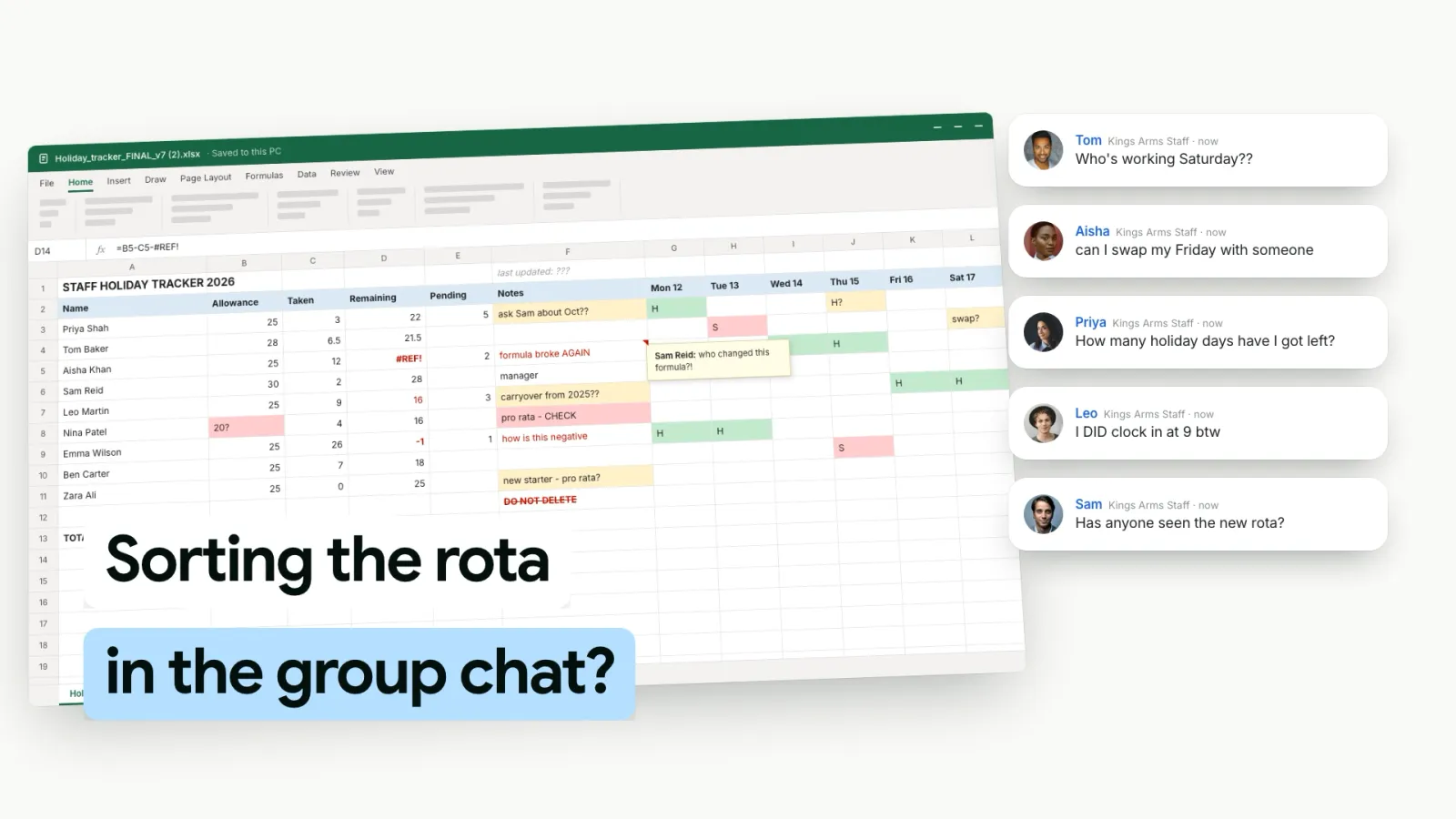
Three or more of these and the ROI on HR software is almost certainly positive — often strongly so. Read our detailed breakdown of manual timesheet problems to put a number on the cost.
What to Look for in HR and Timesheet Software
Not all HR software is built with small businesses in mind. Many tools are designed for enterprise teams with dedicated HR departments — they're complex to configure, slow to onboard, and priced accordingly. When evaluating options, prioritise:
- Mobile-first design — your employees need to submit timesheets from their phones, not a desktop. A clunky mobile experience means low adoption and the same chasing problem you have now.
- Payroll export — direct integration with your payroll provider (Xero, QuickBooks, Sage, or FreeAgent) eliminates the manual re-entry that causes errors. This alone justifies the cost for most businesses.
- Holiday and leave tracking included — holiday entitlement, carry-over rules, bank holiday handling, and approval workflows should all be part of the same tool. Separate systems for leave and timesheets create gaps.
- HMRC-ready records — every hour submitted and approved should produce a timestamped audit trail that stands up to scrutiny.
- Simple to set up — if you need a consultant to configure it, you've bought the wrong tool for your size.
See our complete guide on how to choose timesheet software and our small business timesheetsoverview for a full comparison of what's available.
How TimeTally Fits
TimeTally is designed specifically for businesses with 2–200 employees who need proper timesheet and leave management without enterprise complexity or enterprise pricing.
- Starts simple — employees can submit timesheets from day one with no training. Managers approve in two taps.
- Scales with your team — multi-manager approval workflows, department-level visibility, and configurable leave policies grow with you from 5 to 200 employees
- Payroll-ready — approved hours go to Xero or QuickBooks as a journal, or to any payroll system by CSV, so payroll runs take minutes, not hours
- Holiday tracking built in — pro-rata entitlements, bank holiday rules, carry-over limits, and approval workflows all included at no extra cost
- £3/employee/month — for a team of 10, that's £30/month. Save one hour of payroll admin per run and it's paid for itself many times over
See TimeTally pricing or explore the timesheet app to see how it works.