
Rota Planning
Rota PlannerSchedule shifts and manage your teamTime & Attendance
Time TrackingTimesheets, clocking in, and moreView all features One plan · £3 per employee per month
Calculate bank holidays for part-time workers in the UK. Pick the days someone works and your leave year to see their pro-rata bank holiday entitlement, which bank holidays land on their working days, and how much holiday they have left to book. For employers and part-time staff in England, Wales, Scotland and Northern Ireland.
Where they work
The days they work
3 days a week. Full time is 5.
Their leave year starts on
Calendar year
A full-timer's holiday a year
28 days including bank holidays: the legal minimum of 5.6 weeks for a 5-day week.
Show the results in
Holiday left to book
15.8 days
In the 2026 calendar year (England & Wales), after the bank holidays that fall on the days they work.
1 of the bank holidays falls on days they work: 3.8 days fewer than their share. They book the difference as holiday, so they get the same time off as a full-timer, pro rata.
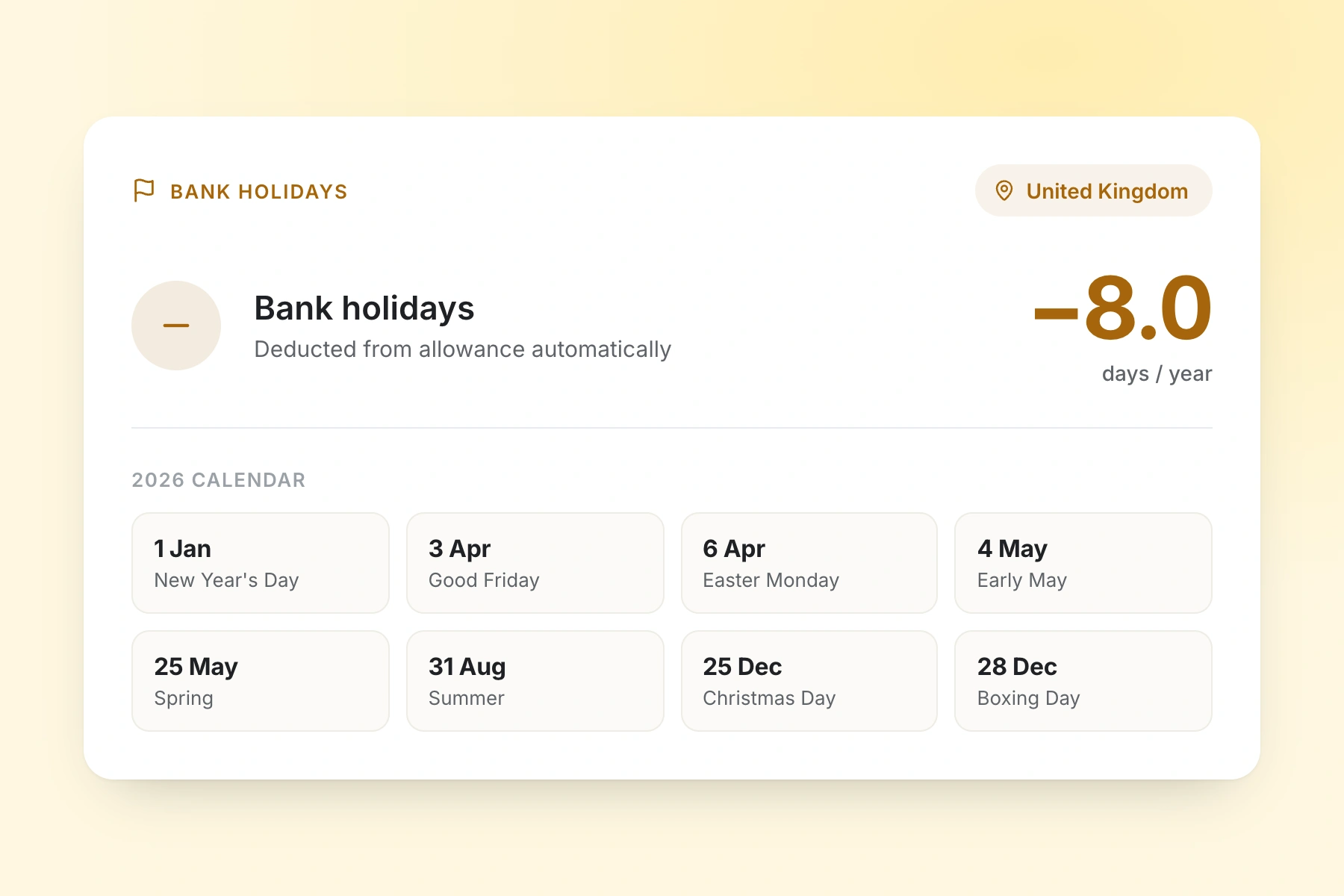
8 bank holidays in this leave year
TimeTally books bank holidays on the days each person works, from their own working week. No card needed.
Bank holiday dates from GOV.UK, checked 21 October 2026. A guide, not legal advice: the contract decides whether bank holidays are part of the allowance.
“The app is simple to use, reliable, and makes managing holidays, absences, and staff records straightforward. The system has saved us a significant amount of administration time.”
 Jordan Ingoe, CLI Manchester
The fair method, and the one Acas describes, treats bank holidays as part of the holiday a part-timer is owed, not as a separate perk. It takes four steps.
Sam works Tuesday, Wednesday and Thursday. The business gives 28 days a year including bank holidays.
Sam has 3.8 days fewer bank holidays on working days than their share, so those 3.8 days are Sam's to book. The total time off is still 16.8 days, the same as a full-timer pro rata.
The Part-time Workers (Prevention of Less Favourable Treatment) Regulations 2000 protect part-time staff from being treated less favourably than a comparable full-timer, and that covers holiday. As Acas puts it, pay and leave are given pro rata for part-time workers.
Every worker is entitled to 5.6 weeks' paid holiday a year: 5.6 × the days they work, never more than 28 days. The law gives nobody a right to bank holidays off, and an employer can count them as part of the 5.6 weeks (GOV.UK). If full-timers get more than the minimum, part-timers must get the same share of the extra. The pro rata holiday calculator works out the allowance for starters and leavers too, and the guide to bank holiday entitlement in the UK covers the rules for everyone.
Five of the eight England and Wales bank holidays in 2026 are Mondays: Easter Monday, both May bank holidays, the August bank holiday and the Boxing Day substitute day. So two people on the same hours can see very different numbers of bank holidays on their working days.
| Works | Bank holidays on their days | Left to book |
|---|---|---|
| Mon, Tue, Wed | 5 | 11.8 days |
| Wed, Thu, Fri | 3 | 13.8 days |
| Tue, Wed, Thu | 1 | 15.8 days |
All three get 16.8 days off in the year. The Monday-to-Wednesday worker just has more of it fixed by bank holidays, and books less. That is the example Acas gives too: two people on 3 days a week both get 16.8 days, and the one who works Mondays uses more of it on bank holidays.
It can go below zero. Someone who works only Mondays gets 5.6 days a year, but 5 Mondays in 2026 are bank holidays, against a share of 1.6. The extra 3.4 days come out of their holiday, leaving 0.6 days to book.
The shortcut to avoid is giving each part-timer whichever bank holidays happen to land on their days. The Monday worker then gets far more paid time off than a colleague on the same hours who works later in the week, and the second one gets less than a full-timer, pro rata.
Count in hours whenever someone's days are not all the same length. Days only work when every day is the same: a 10-hour bank holiday Monday is not the same as a 4-hour Friday.
Someone on a 9-day fortnight or 4 longer days is usually full time on fewer, longer days. Hold their holiday in hours: 210 hours a year if a full-timer gets 28 days of 7.5 hours. A bank holiday on a working day takes that day's hours (8 hours 20 minutes on a 75-hour, 9-day fortnight). One on their day off takes nothing, and their share is protected because it is already inside the 210 hours. The same applies to a part-timer on a 9-day fortnight: work out their share from their weekly hours, then take each bank holiday at the hours of that day.
The calculator above shows hours when every working day is the same length. For irregular hours and zero-hours staff, holiday builds up at 12.07% of hours worked instead: see holiday for variable hours and the zero hours holiday calculator.
Pick the region where the person works: the dates and the count are different, so their share is too.
When a one-off bank holiday is announced, whether staff get it depends on their contract, as Acas notes. If you give it to full-timers, give part-timers their share of it.
Nothing comes off their holiday for it. Acas is clear that an employer cannot make someone use holiday for a bank holiday on a day they don't usually work. Under the pro-rata method they do not lose out either: their share of the bank holidays is already in their total, so a bank holiday on a day off simply leaves them one more day to book.
If the business closes on bank holidays, people who normally work that day take it as holiday. Acas says the employer must make that clear in the contract or give notice. For the pay side of working a bank holiday, see the bank holiday pay calculator.
Count the bank holidays inside the leave year, not the calendar year. With a leave year from 1 April, Easter decides the number, as Acas warns:
On a contract of 28 days including bank holidays, a full-timer books 18 days in the first of those years and 22 in the second. On 25 days plus bank holidays, their total changes instead: 35 days, then 31. Choose “Other” under the leave year in the calculator for any start date. For what happens to unused days at the end of the year, see the annual leave carryover rules.
Doing this by hand means one sum per person, per leave year, and doing it again when someone changes their days. In TimeTally you set it up once.
Pick the days each person works and their hours. Enter the full-time allowance and TimeTally works out their share of it, rounded up to the half day.
Choose England and Wales, Scotland or Northern Ireland for each person. Their bank holidays are booked on the days in their working week and no others, from their start date to their last day.
Decide whether bank holidays come out of the allowance. If they do, the days booked for them come off it, so the balance staff see on their phone is the holiday they can still book. On leave held in hours, each bank holiday takes the hours of that day.
The same app runs your rota and timesheets. Staff ask for time off from their own phone, managers get an email and approve it, and approved leave shows on the rota: putting a shift on it asks first. See the staff holiday tracker and leave tracking software.
Then £3 per employee per month. No card needed to start.

Part-time workers get the same holiday as full-time staff, pro rata. No worker has a legal right to bank holidays off: the right is to 5.6 weeks' paid holiday a year, and an employer can count bank holidays as part of it. Whatever full-timers get, bank holidays included, a part-timer must get the same share of it. Someone on 3 days a week gets 3/5 of a full-timer's holiday, bank holidays and all.
Their share is the year's bank holidays × the days they work ÷ 5. England and Wales have 8 bank holidays a year, so someone on 3 days a week gets 4.8 days, and someone on 2 days gets 3.2. Scotland usually has 9 (10 in 2026) and Northern Ireland 10. How many of those actually fall on their working days depends on which days they work.
Pro-rate the full-time holiday with the bank holidays included, then take off the bank holidays that land on their working days. A full-timer on 28 days including bank holidays gives a 3-day worker 28 × 3 ÷ 5 = 16.8 days. If 1 bank holiday falls on one of their days that leave year, they have 15.8 days left to book themselves.
It costs them nothing. Acas says an employer cannot make someone use holiday for a bank holiday on a day they don't usually work. With the pro-rata method they still get their full share, so fewer bank holidays on their days simply leaves more holiday for them to book.
Work out a full-timer's holiday in hours, then multiply by their weekly hours ÷ full-time weekly hours. 28 days × 7.5 hours is 210 hours; someone on 22.5 hours of a 37.5-hour week gets 210 × 22.5 ÷ 37.5 = 126 hours. Each bank holiday on one of their days then takes the hours they would have worked that day. Use hours whenever their days are not all the same length.
Under the NHS Agenda for Change terms (section 13), part-time staff get public holidays at least pro rata to a full-timer's 8, rounded up to the nearest half day. Their public holiday entitlement is added to their annual leave, and they take any public holiday they would normally work as annual leave. Staff on shifts other than 7.5 hours have both worked out in hours. Northern Ireland has 10 general public holidays.
Because Easter moves. A leave year from 1 April 2026 to 31 March 2027 holds two Easters in England and Wales, so it has 10 bank holidays. The next one, 1 April 2027 to 31 March 2028, has none, so it has 6. Count the bank holidays inside each leave year, not the calendar year.
Yes, if the contract says so. Pro-rate them the same way: a 3-day worker gets 4.8 days of bank holiday on top, not just whichever bank holidays happen to fall on their days. Giving them only the ones that land on their days leaves a part-timer who works late in the week with less than a full-timer, pro rata.
Still have a question? See all FAQs
Checked 21 October 2026.
Set each person's working week once. TimeTally works out their allowance, books bank holidays on the days they work and shows staff what is left.