
Free, printable, for any leave year

Leave Year-End Checklist for UK Employers

A leave year-end checklist for UK employers: what to check 12 weeks before the holiday year ends, 4 weeks before, in the last week and when the new year starts. It covers unused annual leave, carry over, sickness and family leave, leavers and new allowances, and it works for any leave year end: 31 December, 31 March, 5 April or each person's start date.

No card neededBased on Acas and GOV.UK guidance

The annual leave year-end checklist

20 checks in the order you need them. Tick them off as you go: your ticks are saved in this browser, so you can come back to it. Print it or download the PDF to work on paper.

Leave year-end checklist

For UK employers. Works for any leave year end: 31 December, 31 March, 5 April or each person's start date.

Leave year ending:Checked by:

0 of 20 done

Download PDF

8 to 12 weeks before the leave year ends

Find the problems while there is still time to book leave.

  • Annual leave policy template

  • Annual leave carryover rules

  • Zero-hours holiday calculator

4 weeks before

Decide what happens to the leave that is still left.

  • Making employees take annual leave

In the last week of the leave year

Close the year and write the figures down.

  • Holiday pay when an employee leaves

When the new leave year starts

Set everyone up so their first booking is against the right figure.

  • Pro-rata holiday calculator

  • Part-time bank holiday calculator

  • Keeping holiday records

Based on the Working Time Regulations 1998 and Acas and GOV.UK guidance, October 2026. Not legal advice. Interactive version: timetally.uk/resources/leave-year-end-checklist

The leave year

When does your leave year end?

On the date your contracts or staff handbook say. Most employers use the calendar year (ending 31 December) or a year that ends around the end of the tax year (31 March or 5 April). If nothing has been agreed, the law sets it for you: each person's leave year starts on the day they started work, or on 1 October for anyone employed on or before 1 October 1998. That means a different end of leave year for every person, which is a good reason to agree one date for everybody.

Calendar year
Ends 31 December
Financial year
Ends 31 March
Tax year
Ends 5 April
Nothing agreed
Start date anniversary

Unused leave

What happens to unused annual leave at year end?

Under the Working Time Regulations, the basic 4 weeks of holiday has to be taken in the year it belongs to. Unless it can carry over, unused annual leave is lost when the holiday year ends, which is why the first half of the checklist is about getting people to book it. You must give staff a fair chance to take their leave, encourage them to take it and tell them what they will lose. If you don't, they can carry up to 4 weeks into the next year regardless of your policy.

Carry over

Can employees carry over annual leave at year end?

Yes, in four cases. Your contract or a written agreement can allow the 1.6 weeks above the basic 4 weeks, and any extra contractual leave, to carry over. And the law carries leave over when someone couldn't take it because of sickness (up to 4 weeks, used within 18 months), because of maternity, paternity, adoption or shared parental leave, or because you didn't give them the chance. Irregular-hours and part-year workers can carry up to 5.6 weeks in those three cases. The limits and examples are in our annual leave carryover rules guide, and Acas has the same rules on its carrying over holiday page.

Paying for leave

Paying for untaken holiday

You can't pay staff instead of them taking statutory leave while they work for you. The only exception is when someone leaves: then you must pay for the leave they have earned and not taken, even if they were dismissed for gross misconduct. If a leaver has taken more than they earned, you can only take it back from their final pay if that was agreed in writing beforehand. GOV.UK sets out the rules, and our guide to holiday pay when an employee leaves shows the sums.

TimeTally does the end of the leave year for you

Most of this checklist is the same every year. In TimeTally you set the rules once and the new leave year starts on its own, with nothing to run and no spreadsheet to roll forward. Leave, rota and timesheets are in one app for £3 per employee per month, and your staff book holiday on their own phones.

  • The new year starts on its own

    The first time anyone opens a balance in the new leave year, TimeTally creates it from last year's figures: allowance, leave taken, carried days and any changes you made by hand.
  • Your carryover rule, applied to everyone

    Nothing, up to a limit, or everything. Unused leave is carried to two decimal places, and carried days are used before this year's.
  • Expiry dates set for you

    Choose how many days of the new year people have to use carried leave, and each person's expiry date is worked out from it.
  • Family leave carried as the law says

    After maternity, paternity, adoption or shared parental leave, unused leave carries over up to 5.6 weeks (28 days at most) and doesn't expire the next year, whatever your policy.
  • Staff see their new balance

    Everyone sees their own days left in the app, so nobody has to ask what carried over.
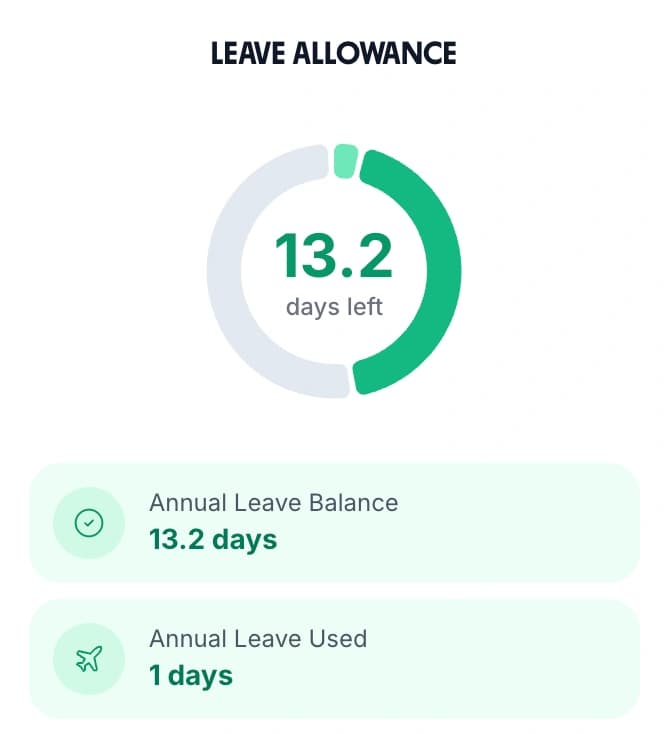
An employee's leave allowance in TimeTally: 13.2 days of annual leave left and 1 day used

What you set once in Settings

Four leave settings decide what happens at the end of every holiday year. You set them when you start and change them whenever your policy changes.

Leave year

The calendar year, or the day your leave year resets each year. Reset on 5 April and the year runs 6 April to 5 April.

How leave builds up

All of it on the first day of the year, a twelfth each month, or a little every day. Starters and part-time staff are pro-rated, and a leaving date cuts the allowance to the share up to their last day.

Carrying leave over

Nothing carries over, up to a limit you set, or everything carries over. Add “use them within” a number of days of the new year if carried leave should expire.

Going into the red

Whether staff can book more leave than they have, and how far below zero they can go.

What it leaves to you

Leave carried because of sickness, or because someone wasn't given the chance to take it, isn't added automatically: adjust that person's balance by hand. A balance below zero doesn't follow anyone into the new year either, so take it off the new allowance by hand if your policy says so.

Bank holidays in the new year

TimeTally books bank holidays for England and Wales, Scotland or Northern Ireland on the days each person works, so the new year's Christmas and Easter are on everyone's calendar.

“The app is simple to use, reliable, and makes managing holidays, absences, and staff records straightforward. The system has saved us a significant amount of administration time.”

CLI ManchesterJordan Ingoe, CLI Manchester

Leave year-end questions

What happens to unused holiday at the end of the year?

The basic 4 weeks of statutory leave has to be taken in the leave year it belongs to, so unused leave is lost unless it can carry over. It can carry over in four cases: the worker couldn't take it because they were off sick (up to 4 weeks, used within 18 months of the end of that year); they couldn't take it because of maternity, paternity, adoption or shared parental leave; you didn't give them a fair chance to take it or tell them it would be lost (up to 4 weeks); or their contract or a written agreement lets them carry the other 1.6 weeks, or any extra contractual leave. Irregular-hours and part-year workers can carry up to 5.6 weeks in the first three cases.

Do I have to let staff carry over holiday?

Not as a rule. Outside the legal exceptions for sickness, family leave and leave you didn't let them take, carry over is your choice, set out in the contract or handbook. Many employers allow a few days, often with a date by which they must be used. Our annual leave carryover rules guide covers each case in detail.

How much annual leave can be carried over in the UK?

By agreement, up to the 1.6 weeks above the basic 4 weeks (8 days for someone on a five-day week), plus any contractual leave on top of the statutory 5.6 weeks. Up to 4 weeks for sickness or when you didn't give the chance to take it, and whatever couldn't be taken because of family leave. For irregular-hours and part-year workers, up to 5.6 weeks for sickness, family leave or leave you didn't let them take.

Can I pay staff instead of them taking holiday?

Not for statutory leave. The only time statutory leave can be replaced by a payment, called payment in lieu, is when someone leaves their job, and then you must pay for leave they have earned and not taken, even after a dismissal for gross misconduct. Leave above the statutory 5.6 weeks comes from the contract, so whether it can be paid off depends on what the contract says.

What if an employee was off sick and couldn't take their leave?

They keep building up holiday while they are off sick, and leave they couldn't take because of sickness carries over: up to 4 weeks (5.6 weeks for irregular-hours and part-year workers), to be used within 18 months of the end of the leave year it is for. Record how much carried and the date it must be used by.

When does the holiday year start in the UK?

Whenever the contract or a workplace agreement says. Many employers use 1 January or a date around the start of the tax year in April. If nothing has been agreed, each worker's leave year starts on the day they started work, or on 1 October for anyone employed on or before 1 October 1998, and runs for 12 months from there.

Where can I track unused leave and carryover days?

A spreadsheet works for a handful of people, but carryover, expiry dates, sickness and family leave make it easy to get wrong. Leave software keeps each person's allowance, leave taken and carried days in one place. In TimeTally the new leave year starts on its own: unused days carry over under the rules you set, with an expiry date if you want one, and leave protected by law after family leave carries whatever your policy says. Staff see their new balance in the app.

Still have a question? See all FAQs

Next year, let the leave year end on its own

Set your carryover rules once. TimeTally starts the new leave year, carries the right days and shows every person their balance, alongside your rota and timesheets.

No card needed · £3 per employee per month after the trial · Cancel anytime