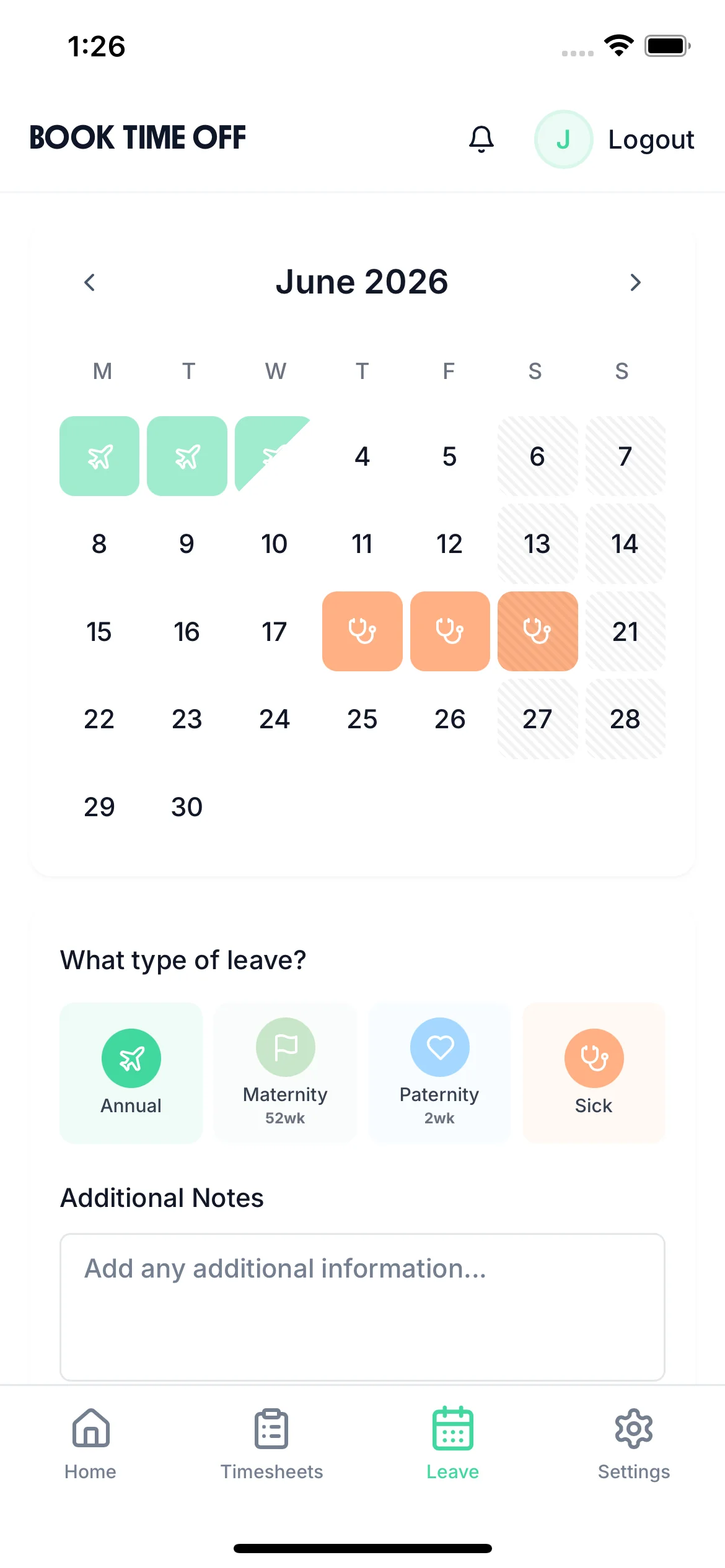
Configure how bank holidays work for your team. Set whether they count as leave or are additional, manage bank holiday working with TOIL, and give employees clear visibility of their entitlement.
TimeTally handles bank holidays as part of annual leave management — with TOIL tracking for bank holiday working and pro-rata calculations for part-time staff.
Click any feature to learn more.

14-day free trial · No credit card needed
If employees get bank holidays off as part of their 28-day statutory entitlement, configure TimeTally to automatically deduct bank holiday days from annual leave balance. Employees see their bank holidays included in their leave calendar.
If bank holidays are contractually additional to annual leave (i.e. employees get 28 days + bank holidays), configure TimeTally accordingly. Bank holidays appear on the calendar but don't reduce the leave balance.
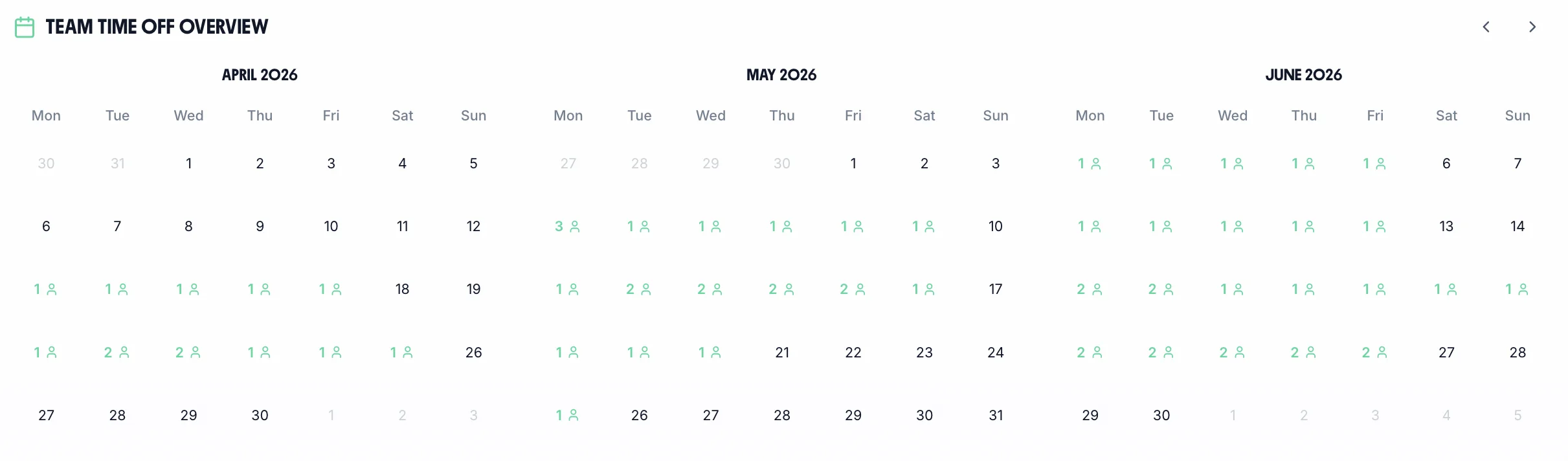
UK bank holidays are marked on the team calendar automatically. See who's working, who's off, and who's taken leave around bank holidays — essential for managing rotas across holiday periods. Your leave management settings determine whether bank holidays are deducted from annual leave or treated as additional days off.
UK bank holiday dates shown on the calendar for England, Scotland, and NI
See which employees are scheduled to work on bank holidays for rota planning
Export leave and bank holiday data for payroll and HR reporting
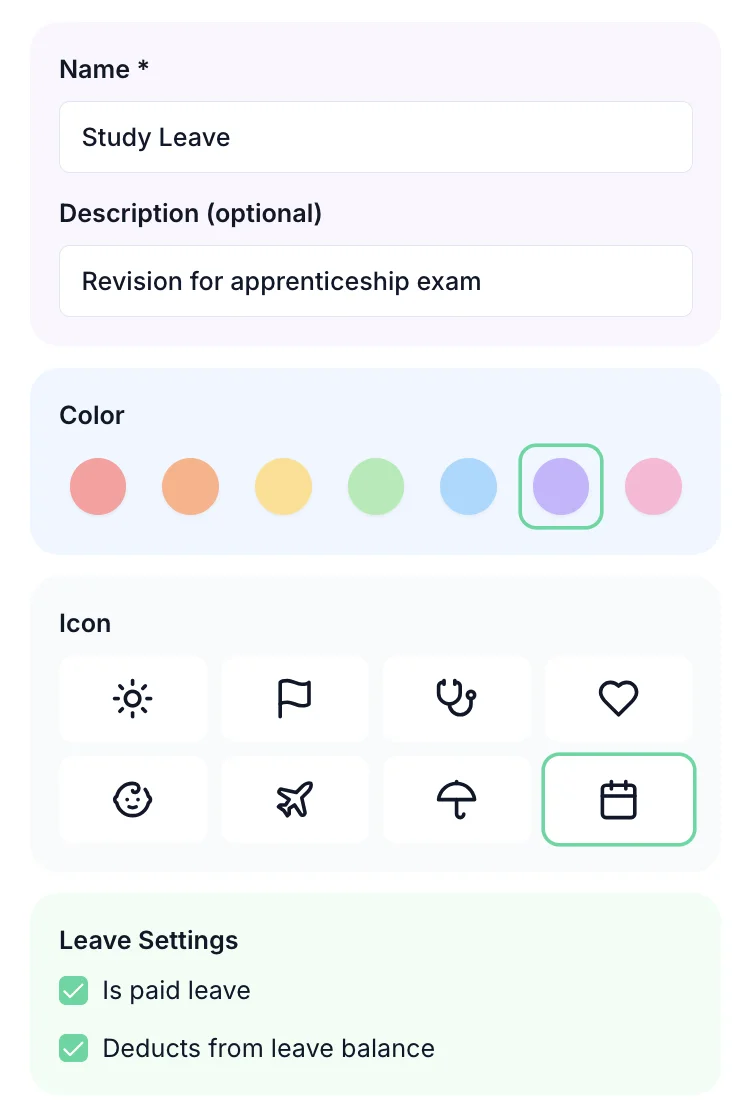
Create a 'Bank Holiday TOIL' leave type with your preferred accrual rate (e.g. 2:1) and an expiry period. When employees work bank holidays, managers approve the TOIL accrual — maintaining a clear, permanent record.
Pair bank holiday management with TOIL management and part-time leave management for a complete solution.
Track statutory and contractual holiday entitlement, carry-over, and pro-rata calculations.
Record self-certified and doctor-certified sick leave. Track Bradford Factor scores automatically.
Accrue, request, and track time off in lieu from overtime and on-call callouts.
Create custom leave types for compassionate, bereavement, and other special circumstances.
Track maternity, paternity, and shared parental leave alongside regular annual leave.
Any custom leave type you need — configured with its own rules, entitlement, and approval flow.
There's no automatic right to bank holidays off — but there are rules on how they're counted and paid.
England and Wales have 8 statutory bank holidays per year; Scotland has 9 (adding 2 January and St Andrew's Day on 30 November); Northern Ireland has 10 (adding St Patrick's Day on 17 March and the Battle of the Boyne on 12 July). The specific bank holidays an employee is entitled to are determined by their employment contract, not automatically by the nation in which they work. Employers with staff across multiple UK nations must apply the correct schedule for each location.
There is no statutory right to time off on a bank holiday in UK law — the right arises entirely from the employment contract. A contract that says '20 days plus 8 bank holidays' creates a contractual right to those specific days off. A contract that says '28 days including bank holidays' gives no extra entitlement when a bank holiday falls. Where a contract is silent on bank holidays, any consistent practice of granting them off may become an implied contractual term.
Part-time workers must be treated no less favourably than comparable full-time workers on a pro-rata basis under the Part-Time Workers Regulations 2000. A worker who never works on Mondays has no entitlement to a Monday bank holiday — the entitlement only arises on days they would normally work. Where a part-time worker's contracted day consistently falls on bank holidays, the employer must ensure they receive a pro-rata equivalent to what full-timers get.
If a bank holiday falls on a day that an employee is already on annual leave, and the contract entitles them to bank holidays as days off, the employer must grant an alternative day's leave in lieu. The employee should not have their annual leave balance reduced for a day that was also a bank holiday. This obligation applies regardless of when the annual leave was booked relative to the bank holiday.
Employers may designate substitute bank holidays — for example, a day earlier in the week when a bank holiday falls on a weekend. This is lawful provided the contract allows it, or employees agree. Similarly, where an employee works on a bank holiday, many contracts entitle them to a lieu day at a mutually agreed later date. Lieu days must be managed carefully in leave systems to ensure they are taken and do not expire without notice.
If a bank holiday falls while an employee is on sick leave and their contract entitles them to bank holidays as days off, they are entitled to reclaim that bank holiday as a separate day's leave — it should not be counted against their sick leave or absorbed into it. The practical effect is that the employee accrues an additional day's leave to use once they return. Employers should track bank holidays falling within sick leave periods to avoid underpayment claims.
Zero-hours workers accrue holiday entitlement based on hours worked — they do not automatically get bank holidays off as distinct days. Where bank holidays are included within the 5.6 weeks' statutory entitlement, the worker simply uses their accrued entitlement on a bank holiday if they wish not to work. Rolled-up holiday pay arrangements are legally complex following Harpur Trust v Brazel and employers should seek current advice before using them for zero-hours staff.
Employees on fixed-term contracts have the same bank holiday rights as permanent employees — there is no reduction for the temporary nature of the role. Entitlement is pro-rated to the length of the contract within the leave year, meaning a 6-month fixed-term employee is entitled to half the annual bank holiday allocation. Less favourable treatment of fixed-term workers in relation to bank holidays is prohibited under the Fixed-Term Employees (Prevention of Less Favourable Treatment) Regulations 2002.
Swipe to see more →
Whether you run a hospitality business, a construction company, or a healthcare organisation, TimeTally adapts to how your industry manages leave.
TimeTally lets you configure bank holidays for your organisation. You can choose whether UK bank holidays are automatically deducted from annual leave entitlement (if employees are contractually entitled to them off) or treated separately. The system supports England & Wales, Scotland, and Northern Ireland bank holiday calendars.
If an employee works a bank holiday, you can create a TOIL accrual for the hours worked at your agreed rate (commonly 2:1 for bank holiday working). This appears in their TOIL balance and can be taken as leave later. Alternatively, bank holiday working can be flagged for paid overtime processing through payroll export.
Yes. Some employers give office staff bank holidays as additional leave while shift workers follow a different arrangement. In TimeTally, you can configure leave policies per employee or group to reflect different contractual arrangements.
UK bank holidays can be displayed on the team calendar as reference markers, so managers and employees can see upcoming bank holidays when planning leave or rotas. Employees who book off bank holiday days have them appear as annual leave (if that's your policy).
Yes. Part-time employees are entitled to bank holidays on a pro-rata basis in proportion to their working hours. TimeTally calculates part-time leave entitlement proportionately, including bank holidays, when configured correctly.
TimeTally is £2 per employee per month, all features included. Bank holiday management, leave tracking, TOIL, time tracking, and payroll exports are all included in the same price.